Category: Travel

  • Travel Insurance Guide for India: What You Need to Know

    Travel Insurance Guide for India: What You Need to Know

    Traveling to India is an unforgettable experience. From the iconic Taj Mahal and the palaces of Rajasthan to the beaches of Goa and the backwaters of Kerala, the country offers something for every traveler.

    While most trips go as planned, unexpected events such as medical emergencies, flight cancellations, lost baggage, or passport issues can quickly disrupt your journey and lead to significant expenses. That’s where travel insurance becomes an essential part of travel planning.

    In this guide, we’ll explain why travel insurance guide for India is important and the risks travelers should be aware of, what a typical policy covers, and how to choose the right coverage for a safe and worry-free trip.

    Why Do You Need Travel Insurance for India?

    Travel insurance is becoming an essential part of trip planning. According to the Allianz Partners Travel Index 2025, 85% of Indians planning international travel are likely to purchase travel insurance, reflecting growing concerns about medical emergencies, trip disruptions, and financial protection.

    This trend is reinforced by an ICICI Lombard study, which found that 92% of Indian travelers intend to buy travel insurance for future international trips, while 73% recognize its importance in protecting their travel experience.

    Travel insurance proves its value when things go wrong. An AXA Assistance survey revealed that nearly 70% of travelers experienced disruptions such as flight delays, cancellations, or lost baggage. Among those with travel insurance, 92% found the coverage beneficial in recovering costs and managing unexpected situations.

    Whether you’re visiting India for leisure, business, or education, travel insurance can provide valuable financial protection and peace of mind when the unexpected happens.

    Health and Safety Risks Travelers Should Be Aware of

    India offers incredible travel experiences, but visitors should be prepared for certain health and safety risks that can ruin their trip. Understanding these risks is an important part of travel insurance guide for India

    Health Concerns

    Infectious Diseases:

    Air Quality Issues:

    Some major cities experience periods of high air pollution, which may affect travelers with asthma or respiratory conditions.

    Safety Concerns

    Transportation Risks:

    Busy roads, heavy traffic, and unfamiliar driving conditions can increase the risk of accidents, particularly in large cities.

    Theft and Loss of Belongings:

    Pickpocketing, bag theft, and lost travel documents can occur in crowded tourist areas, airports, and public transportation hubs.

    Weather Disruptions:

    India experiences diverse weather patterns, including: Monsoons, floods, cyclones, and extreme heat can occasionally lead to flight delays, cancelled plans, and transportation disruptions.

    While most trips to India are safe and enjoyable, unexpected events can happen. Travel insurance helps protect travelers from the financial impact of medical emergencies, trip interruptions, lost baggage, and other unexpected situations.

    How Travel Insurance Protects You from Unexpected Expenses

    Travel insurance provides a safety net by helping cover many of these unexpected expenses.

    Trip Cancellations and Interruptions

    Illness, family emergencies, severe weather, or travel problems can force travelers to cancel or cut short their trips. Travel insurance can repay eligible non-refundable expenses, such as flight tickets, hotel bookings, and pre-paid tours, helping reduce financial losses.

    Medical Expenses and Emergency Care

    Healthcare costs can quickly add up if you require medical treatment while traveling. Most travel insurance policies cover emergency medical expenses, hospitalization, ambulance services, and, in some cases, medical evacuation. This ensures travelers can access necessary care without worrying about substantial out-of-pocket costs.

    Lost, Stolen, or Delayed Belongings

    Lost baggage, stolen valuables, or delayed luggage can disrupt any trip. Travel insurance may provide compensation for lost or damaged belongings and repay essential purchases made while waiting for delayed baggage, allowing travelers to continue their journey with minimal disruption.

    Travel insurance offers both financial protection and peace of mind, allowing travelers to focus on enjoying their trip rather than worrying about unexpected setbacks.

    Types of Travel Insurance Coverage Available

    Travel insurance policies are available in different forms to suit various travel needs. Choosing the right policy is one of the most important recommendations in this travel insurance guide for India.

    Single-Trip Travel Insurance

    A single-trip policy provides coverage for one specific journey, from departure until return. It is ideal for travelers taking a one-time vacation, business trip, or family visit to India.

    These plans typically cover medical emergencies, trip cancellations, baggage loss, and travel delays during the insured trip.

    Multi-Trip Travel Insurance

    Frequent travelers may benefit from a multi-trip or annual travel insurance plan. Instead of purchasing a new policy for every journey, travelers receive coverage for multiple trips within a specified period, usually one year.

    This option is often more convenient and cost-effective for business travelers and individuals who travel regularly.

    Comprehensive Travel Insurance

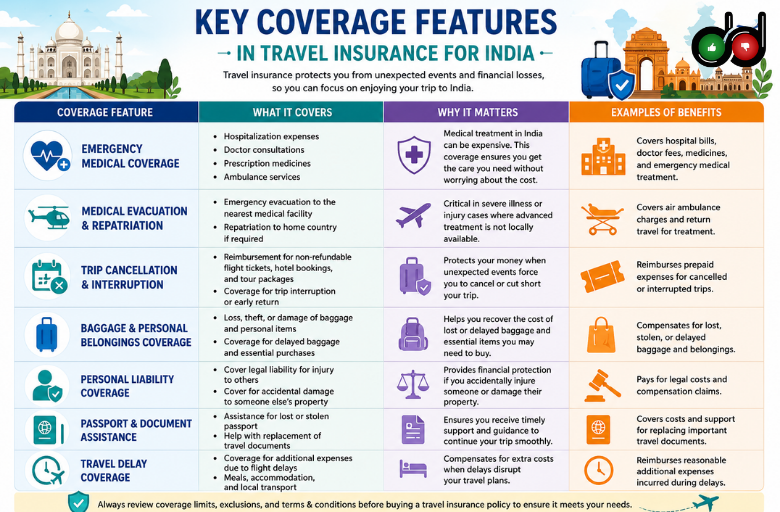
    Such Insurance plans offer the broadest level of protection and are generally recommended for international travelers visiting India. In addition to medical coverage, these policies often include trip cancellations, emergency evacuation, baggage protection, passport loss assistance, personal liability coverage, and travel delays.

    Key Coverage Features to Look For

    Not all travel insurance policies provide the same level of protection. Before purchasing a plan, travelers should carefully review the coverage details and policy limits.
    How to Choose the Right Travel Insurance Plan

    Not all travel insurance policies offer the same level of protection. A policy that looks affordable today could leave you with unexpected expenses tomorrow if you overlook key coverage details. Before purchasing travel insurance for India, review these essential dos and don’ts to help you compare policies, avoid common pitfalls, and choose coverage that best suits your travel needs.
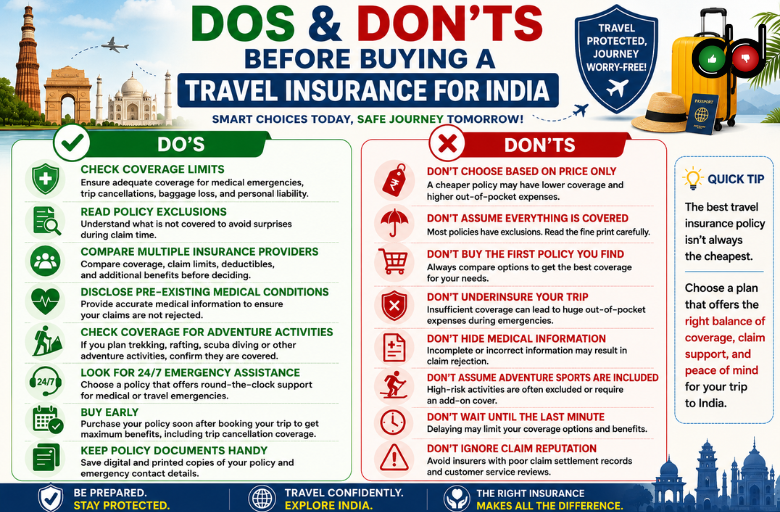
    Dos and don'ts of buying travel insurance for India infographic featuring coverage limits, policy exclusions, medical disclosures, emergency assistance, and common mistakes to avoid.

    Is Travel Insurance Mandatory for India?

    For most visitors, travel insurance is not currently mandatory for entry into India.

    However, many travel experts strongly recommend purchasing coverage because healthcare costs, travel disruptions, and emergencies can occur unexpectedly.

    Additionally, some countries require travel insurance for visa approval, particularly Schengen destinations in Europe. Travelers planning multi-country itineraries should verify insurance requirements before departure.

    How Do Dos and Don’ts Help You Navigate Travel Insurance for India?

    Travel insurance policies can be confusing, with varying coverage limits, exclusions, and claim requirements. While insurance providers explain what their policies offer, Dos and Don’ts helps you understand what really matters when choosing coverage for your trip to India.

    This platform simplifies travel insurance by providing practical guidance, clear explanations, and real-world travel insights to help you make informed decisions.

    Clear Coverage Insights: Understand what travel insurance typically covers, including medical emergencies, trip cancellations, baggage loss, and travel delays.

    Avoid Costly Mistakes: Learn about common travel insurance pitfalls, policy exclusions, and coverage gaps before purchasing a plan.

    Easy-to-Follow Guidance: Access straightforward information on choosing the right travel insurance policy based on your travel needs and budget.

    Travel Preparedness: Discover important dos and don’ts that help you stay protected and avoid unexpected expenses during your trip.

    The right travel insurance can provide peace of mind, but choosing the right policy starts with understanding your options.

    Explore Dos and Don’ts to simplify travel insurance for India and travel with greater confidence.

    Conclusion

    India offers incredible travel experiences, but even the most carefully planned trip can encounter unexpected challenges.

    Travel insurance is not just an additional expense—it is a practical investment in your safety, finances, and peace of mind. Whether it’s a medical emergency, cancelled flight, delayed baggage, or lost passport, the right policy can help you navigate disruptions without significant financial stress.

    By following this travel insurance guide for India, travelers can choose suitable coverage and enjoy greater peace of mind throughout their journey.

    Frequently Asked Questions (FAQs)

    1. Is travel insurance mandatory for visiting India?

    No, travel insurance is not currently mandatory for most travelers visiting India. However, it is highly recommended as it can help cover unexpected expenses such as medical emergencies, trip cancellations, lost baggage, and travel delays.

    2. What does travel insurance for India typically cover?

    Most travel insurance policies cover emergency medical expenses, hospitalization, trip cancellations, trip interruptions, lost or delayed baggage, passport loss assistance, and personal liability. Coverage may vary depending on the insurer and policy selected.

    3. How much travel insurance coverage do I need for India?

    The amount of coverage you need depends on factors such as trip duration, planned activities, and personal health conditions. In general, travelers should choose a policy with sufficient medical coverage, trip protection, and baggage benefits to avoid significant out-of-pocket expenses.

    4. Does travel insurance cover pre-existing medical conditions?

    Some travel insurance providers offer coverage for pre-existing medical conditions, while others may exclude them or require additional coverage. Always review the policy terms carefully and disclose any medical conditions when purchasing insurance.

    5. Can I buy travel insurance after booking my trip?

    Yes. In fact, it is often recommended to purchase travel insurance soon after booking your trip. Buying early may provide access to additional benefits, such as trip cancellation coverage before your departure date.

    6. Is travel insurance worth it for a trip to India?

    For many travelers, yes. While no one expects travel problems, medical emergencies, flight disruptions, lost belongings, or unexpected cancellations can happen. Travel insurance provides financial protection and peace of mind, allowing you to focus on enjoying your trip rather than worrying about unforeseen expenses.

    Leave a Reply

    Your email address will not be published. Required fields are marked *

  • 15 Common Mistakes to Avoid Before an International Trip(2026 Guide)

    15 Common Mistakes to Avoid Before an International Trip(2026 Guide)

    Planning an international trip feels exciting—but it’s also where most mistakes begin. Not because people are careless, but because they miss small rules that aren’t obvious: missed documents, last-minute packing,  can create unnecessary stress even before your journey begins. Some mistakes cost money. Others cost time. And a few can even stop your trip before it starts. To help you prepare, here are 15 Common Mistakes to Avoid Before an International Trip (2026 Guide).

    This guide walks you through 15 common mistakes travelers make before flying abroad, in a clear Dos & Don’ts style, so you know exactly what to do—and what to avoid—before stepping out of your home. 

    Understanding the most common mistakes to avoid before international travel can help make your trip smoother and stress-free. So,  Before you pack your bags, check the rules that actually matter.

    Why Dos & Don’ts Matter Before Travel

    Many travelers focus on destinations, bookings, and itineraries, but overlook the basics that actually determine how smooth their journey will be. Most travel blogs show destinations. Very few tell you what NOT to do before you leave. Understanding travel dos and don’ts helps you avoid confusion at airports, prevents delays, and saves money and reduces your travel stress.

    Think of this as your pre-travel checklist for peace of mind.

    Explore country-specific rules on Dos & Don’ts

    Common Mistakes to Avoid Before International Travel

    Before we get into the 15 common mistakes to avoid before an international trip, it helps to understand where most of these problems usually happen. From missing documents and payment issues to packing mistakes and poor planning, small oversights can quickly turn into unnecessary travel stress.

    To make things easier, we’ve broken these common travel mistakes into five simple categories — Documentation, Financial, Packing & Tech, Health & Safety, and Travel Planning. This not only makes the information easier to follow, but also helps you prepare step by step without missing important details before your journey.

    Documentation  Mistakes:

    Travelers should always verify passport, visa, insurance requirements through trusted sources like the IATA Travel Centre before flying abroad.

    Passport and visa issues are among the most common international travel mistakes.

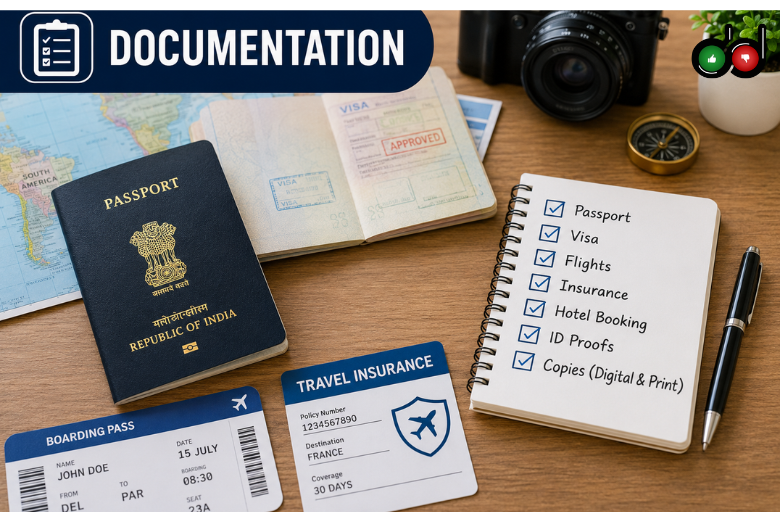
    Travel documents and passport checklist for international trip preparation.
    Keep your travel documents organized before flying abroad.

    1. Traveling with an Almost Expired Passport  – 

    One of the most common—and costly—mistakes is assuming a passport is valid as long as it hasn’t expired. Many countries require your passport to be valid for at least six months beyond your travel date. If it isn’t, you may be denied boarding or entry. 

    2. Not Verifying Visa Requirements

    Visa rules are not universal and can change frequently. Relying on outdated information or assumptions can lead to denied boarding or entry.

    Always check official embassy or airline sources for latest updates on Visa rules before finalizing your plans.

    Visa-on-arrival and E-Visa  rules change frequently. 

    3. Not Keeping Backup Copies of Travel Documents

    Losing important documents like your passport or visa can be stressful, especially in a foreign country.

    Having both digital and printed copies of passport, visa, tickets and insurance can make replacement or verification much easier. 

    • Don’t: Carry only originals.
    • Do: Keep digital and printed copies of passport, visa, tickets, insurance

    Helps in case of loss or theft.

    Financial Mistakes

    ravel budget setup with cash, cards, calculator, and mobile banking app.
    Plan your travel finances before your international trip.

    4. Forgetting to Inform Your Bank 

    Banks often block transactions from unfamiliar locations as a safety measure.

    Without prior notice to your bank, your card may stop working abroad  leading to blocked transactions. This can leave you stranded without access to funds at a critical moment.

    Ensure you inform your bank or change the settings in your bank app a day before your travel to avoid card blocks.

    • Don’t: Use your card abroad without notifying your bank.
    • Do: Inform your bank to avoid card blocks. 

    Fraud detection systems may freeze your card.

    5. Depending Only on Cash

    Relying only on cash can be inconvenient and risky. Many countries widely accept cards, prefer digital payments and carrying large amounts of cash increases the risk of loss.

    • Don’t: Depend only on cash.
    • Do: Carry a mix of cash + international debit/credit cards. 

    Digital payments are widely accepted globally.

    Health & Safety Mistakes

    Before international travel, review vaccination and destination health updates on CDC Travelers’ Health.

    Travel health and safety essentials including first aid kit, medicines, and vaccination documents.
    Prepare your health and safety essentials before traveling abroad.

    6. Skipping Travel Insurance

    Many travelers skip insurance to save money, but medical emergencies, trip cancellations, or lost baggage can be extremely expensive abroad.

    Travel insurance acts as a safety net in unpredictable situations. 

    As medical emergencies abroad can be expensive,  travel insurance provides coverage for health issues, delays, and lost baggage. 

    • Don’t: Think “nothing will happen.”
    • Do: Get travel insurance covering health, baggage, and delays. 

    One emergency abroad can be expensive 

    7. Ignoring Vaccination Requirements(if any) 

    Ignoring vaccination rules is one of the most overlooked international travel planning mistakes.

    Some countries require proof of specific vaccinations or health documentation before entry.

    Failing to check these requirements in advance can lead to delays, denied entry, or complications during immigration procedures.

    • Don’t: Ignore the health rules of your destination.
    • Do: Check if vaccinations are required.

    Some countries require proof of vaccines.

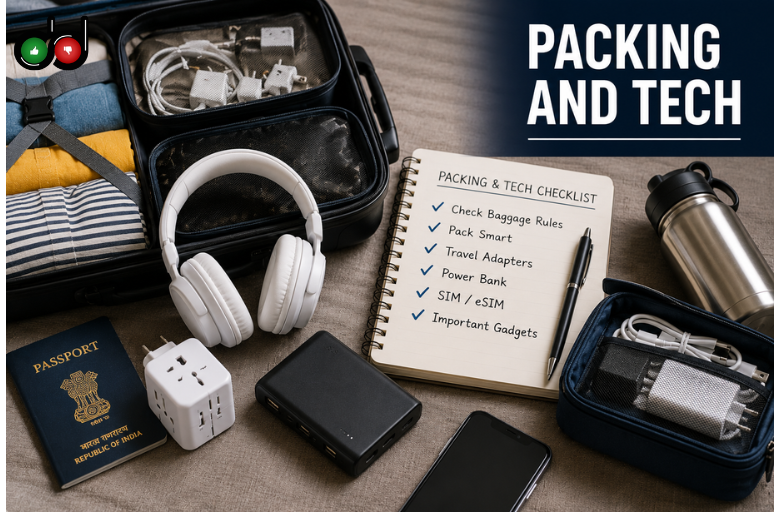
    Packing & Tech Mistakes

    Overpacking is another common travel mistake before flying abroad.

    Packing and tech essentials for international travel including gadgets, luggage, and travel accessories.
    Pack smart with the right travel essentials and tech accessories.

    8. Packing Without Checking Rules

    Packing without understanding airline and airport rules can lead to confiscated items or delays at security checks. Items like liquids, batteries, and sharp objects are often regulated and must be packed correctly. 

    Airlines and airports have strict rules on what you can carry. Packing restricted items can lead to confiscation or delays during security checks. 

    • Don’t: Pack restricted items
    • Do: Follow airline baggage guidelines

    Avoid airport confiscation

    9. Forgetting Travel Adapters 

    Different countries use different plug types. Without an adapter, charging your devices becomes difficult. Plug types differ across countries. 

    • Don’t: Assume your charger will work
    • Do: Carry a universal travel adapter 

    Plug types vary by country.

    10. Ignoring International Roaming or SIM Options 

    Landing in a new country without internet access can make even simple tasks like finding your hotel or booking a taxi difficult. Planning for a local SIM card, eSIM, or international roaming ensures you stay connected from the moment you arrive.

    Arriving without internet access can make navigation and communication difficult.

    • Don’t: Land without internet access
    • Do: Arrange SIM, eSIM, or roaming

    Helps with maps, bookings, emergencies

    Travel Planning Mistakes

    Travel planning essentials with itinerary, map, passport, and travel checklist for international trip preparation.
    Good travel planning helps avoid unnecessary stress during international trips.

    11. Arriving Late at the Airport

    International travel involves multiple steps, including check-in, baggage drop, security screening, and immigration. International flights require more time for check-in, security, and immigration.

    Arriving late increases the risk of missing your flight, even if you have completed online check-in. 

    • Don’t: Reach last minute.
    • Do: Arrive 3–4 hours early for international flights.

    Security checks and immigration take time.

    12. Ignoring Accommodation Details

    Booking accommodation without checking key details such as location, check-in time, cancellation policies and reviews can lead to inconvenience upon arrival, especially after a long journey. 

    Ignoring these details can lead to inconvenience after arrival. 

    • Don’t: Book without reading policies.
    • Do: Check check-in time, location,  cancellation rules, and reviews

    Avoid last-minute surprises.
    13. Not Planning Airport Transfers

    Arriving in a new country without a transport plan can be overwhelming, particularly if you land late at night or in an unfamiliar city.

    Pre-booking a transfer or understanding local transport options saves time and stress. 

    • Don’t: Land without a transport plan.
    • Do: Pre-book taxis or check public transport.

    Especially important for late-night arrivals

    14. Not Researching Local Laws & Culture

    Every country has its own rules, customs, and expectations. Something considered normal in one place may be inappropriate or even illegal in another.

    Basic awareness helps avoid uncomfortable or serious situations. Not knowing them can lead to confusion or even penalties. 
    • Don’t: Assume rules are the same everywhere.
    • Do: Learn basic local laws and etiquette.

    Small mistakes can lead to fines or trouble and awkward situations

    15. Not Tracking Flight & Check-in Rules

    Many airlines have strict check-in timelines. Missing the online check-in window or failing to review airline updates can result in additional charges or even denied boarding. 
    Some airlines have strict check-in deadlines. 

    • Don’t: Assume everything is automatic.
    • Do: Check airline emails and complete online check-in.

    Saves time and avoids last-minute issues

    Smart Traveler tip to avoid mistakes before an international trip

    Use the destination search tool on Dos and Don’ts to explore travel rules and local guidelines.

    With Dos & Don’ts, you can check everything in one place—before you travel.

    ✔ Country rules
    ✔ Airport do’s & don’ts
    ✔ Cultural guidelines

    Start exploring travel rules and destination-specific guidance before you fly.

    Explore how Dos and Don’ts simplifies international travel preparation and helps understand the 15 most common travel mistakes to avoid before a travel

    Most international travel problems don’t happen because people are careless. They happen because travelers don’t know the rules, miss important details, or find conflicting information too late. Dos and Don’ts simplifies this by providing clear, objective, and verified travel guidelines that help tourists avoid common pre-travel mistakes before they become stressful situations.

    Verified Travel Rules: Access accurate, updated information on passport validity requirements, visa rules, baggage restrictions, airport security guidelines, and international travel documentation without relying on scattered or outdated sources.

    Structured Information: Get clean, easy-to-understand travel guidance designed for quick decisions before and during your trip.

    Universal Coverage Through Blogs: While city and country-specific dos and don’ts can be explored through search, the latest travel updates, airport rules, packing guidelines, visa changes, travel mistakes to avoid, and real-time travel advice are simplified through regularly updated blogs designed for practical travel planning.

    Time Savings: Know what to expect before you travel instead of scrambling for answers at the airport or after landing.

    Stress-Free Travel Planning: Avoid confusion, unexpected delays, denied boarding, unnecessary expenses, and last-minute panic with simplified travel rules in one place.

    Conclusion:

    By avoiding these mistakes before international travel, you can prepare better and travel confidently.

    Travel doesn’t go wrong because of big problems—it goes wrong because of small, avoidable mistakes. A missed document, a forgotten adapter, or a late arrival can quickly turn excitement into frustration.

    Think of preparation as your first destination—get it right, and everything else becomes easier. 

    FAQs

    1. What is the most common mistake people make before an international trip?

    One of the biggest mistakes is not checking passport validity and visa requirements in advance. Many countries require at least six months of passport validity from the date of travel.

    2. How early should I reach the airport for an international flight?

    It is recommended to arrive at least 3–4 hours before departure to complete check-in, baggage drop, security checks, and immigration procedures comfortably.

    3. Is travel insurance necessary for international travel?

    Yes, travel insurance is highly recommended. It helps cover unexpected medical expenses, flight cancellations, baggage loss, and other travel emergencies.

    4. Should I carry cash or use international cards while traveling abroad?

    A combination of both works best. Carry some local currency for small expenses while using international debit or credit cards for convenience and safety.

    5. What important documents should I keep copies of while traveling?

    You should keep digital and printed copies of your passport, visa, flight tickets, hotel bookings, and travel insurance documents.

    6. Why is it important to check local laws and customs before traveling?

    Every country has different rules, cultural expectations, and restrictions. Understanding them beforehand helps you avoid misunderstandings, fines, or unnecessary trouble during your trip.

    Key Takeaways

    • Planning an international trip involves avoiding common mistakes, such as checking passport validity and visa requirements.
    • 15 Common Mistakes to Avoid Before an International Trip (2026 Guide) categorizes errors into Documentation, Financial, Packing & Tech, Health & Safety, and Travel Planning.
    • Forgetting to inform your bank about travel plans can lead to card issues abroad, so always notify them in advance.
    • Ensuring you have travel insurance and understanding local laws can prevent major problems during your trip.
    • Use Dos and Don’ts to explore travel rules and make informed decisions before you travel.
    Home » Travel

  • 10 Common Tourist Scams Around the World – How to Avoid Them

    10 Common Tourist Scams Around the World – How to Avoid Them

    Travel opens doors to new cultures, unforgettable experiences, and meaningful connections—but it also exposes you to common tourist scams around the world. If you don’t know how to avoid travel scams, a dream trip can quickly turn stressful and expensive.

    Today, the risk is higher than ever: over 608 million people fall victim to scams globally each year, and travel-related fraud alone is projected to cross $25 billion annually. Even more concerning, 47% of Indian travelers report being scammed, with many losing significant amounts.

    This isn’t just bad luck—it’s a pattern. And once you understand how these scams work, you can avoid becoming part of the statistics.

    Scammers have now advanced to digital frauds along with the usual traditional tricks. They use taxi fraud, pickpocketing tricks, fake police schemes, and digital frauds to target unsuspecting visitors every day. Understanding these risks—and knowing how to respond—can save you money, time, and peace of mind.

    Why travelers are easy targets

    Scammers don’t pick victims randomly—they look for opportunity.

    When you travel:

    • You step into unfamiliar environments
    • You depend on strangers for help
    • You carry cash, cards, and documents
    • You’re often distracted, excited, or rushed

    This combination makes tourists high-value, low-resistance targets. Scammers increase their activity by up to 28% during peak tourist seasons, when crowds help them blend in and disappear more easily.

    Why These Scams Work

    Tourist scams succeed because they manipulate basic human psychology:

    • Trust: You assume helpful intent
    • Fear: Authority creates pressure
    • Confusion: New environments reduce awareness
    • Urgency: You react instead of thinking

    Scammers don’t rely on force—they rely on your split-second decisions. And with the rise of digital fraud, even experienced travelers are vulnerable. Today, over 36% of travel scams begin online, through fake booking links, phishing emails, or impersonation.

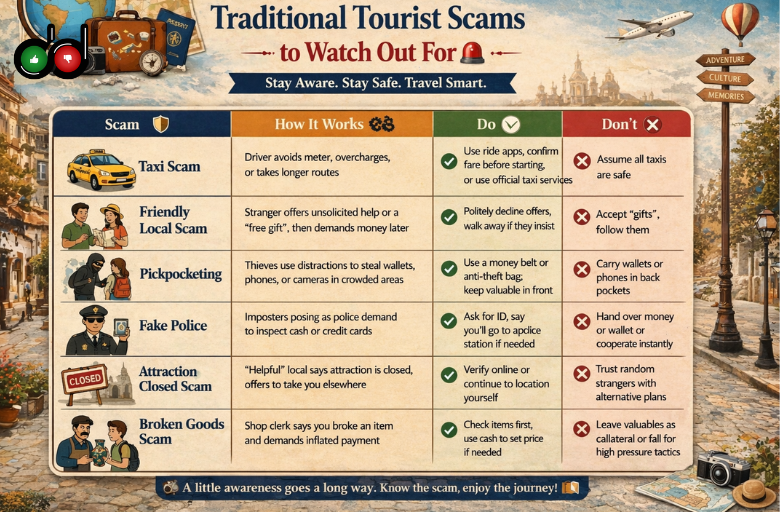
    Most Common Tourist Scams

    Before diving into the list, it helps to understand that tourist scams broadly fall into two categories: traditional scams and new-age scams.

    🧳 What are Traditional Scams?

    Traditional scams are on-ground, face-to-face tricks that have existed for decades. They rely on human interaction—like a taxi driver overcharging, a “friendly” stranger offering help, or pickpockets creating distractions in crowded places.

    They are called traditional scams because:

    • They have used these tricks for years across popular tourist destinations.
    • They follow predictable patterns
    • They depend on human psychology—trust, confusion, and urgency

    These scams don’t need technology—just the right moment and an unaware traveller.


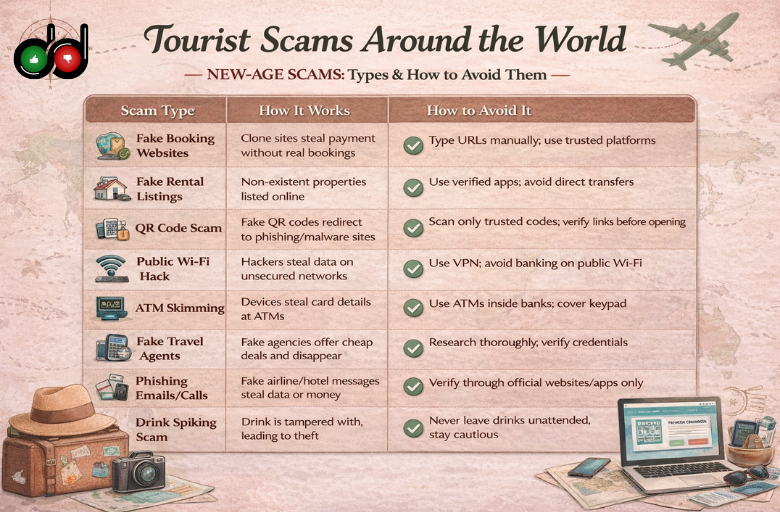
    📱 What are New-Age Scams?

    New-age scams are digitally driven or tech-enabled frauds that often begin before your trip even starts. These include fake booking websites, phishing emails, QR code scams, and fraudulent listings.

    They are called new-age scams because:

    • They use technology, AI, and digital platforms
    • They are more sophisticated and harder to detect
    • They can target you globally, even before you travel

    How Dos and Don’ts helps you to avoid these scams

    Key Features for Navigating with Confidence is how it works:

    • Verified Rule Sets: Get access to factual, up-to-date safety tips while traveling locally and globally, eliminating the guesswork before you arrive.
    • Structured Information: Skip the long-form reviews; our platform offers easy-to-read, bulleted guidelines designed for quick consumption on the go.
    • Universal Coverage: We provide behavioral guidance that covers the full spectrum of travel guidelines.
    • Time and Stress Savings: Avoid uncomfortable social situations or being looted by knowing exactly what is expected of you in advance.
    • Cultural Intelligence: Understand the local specific and common scams and the way to avoid them, ensuring you remain safe at all times. 

    By focusing on preparedness rather than opinions, Dos and Don’ts transform how you remain safe from scamsters whether traveling in group or solo travel. Whether you are a first-time visitor or a localite, we provide the clarity you need to navigate guidelines without friction or unpleasantness.

    FAQs


    1. What are the most common tourist scams globally?
    Common scams include taxi overcharging, pickpocketing, fake police checks, distraction scams, and “friendly local” setups.

    2. How can I identify a scam quickly?
    Look for red flags such as urgency, unsolicited help, refusal to use official systems (like taxi meters), or requests for cash without receipts.

    3. Are scams more common in certain countries?
    Scams can occur anywhere, especially in high-tourism areas. The type of scam may vary by region, but no destination is completely scam-free.

    4. What should I do if I get scammed?
    Stay calm, avoid confrontation, report the incident to local authorities or your embassy if necessary, and block compromised cards immediately.

    5. Is it safe to trust locals offering help?
    Not always. While many locals are genuinely helpful, unsolicited assistance—especially in tourist hotspots—should be approached cautiously.

    6. How can I protect my money while travelling?
    Use a mix of payment methods, avoid carrying large cash amounts, use secure wallets, and enable transaction alerts on your cards.

    Key Takeaways

    • Traveler scams around the world cost individuals and the industry billions, with over 608 million victims annually.
    • Scammers target tourists due to their vulnerability in unfamiliar environments and reliance on strangers.
    • Common scams include taxi fraud, pickpocketing, and digital scams like phishing and fake bookings.
    • Understanding both traditional and new-age scams helps travelers protect themselves and navigate safely.
    • Adopting key features such as verified rule sets and cultural intelligence enhances safety and confidence while traveling.

    Leave a Reply

    Your email address will not be published. Required fields are marked *

  • Schengen Visa Rules for Indian Citizens: Documents, Interview Tips, and Entry Requirements

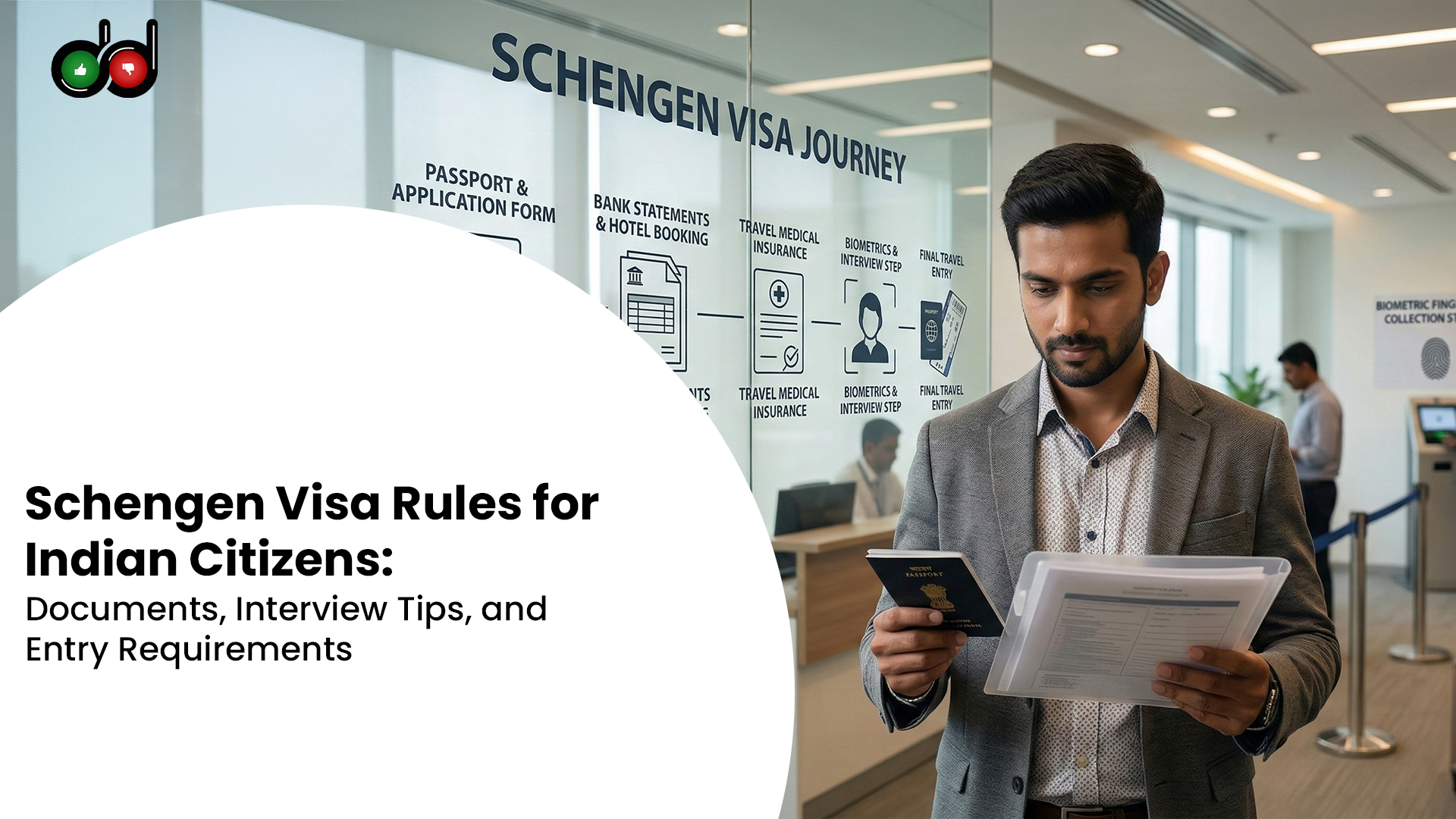
    Schengen Visa Rules for Indian Citizens: Documents, Interview Tips, and Entry Requirements

    Indian travellers filed over 1.1 million visa requests last year. About 165,000 people faced Schengen visa rejection reasons like bad paperwork. You must understand the updated Schengen visa rules for Indian citizens to stay ahead. 

    The Schengen visa fee for Indians in 2026 is now 90 euros and non-refundable. New tech like the EES entry/exit system in India starts in April 2026 to track your stay digitally. Follow these Schengen visa rules for Indian applicants to get your approval. We help you get your Schengen visa documents right the first time.

    Schengen Visa Documents Indian Citizens Actually Need in 2026 (The Full Checklist)

    Missing a single paper leads to a fast rejection. You must follow the latest Schengen visa rules for Indian applicants to secure your trip. Use this checklist to get your Schengen visa documents ready.

    1. The Passport Rule Most First-Time Indian Applicants Miss

    Your passport needs three months of validity after you return home.

    • Submit all old or cancelled passports.
    • Get a police FIR if you lost an old passport.
    • Ensure you have two blank pages for the new digital stickers.

    2. Financial Documents: Why Bank Statements Get Rejected

    A healthy bank balance for Schengen visa approval shows you can afford the trip.

    • Provide stamped bank statements for the last six months.
    • Avoid sudden large deposits that you cannot explain.
    • Include your ITR for the Schengen visa for the last three years.
    • Keep a bank balance for a Schengen visa of at least ₹2 to ₹5 lakhs depending on your stay duration.

    3. Travel Insurance: The One-Day Gap That Kills Applications

    You must buy Schengen travel insurance with a minimum coverage of 30,000 euros to cover medical emergencies. Match your insurance dates exactly with your flights. Even a one-day gap violates the Schengen visa rules for Indian travellers and causes a rejection.

    Errors in these papers are common Schengen visa rejection reasons that you can easily avoid with the right preparation.

    Schengen Visa Rejection Reasons Indian Applicants Hit Most and What’s Changed in 2026

    Schengen visa rejection reasons

    The Schengen visa rules for Indian travellers require a clean record. Most rejections happen because your travel history or money trails don’t add up.

    1. The Wrong Embassy Problem Nobody Talks About

    You must apply at the embassy where you spend the most nights. If you spend eight days in Germany and two in France, you must apply through Germany. 

    Applying to the wrong mission is a common trigger for Schengen visa rejections. Digital systems in 2026 track your hotel bookings to catch these errors.

    2. Proof of Return Intent: The Invisible Rejection Trigger

    Show you have reasons to come back to India. Including details about your job, family, or property in your Schengen visa cover letter from India helps establish strong ties to your home country. 

    A strong cover letter for a Schengen visa from India explains why you won’t overstay. Follow these Schengen visa rules for Indian citizens to lower your risk.

    3. Which Country to Apply Through for the Best Approval Odds

    Check the Schengen visa approval rate data for India before you book. Lithuania and Latvia have a 92% to 95% Schengen visa approval rate in India for most travellers. Avoid countries like Malta, which rejects nearly 38% of applicants. 

    Pick a country with a high Schengen visa approval rate that fits your real travel plan. Once you pick the right country, you must book your VFS Global appointment in India to start the process.

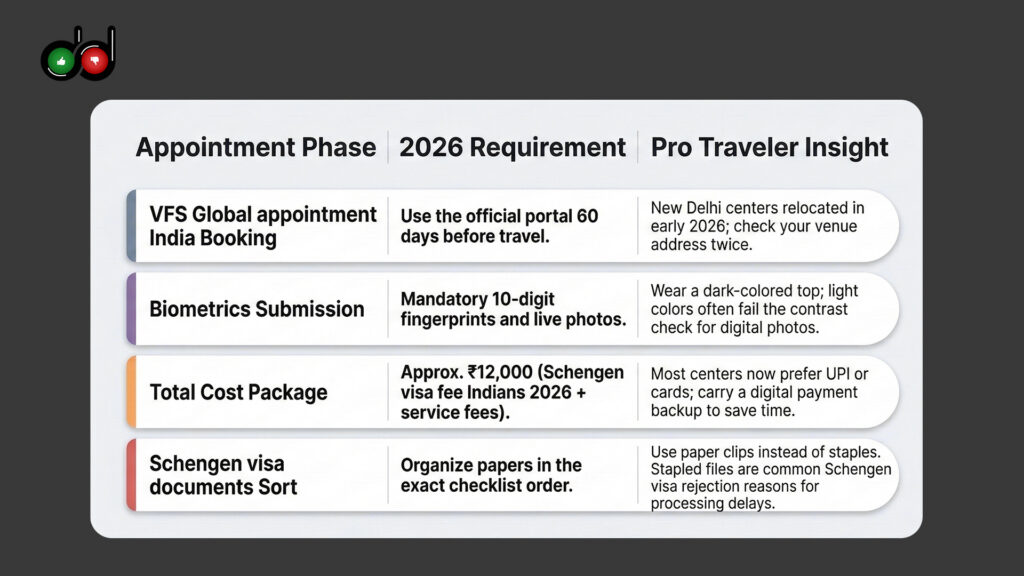
    VFS Appointment Process and Schengen Visa Rules for Indian Travellers

    Schengen visa documents

    Securing a VFS Global appointment in India is the first major hurdle. You must follow the exact Schengen visa rules for Indian citizens to avoid being turned away at the door.

    1. How the VFS Global Appointment in India Actually Works

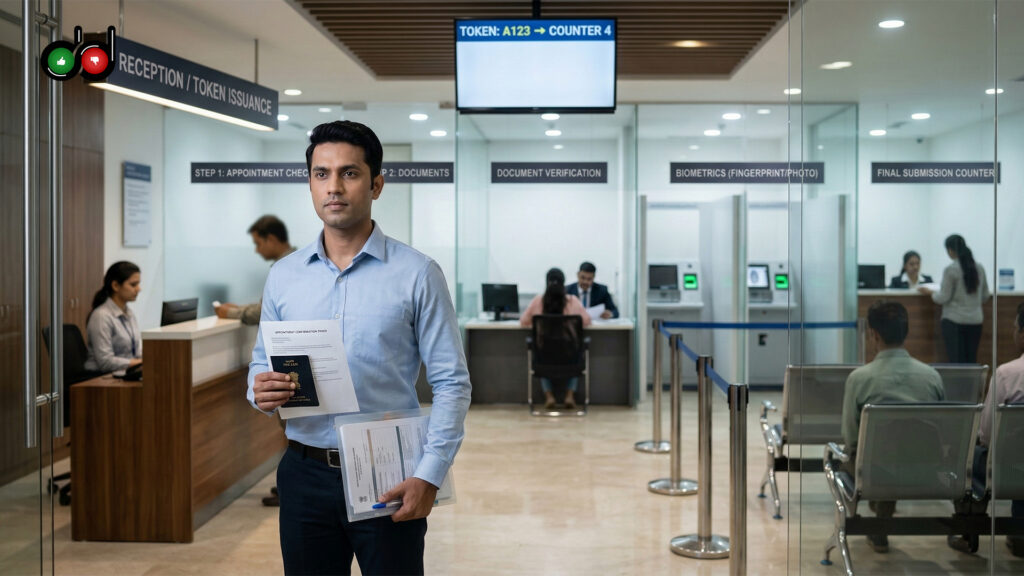
    The process for a VFS Global appointment in India is now fully digital. You must show up in person to provide your fingerprints and a digital photo.

    • Follow the Schengen visa rules for Indian applicants by bringing your printed appointment letter.
    • You pay the Schengen visa fee 2026 of roughly ₹9,400 at the centre if you did not pay online.
    • If you gave biometrics in the last 59 months, you might skip the fingerprints, but the consulate still needs a fresh photo.
    • Organise your Schengen visa documents in the exact order the checklist requires.

    2. Processing Times and When to Apply in 2026

    Most applications take 15 days, but peak times often stretch to 45 days. High demand causes Schengen visa rejection reasons when people apply too late. Follow the Schengen visa rules for Indian travellers by applying at least two months early.

    These Schengen visa rules for Indian applicants ensure your file gets a fair review before your flight.

    Key Facts for Your VFS Global Appointment India:

    VFS Global Appointment India

    Managing your timeline stops common errors and secures your entry into Europe.

    The 90/180 Day Rule and the EES Change Affecting Every Indian Traveller in 2026

    Staying legal in Europe requires mastering the 90 days, 180 days Schengen rule. This rule limits your stay across 29 countries. Following the Schengen visa rules for Indian citizens means tracking every trip to avoid fines.

    1. How the 90 days 180 days The Schengen rule actually works.

    The 90-day, 180-day Schengen rule counts back 180 days from each day you spend in Europe.

    • You get a total of 90 days.
    • Short trips out of the zone do not reset your stay limit.
    • Overstaying is one of the top Schengen visa rejection reasons for future visits.
    • Always follow the Schengen visa rules for Indian travellers to stay compliant.

    2. EES entry/exit system in India in 2026 (What You Must Know)

    The EES (Entry-Exit System) in India hits full mandatory operation on April 10, 2026. This digital gatekeeper replaces manual stamps with biometrics. When you present your Schengen visa documents at the border, the system records your face and fingerprints. 

    Any overstay is instantly flagged across the zone. Stick to the Schengen visa rules for Indian travellers to protect your travel record. These Schengen visa rules for Indian points keep you safe.

    Mastering these entry rules ensures your European trip stays on track.

    How Dos and Don’ts Simplify Schengen Visa Rules for Indian Travellers

    Traditional travel sites focus on photos, but Dos and Don’ts gives you objective, location-specific data. We bridge the gap regarding local etiquette and Schengen visa rules for Indian citizens. 

    Our platform ensures you have a confident experience across 10,000+ spaces.

    • Verified Rule Sets: Access up-to-date entry requirements and Schengen visa documents checklists to eliminate guesswork.
    • Structured Information: Get easy-to-read, bulleted guidelines for quick consumption while you travel.
    • Universal Coverage: We provide behavioural guidance for everything from government offices to tourist landmarks.
    • Time & Stress Savings: Avoid being turned away at the door by knowing exactly what is expected.

    We help you follow Schengen visa rules for Indian travellers without friction. Explore how Dos and Don’ts simplifies your trip. Dos and Don’ts

    Conclusion

    Schengen visa rules for Indian applicants are stricter in 2026. Higher fees and low success rates make every mistake expensive. Missing one detail in your Schengen visa documents leads to an instant rejection. 

    The EES system now records overstays digitally, creating permanent blacklists across 29 countries. One error ruins your travel future and wastes your non-refundable money. 

    You cannot afford to guess. Dos and Don’ts provides the verified, fact-based guidance you need to follow Schengen visa rules for Indian travel. Use our platform to secure your approval and travel with total peace of mind.

    Check the specific requirements for your destination on Dos and Don’ts before you submit your file to ensure total compliance.

    FAQs

    1. How much bank balance is required for a Schengen visa from India?

    A healthy bank balance for a Schengen visa shows you can afford Europe. Most Schengen visa rules for Indian applicants suggest ₹2–5 lakhs. Avoid sudden deposits, which are top Schengen visa rejection reasons. Don’t forget your ITR for the Schengen visa too.

    2. Is a cover letter mandatory for Schengen visa applications from India?

    A cover letter for a Schengen visa from India is your best chance to prove return intent. It helps you follow Schengen visa rules for Indian citizens by explaining your itinerary. Missing this often triggers common Schengen visa rejection reasons during your application review.

    3. Can I apply for a Schengen visa if I plan to visit multiple countries?

    Determining which country to apply to for a Schengen visa from India depends on where you will spend the most time. If stays are equal, use your first entry point. Violating this part of the Schengen visa rules for Indian travel often results in a fast rejection.

    4. What is the Schengen visa fee for Indian applicants in 2026?

    The Schengen visa fee for Indians in 2026 is €90. This non-refundable payment is separate from the service charges for your VFS Global appointment in India. Follow Schengen visa rules for Indian applicants to avoid losing your money to avoidable Schengen visa rejection reasons.

    5. What does the EES system mean for Indian travellers entering Europe in 2026?

    The EES entry/exit system in India starts in April 2026. It tracks the 90-day, 180-day Schengen rule using digital biometrics instead of stamps. Follow Schengen visa rules for Indian entry to ensure your data record stays clean for future visits.

    6. Which Schengen country is easiest to get a visa from for Indian applicants?

    Lithuania and Iceland have the best Schengen visa approval rate in India. When choosing which country to apply for Schengen from India, match your itinerary exactly. Always double-check your Schengen visa documents to meet all the Schengen visa rules for Indian travellers.

    2 responses to “Schengen Visa Rules for Indian Citizens: Documents, Interview Tips, and Entry Requirements”

    1. Vandana Avatar
      Vandana

      Very informative and helpful blog. Thank you.

    2. Neelam Arora Avatar
      Neelam Arora

      I got very useful information from this blogg as I m planning to travel to Europe. Step by step I have followed all the do’s and don’ts which is really helping me . Thanks for such a wonderful information…my best wishes 🙏

    Leave a Reply

    Your email address will not be published. Required fields are marked *

  • Visa Rules for Indian Citizens: Types, Application Process, and Travel Requirements

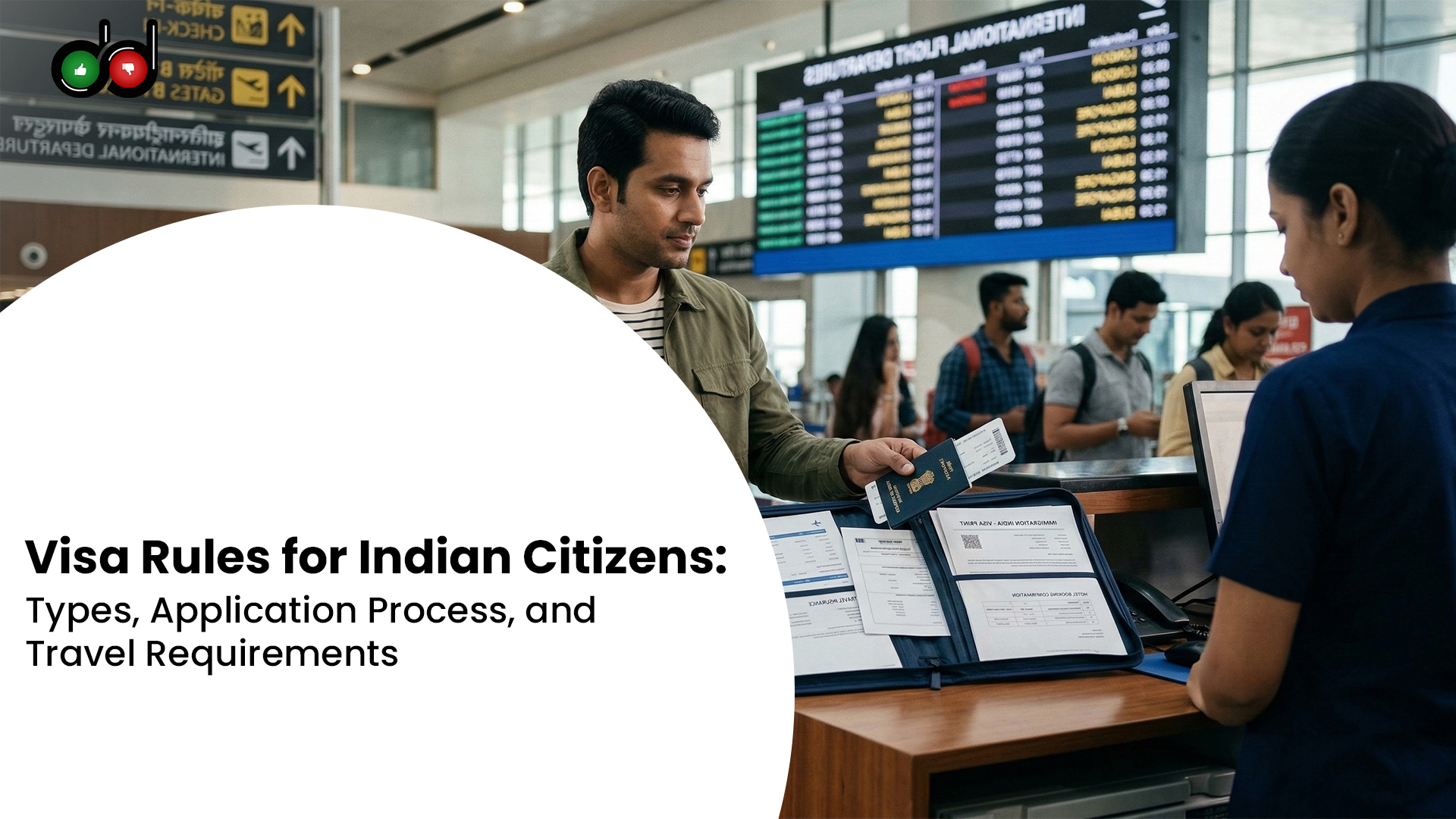
    Visa Rules for Indian Citizens: Types, Application Process, and Travel Requirements

    Travel hit a high in 2025 with 3.27 crore trips from India. Demand grew fast as 2 crore people flew internationally in the final quarter of that year. You often lose time because of small errors in paperwork or choosing the wrong visa types for Indians. 

    This guide clarifies visa rules for Indian citizens for your 2026 trips. We cover the visa application process for Indians and the travel requirements for Indian citizens at the border. 

    EU guidance says ETIAS starts in late 2026. Appointment wait times remain estimates only. Follow these visa rules for Indian citizens to avoid rejections.

    Visa Rules for Indian Citizens by Visa Type and Destination Pattern

    Picking the right category is your first hurdle. Most travellers get stuck because they confuse visa types for Indians, which leads to denied boarding. 

    Under current visa rules for Indian citizens, a tourist permit won’t work for a short tech workshop in Berlin or London. You need a business entry for that. Following the latest visa rules for Indian citizens helps you avoid these costly mistakes.

    A) The 5 Visa Types Indians Commonly Mix Up

    • Tourist and Visitor Visa: Use this for holidays. Some countries now ask for a host ID if you stay with friends.
    • Business Visa: This is for meetings only. Don’t use it to seek a job.
    • Student Visa: You need an admission letter and a clear funding plan.
    • Work Visa: These often involve a lottery or skilled points system.
    • Transit Visa: You might need a transit visa for a London or Dubai layover, even if you stay airside.

    B) Visa Free, Visa on Arrival, eVisa, ETA

    The eVisa for Indian passport holders is now common for Russia and Japan. However, a visa on arrival for Indians in Thailand or Indonesia still requires you to show $500 in cash or a card. Always check the latest visa rules for Indian citizens before you fly, as lists change. 

    C) The Less Obvious Category

    Some visa rules for Indian citizens apply even if you don’t leave the plane. A transit visa is mandatory for certain UK or Canadian layovers. Other countries require pre-travel authorisation even for visa-free entry.

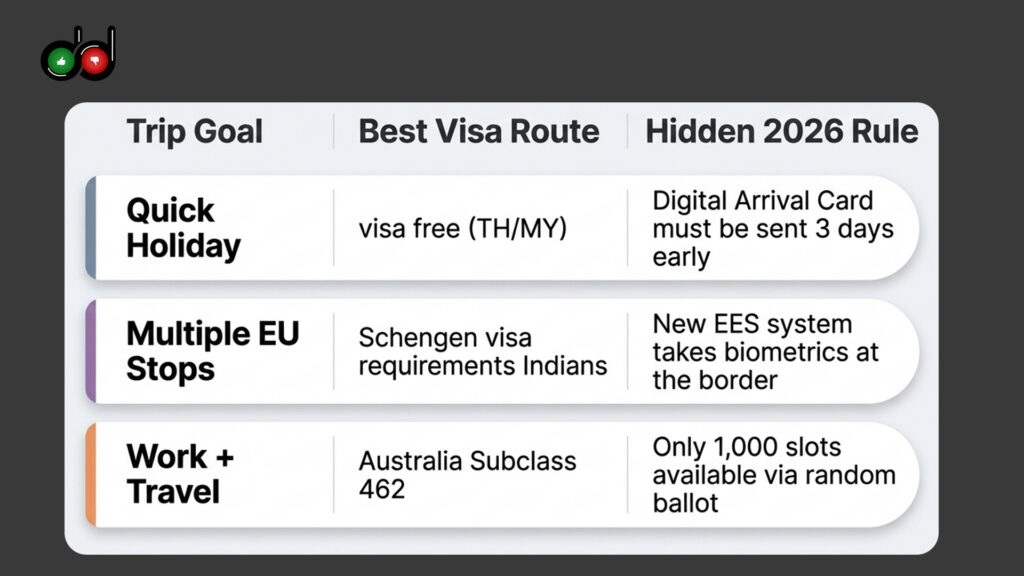
    Quick Decision Table

    visa application process for Indians

    These visa rules for Indian citizens ensure your profile matches your purpose. Getting this part right sets the stage for a smooth visa application process for Indians.

    Visa Application Process for Indians: The Step-by-Step Path That Prevents Rejections

    Success depends on how you handle the official visa application process for Indians. Even minor errors in your digital forms can lead to immediate refusal. Follow this path to keep your travel plans on track for 2026.

    Step 1: Choose the Right Application Channel

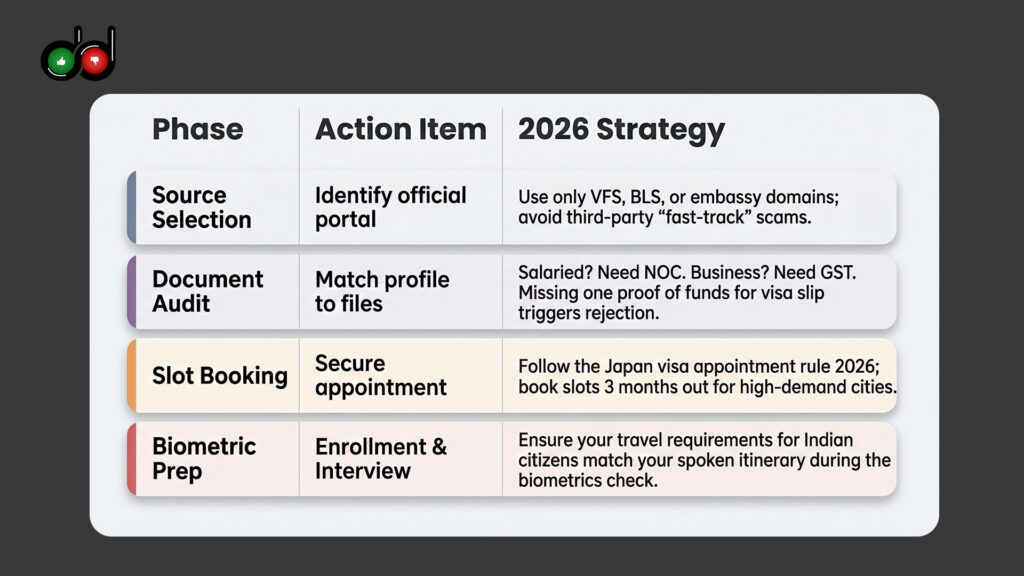
    Stop using unofficial third-party sites. Always go through the embassy portal or authorised centres like VFS Global. The Japan visa appointment rule 2026 now requires you to book a slot online if you live in Chennai or Hyderabad; walk-ins ended in March. 

    For the US, remember that visa types for Indians like the B1/B2 (Dropbox) are now centralised in New Delhi.

    Step 2: Build a Visa File That Matches Your Profile

    • Salaried Applicants: You must provide an original NOC on company letterhead and 6 months of salary slips.
    • Self-Employed: Include your GST registration and the last three years of ITR.
    • Students: Carry your Bonafide Certificate and a signed letter from your sponsor.
    • Sponsorship: If a relative pays for you, include their proof of funds for the visa and a notarised invitation.

    Step 3: Appointments and Wait Times

    The US B1/B2 visa visa wait time in India varies by city.. Chennai currently offers slots within 1.5 months, while Mumbai averages 10 months. Check these daily, as new slots open often.

    travel requirements for Indian citizens

    Step 4: Biometrics and Interviews

    Schengen visa requirements for Indians now involve the Entry/Exit System (EES) for biometric capture. During interviews, avoid vague answers like “I just want to see the city.” Instead, explain your specific daily plans to show your travel intent is real.

    Building a strong file simplifies the visa application process for Indians. Next, we will check the specific travel requirements for Indian citizens that matter at the airport.

    Travel Requirements for Indian Citizens: What Immigration Checks First

    Getting your passport stamped at the embassy is only half the battle. To clear the border, you must meet specific travel requirements for Indian citizens at the immigration counter. Officers in 2026 are stricter about digital verifications and physical documents alike.

    1. Passport Validity and Blank Pages Rules

    Airlines strictly enforce the six-month rule. If your passport expires in less than six months from your travel date, they will deny you boarding.

    • Check for Blank Space: Certain visa types for Indians require full-page stickers. You generally need at least two entirely blank pages for entry and exit stamps.
    • Physical Condition: Ensure your passport has no torn pages or data-chip damage. These issues lead to immediate deportation or boarding denials.

    2. Proof of Funds and Financial Story

    Immigration officers often ask for fresh proof of funds for visa checks at the desk. Under Schengen visa requirements, Indians must show roughly €100 for each day of the stay. 

    Carry a printed bank statement from the last 90 days or show a live balance on your travel card app. Avoid making large, unexplained deposits right before you travel. This looks suspicious during a random check of your visa rules for Indian citizens’ compliance.

    3. Travel Insurance, Hotel, and Itinerary Rules

    For many regions, travel insurance for a visa is a mandatory entry document. Your policy must cover at least $30,000 to $50,000 for medical emergencies and include clauses required by local visa rules for Indian citizens.

    • Verification: Keep a printed copy of your hotel bookings.
    • Host Details: If you stay with a friend, have their invitation letter and local ID copy ready. Officers may call them to verify your travel requirements for Indian citizens.

    4. Return Ticket and Onwards Travel

    Meeting the onwards ticket requirement is non-negotiable for almost all visas on arrival for Indian destinations. You must show a confirmed flight out of the country; “dummy” tickets often fail verification in 2026. 

    If you are on a multi-country tour, have the next flight and the visa types for Indians required for that next stop ready on your phone or in a folder. Following these visa rules for Indian citizens ensures you don’t get turned back at the gate.

    How Dos and Don’ts Simplify Visa Rules for Indian Citizens

    How Dos and Don’ts Simplify Visa Rules for Indian Citizens

    Traditional platforms focus on subjective reviews, but Dos and Don’ts provides objective, location-specific guidelines for visa rules for Indian citizens. 

    We bridge the information gap regarding local requirements and etiquette to ensure a confident travel experience across 10,000+ spaces.

    Key Features for Planning with Confidence:

    • Verified Rule Sets: Access factual, up-to-date documentation and entry requirements for visa rules for Indian citizens.
    • Structured Information: Use easy-to-read, bulleted guidelines instead of long-form reviews for quick consumption.
    • Universal Coverage: Get behavioural guidance for government offices, landmarks, and private spaces globally.
    • Cultural Intelligence: Understand specific restrictions and traditions to remain respectful in any area.

    By focusing on preparedness, Dos and Don’ts ensures you handle visa rules for Indian citizens without friction. Explore how Dos and Don’ts help you visit with confidence. → Dos and Don’ts

    Conclusion

    Visa rules for Indian citizens in 2026 reward preparation more than luck. Minor errors like inconsistent bank statements or missing travel insurance for visa documents cause immediate rejections. 

    These failures often lead to forfeited flight costs and permanent marks on your immigration history. Worse, being turned back at the border is humiliating and expensive. Avoid these high-stakes risks by sticking to the correct visa application process for Indians. 

    Dos and Don’ts provides the verified, objective guidelines you need to navigate visa rules for Indian citizens safely. Our structured checklists ensure you meet every requirement before you arrive at the counter.

    FAQs

    1. What are the visa rules for Indian citizens when a country offers a visa on arrival? 

    Even with a visa on arrival for Indians, you must follow specific visa rules for Indian citizens. This includes showing proof of funds for a visa, a confirmed onwards ticket requirement, and meeting the travel requirements for Indian citizens at the border.

    2. What is the safest visa application process for Indians to avoid fraud? 

    The safest visa application process for Indians involves using official portals. Stick to authorised channels for visa types for Indians, like the eVisa for Indian passport holders. Avoid agents who promise “guaranteed” entries against visa rules for Indian citizens.

    3. How much bank balance is needed for a tourist visa? 

    The proof of funds for a visa varies by country. For Schengen visa requirements, Indians must show roughly €100 daily. Your balance must justify the travel requirements for Indian citizens based on your specific trip length and local costs.

    4. Do travel requirements for Indian citizens include travel insurance? 

    Yes, travel insurance for a visa is mandatory for many visa types for Indians. It ensures you meet the travel requirements for Indian citizens regarding health emergencies. Most visa rules for Indian citizens for Europe or the USA require specific minimum coverage.

    5. When will ETIAS start for travel to Europe? 

    Official guidance states ETIAS begins in late 2026. This changes the visa rules for Indian citizens who previously travelled visa-free. It will become a core part of the travel requirements for Indian citizens visiting the Schengen Zone soon.

    6. Why do appointment wait times change so much for US visas? 

    The US B1/B2 visa India wait time shifts based on local demand and embassy staffing. These estimates are part of the visa application process for Indians and vary by city. Check the latest visa rules for Indian citizens frequently.

    Leave a Reply

    Your email address will not be published. Required fields are marked *

  • Passport Rules in India: Application Process, Document Requirements, and Validity

    Passport Rules in India: Application Process, Document Requirements, and Validity

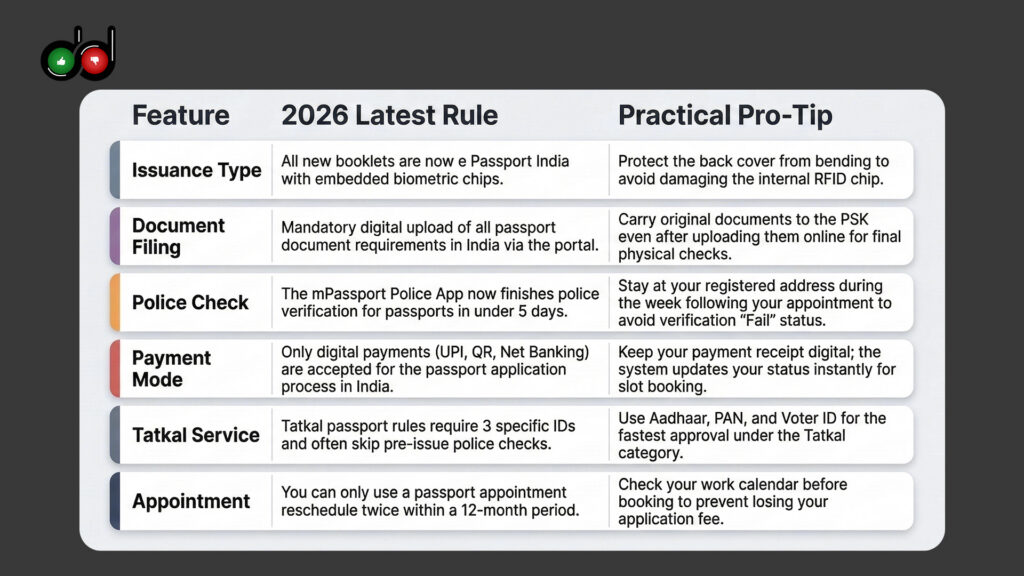
    Getting travel documents shouldn’t be hard. Updated passport rules in India for 2026 make the system faster for you. Last year, the government issued over 1.4 crore passports

    The current passport application process in India uses ePassport India chips for better security. Many people face rejection because they ignore specific passport document requirements India’s offices demand. 

    You must verify your proof of address for your passport before booking any slots. Dr S. Jaishankar noted that passport numbers grew from 91 lakh to 1.46 crore. Follow these passport rules in India to avoid delays.

    Passport Rules in India for Fresh Applications (Passport Application Process India)

    Applying for a new travel document is easy once you know the updated passport rules in India. The passport application process in India requires you to register on the government portal and choose an available slot.

    1. Online Steps That Decide Your Timeline

    Register, fill out your details, and pay the fee to book your visit. You can visit a centre following Passport Seva Kendra rules or a nearby Post Office Passport Seva Kendra. 

    All new applicants now receive an ePassport India with an embedded chip for better security.

    2. Appointment Rules Many People Learn Too Late

    Life happens, but a passport appointment reschedule is limited to two attempts per year. If you exceed this, your application closes. Strict Tatkal passport rules often allow only one reschedule, so choose your dates carefully.

    3. PSK Counter Reality Check

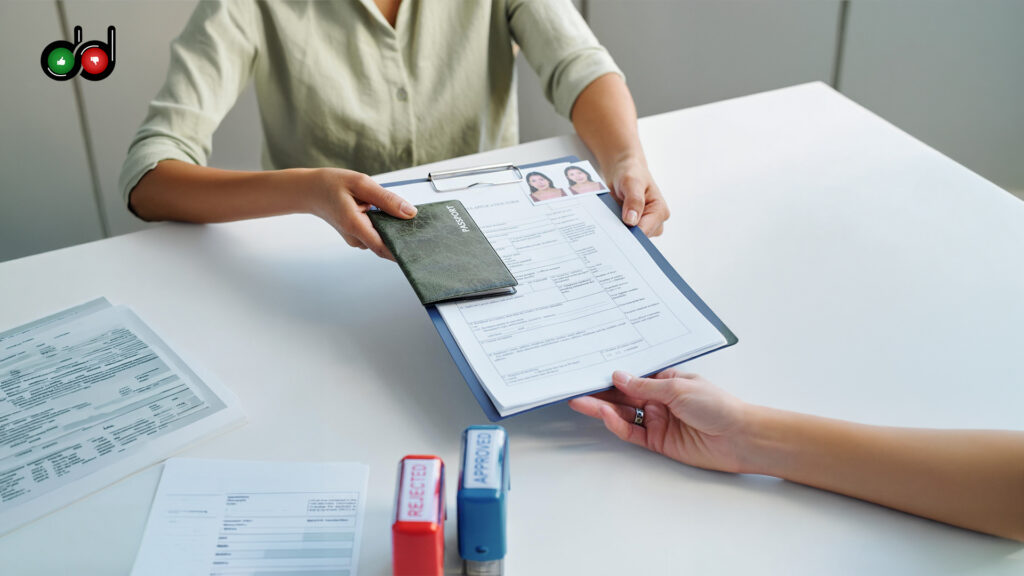
    Bring your originals and self-attested copies. Staff verify your identity and take your biometrics on-site. Meeting the passport document requirements India’s authorities set is vital for a “Clear” status.

    4. Police Verification Timing

    A local officer completes the police verification for the passport by visiting your home. They check your proof of address for your passport and talk to neighbours. If you follow these passport rules in India, you will get your booklet quickly. 

    Understanding these passport rules in India keeps your travel timeline on track. With your application submitted, getting your paperwork in order is the next major step to success.

    Passport Rules in India for Proofs and Forms (Passport Document Requirements India)

    Passport Rules in India for Proofs and Forms

    Preparing your documents is the most important part of the passport application process in India and is required for success. Any error in your name or stay details can lead to your file being put “on hold”.

    1. The Three Proof Buckets You Must Get Right

    You need three main types of evidence: identity, address, and date of birth. For most people, a single Aadhaar card covers all three, making it the top choice for passport document requirements in India officers look for first. 

    If you don’t have Aadhaar, you can use:

    • Identity: Voter ID, PAN Card, or a driving licence.
    • Address: Proof of address for passport can include utility bills (electricity, water, or gas) in your name.
    • Date of Birth: A birth certificate is best. You can also use a school leaving certificate or a 10th-grade marksheet.

    2. Name and Address Mismatch Traps

    A small spelling mistake across different IDs is a common reason for rejection under current passport rules in India. If your Aadhaar shows a different house number than your electricity bill, fix it before your appointment. 

    If you live in a rented house, only a registered rent agreement works as valid proof of address for a passport. Notarised agreements often get rejected at the counter.

    3. Minors and Family Applications

    Following minor passport rules in India sets is mandatory for parents. You must provide Annexure D, which is a declaration signed by both parents. If one parent is abroad, you need Annexure C. Minors don’t give fingerprints if they are under five years old, but they still need to visit the centre with their parents.

    4. Annexures and Declarations People Skip

    Special cases like a name change after marriage or being a single parent require specific forms. For example, Annexure E is a standard self-declaration that most adult applicants must sign. Always download the latest versions from the official portal to stay within passport rules in India.

    Getting these papers right ensures you won’t have to visit the centre a second time. Now that your documents are ready, you should check how long your new book remains valid and when you might need a refresh.

    Passport Validity Rules in India 2026 and Reissue Triggers

    Passport Validity Rules in India

    Understanding how long your travel document stays active is a vital part of following passport rules in India. You don’t want to realise your papers expired just days before a big trip.

    1. Adult and Minor Validity Basics

    According to passport rules in India, most adults receive a 10-year passport validity period in India.

    • Minors: Under minor passport rules in India, documents stay valid for five years or until the child turns 18.
    • Teens: If you are between 15 and 18, you can choose a full 10-year ePassport India by paying the adult fee. 

    This choice simplifies your future passport application process in India.

    2. Reissue Moments That Catch People Off Guard

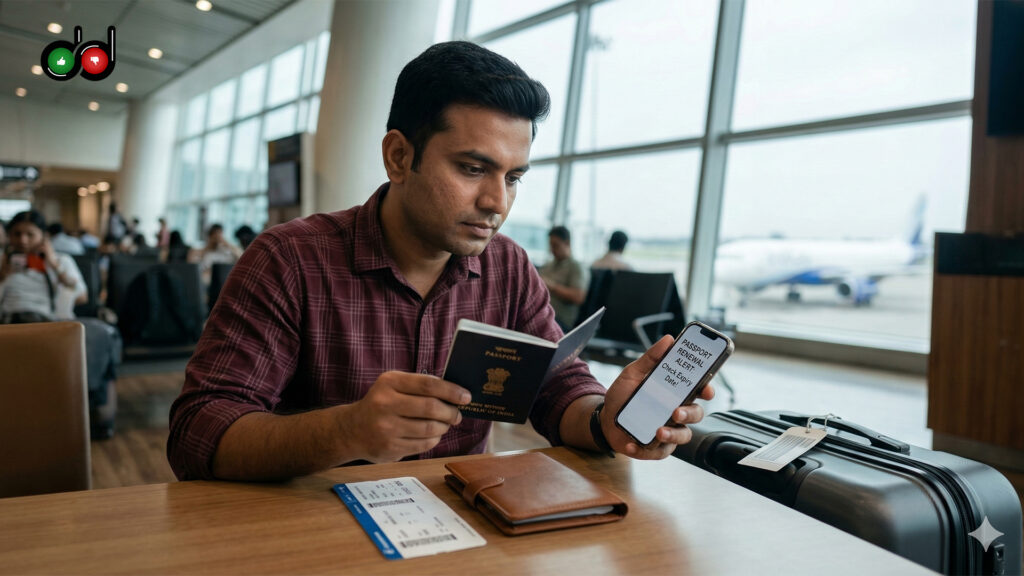
    You must apply for a reissue passport in India if you have less than six months of validity left. Many countries deny visas if your document is near expiry. Other common reasons for a reissue include:

    • Running out of pages for stamps.
    • Damaging the booklet or the chip.
    • Changing your name or home address.

    3. Fees, Pages, and Add-on Services

    The fee for a 36-page booklet is ₹1,500, while a 60-page jumbo booklet costs ₹2,000. If you need it fast, Tatkal passport rules require an extra ₹2,000 payment. Following these passport rules in India helps you avoid last-minute stress. All these costs align with the official passport rules in India for 2026.

    Quick Guide to Passport Rules in India (2026 Updates):

    Quick Guide to Passport Rules in India

    How Dos and Don’ts Take the Guesswork Out of Indian Passport Rules, Documents, and Validity

    Instead of reading subjective reviews, use Dos and Don’ts for objective, location-specific passport rules in India. Our platform bridges the gap regarding local norms to ensure a confident experience at the Post Office Passport Seva Kendra.

    Key Features for Confidence:

    • Verified Rule Sets: Access factual, up-to-date passport document requirements in India needs.
    • Structured Information: Get easy-to-read, bulleted Passport Seva Kendra rules.
    • Universal Coverage: Guidance for government offices following passport rules in India.
    • Time & Stress Savings: Know exactly what is expected for your passport application process in India.
    • Cultural Intelligence: Understand etiquette for administrative areas.

    Explore how Dos and Don’ts simplifies passport rules in India → Dos and Don’ts

    Getting your documents right is simpler when you have a clear plan.

    Conclusion

    Mastering passport rules in India requires absolute precision. One tiny name mismatch or an incorrect proof of address for a passport can derail months of travel planning. 

    Missing a detail in the passport application process in India leads to rejected visas, lost flight money, or even missed career opportunities abroad. These errors often cause permanent delays and unnecessary legal stress. 

    To prevent these failures, Dos and Don’ts offers verified, structured passport document requirements for Indian guidelines. Using these passport rules in India ensures you walk into your appointment prepared and walk out with your travel dreams intact.

    Master the passport rules in India and meet all passport document requirements in India to finish your passport application process in India. Visit Dos and Don’ts today.

    FAQs

    1. What are the passport rules in India for address proof if I recently shifted? 

    Under current passport rules in India, you must provide proof of address for your current stay for your passport. Use an active bank passbook or a registered rent agreement. This ensures your passport application process in India matches your police verification for passport location.

    2. Can I reschedule a PSK appointment if I miss my slot? 

    Yes, but passport appointment reschedule limits apply. You get two attempts for normal cases under Passport Seva Kendra rules. If you miss these, your passport application process in India closes. Always check the Post Office Passport Seva Kendra availability before rebooking.

    3. What is passport validity in India for minors? 

    Standard passport validity in India for children is five years or until they turn 18. However, minor passport rules in India allow teens aged 15–18 to choose a 10-year ePassport India by paying adult fees and meeting passport document requirements in India.

    4. Are Tatkal passport rules in India different from normal applications? 

    Strict Tatkal passport rules require three specific IDs and an urgency declaration. This speeds up your passport application process in India, often skipping pre-issue police verification for passports. Ensure you meet every passport document requirement for India to avoid immediate rejection at the counter.

    5. Do I need photos for the passport application at PSK? 

    No, staff capture your photo at the centre following Passport Seva Kendra rules. However, minor passport rules in India require parents to bring physical photos for children under four. For adults, the passport application process in India uses digital biometric capture for ePassport India.

    6. Is an ePassport mandatory in 2026? 

    The 2026 passport rules in India mandate the issuance of an ePassport India for all new applicants. While older booklets stay valid until their passport validity in India ends, any reissue of an Indian passport task will now result in a chip-embedded document.

    Leave a Reply

    Your email address will not be published. Required fields are marked *

  • Indian Rail Ticket Cancellation Rules: Refund Process, Charges, and Timelines

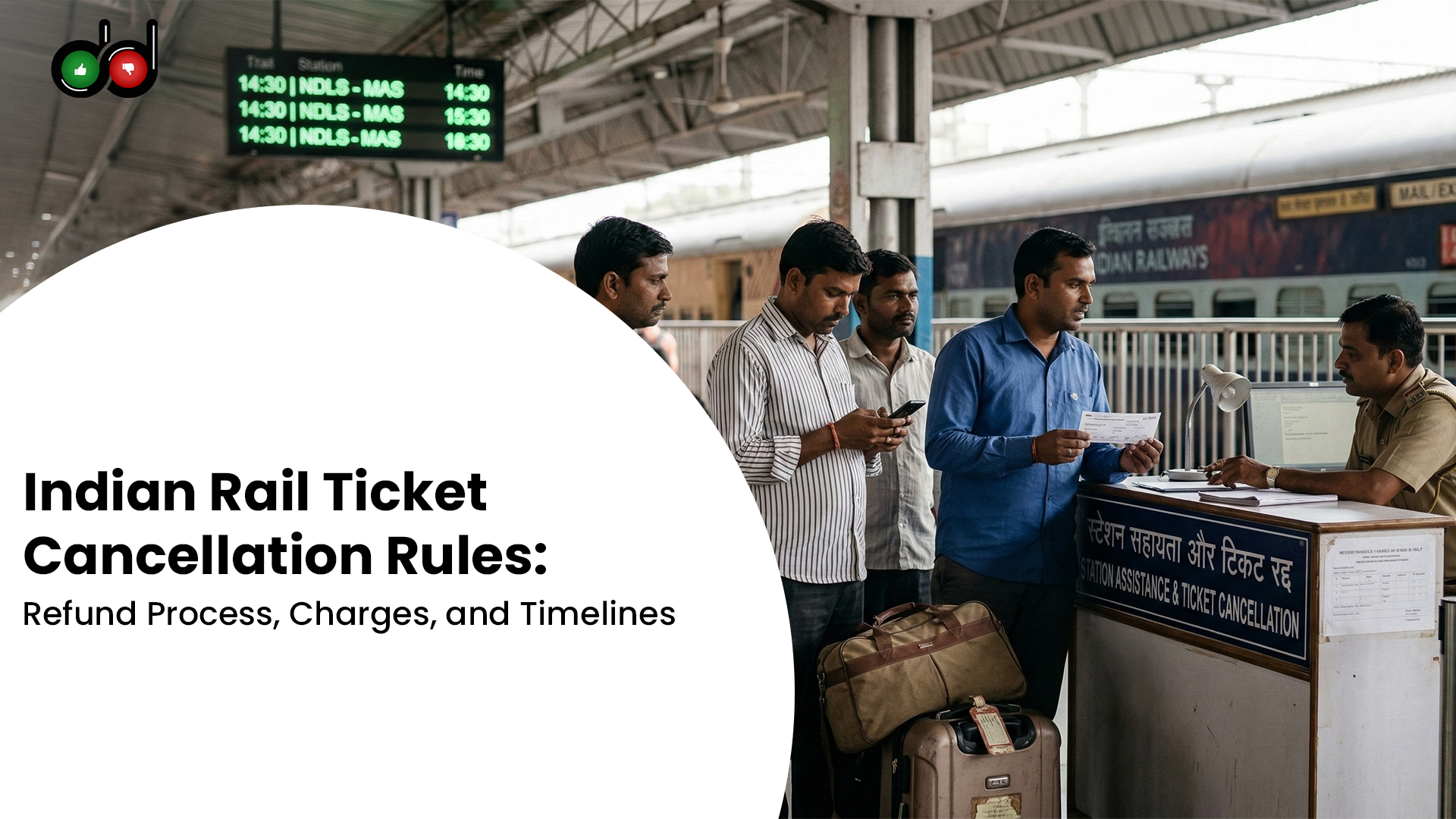
    Indian Rail Ticket Cancellation Rules: Refund Process, Charges, and Timelines

    Indian Railways carried 6.905 billion (690.5 crore) passengers in FY 2023–24. IRCTC reported a total revenue of ₹70,693 crore that year, yet passengers lost money by cancelling too late or missing TDR deadlines. 

    The cancellation rate for far-ahead bookings hit 21%, forcing Railways to cut the Advance Reservation Period from 120 to 60 days in November 2024. The 2025 shift to 8-hour chart preparation for post-2 PM trains closed the IRCTC refund policy window earlier than most passengers expected. 

    This guide breaks down every Indian rail ticket cancellation rule: train ticket cancellation charges by class, Tatkal policy, and TDR timelines that decide your refund.

    The Cancellation Charge Slab System Nobody Reads Until It’s Too Late

    Indian rail ticket cancellation rules work on a time-sensitive slab system. Every hour closer to departure costs you more, and the structure shifts depending on your class of travel. 

    Understanding IRCTC cancellation charges by class upfront saves you from losing a significant portion of your fare.

    1. Class-Wise Flat Charges for Cancellations 48+ Hours Before Departure

    Cancel more than 48 hours before departure, and a fixed flat fee applies per passenger:

    • ₹240+GST for EC/1A
    • ₹200+GST for 2A
    • ₹180+GST for 3A/CC/3E
    • ₹120 for Sleeper
    • ₹60 for the second sitting. 

    GST at 5% applies only on AC class cancellations. E-ticket refunds are processed within 3 to 5 working days to the original payment account.

    2. The 48–12 Hour and 12–4 Hour Slabs That Wipe Out Half Your Fare

    The IRCTC cancellation time limit directly controls your deduction. Cancel between 48 and 12 hours before departure, and 25% of the total fare is deducted. 

    Cancel between 12 and 4 hours, and you lose 50%. Both slabs apply subject to the flat minimums above.

    3. The 4-Hour Rule That Catches Most Passengers Off Guard

    No refund applies to confirmed tickets cancelled within 4 hours of departure. RAC ticket refunds and waitlisted ticket cancellations have a stricter 30-minute cut-off before departure.

    Tatkal tickets follow a completely separate set of cancellation rules with far stricter refund terms.

    Indian Rail Ticket Cancellation Rules for Tatkal and Premium Tatkal Tickets

    Indian Rail Ticket Cancellation Rules for Tatkal

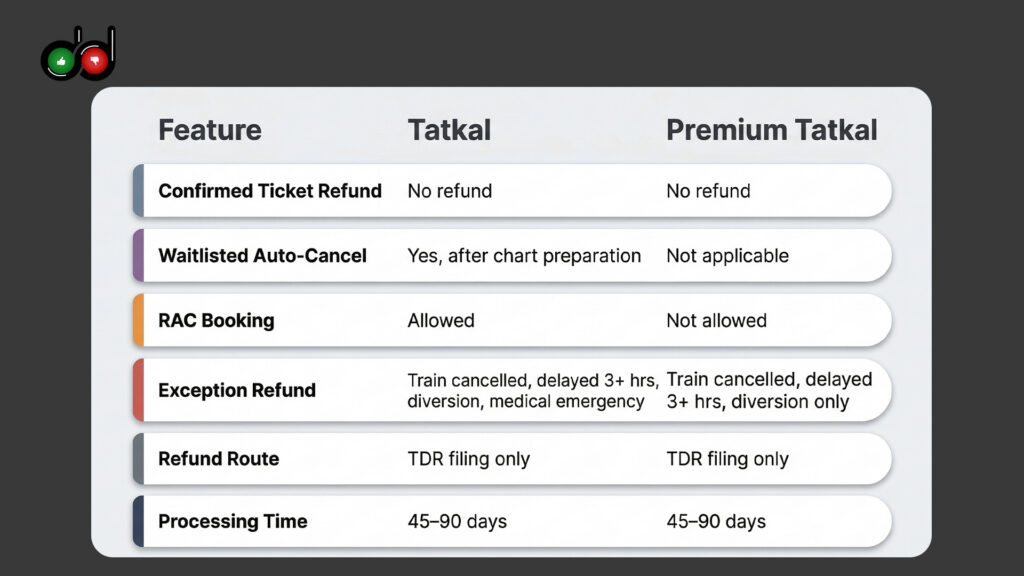
    Most passengers assume a Tatkal ticket refund works like a regular booking. It doesn’t. The cancellation framework for Tatkal and Premium Tatkal is separate, stricter, and far less forgiving. Knowing these rules before you book saves you from a complete fare loss.

    1. Confirmed Tatkal Tickets—Zero Refund, No Exceptions

    No refund applies on confirmed Tatkal ticket cancellation under standard circumstances. 

    The only valid exceptions are:

    • Train cancelled by Railways.
    • The train was delayed 3+ hours.
    • Train running on a diverted route.
    • A verified medical emergency with full documentation. 

    Refund claims in these cases must go through TDR filing rules in India, and processing takes 45 to 90 days through the concerned zonal railway office.

    2. Waitlisted Tatkal Tickets—What Happens After Chart Preparation

    IRCTC auto-cancels the waitlisted Tatkal e-tickets after chart preparation time and refunds the full fare minus the ₹20 + GST service charge per passenger within 5 to 7 business days

    Counter-booked waitlisted Tatkal tickets must be manually cancelled before chart preparation, or the entire fare is forfeited.

    3. Partially Confirmed Tatkal Group Tickets—The Rule Nobody Understands

    If even one confirmed passenger boards on a partially confirmed group PNR, no refund is issued for the waitlisted passengers on the same ticket. Cancel the entire ticket before chart preparation time at IRCTC to protect the refund.

    Tatkal vs Premium Tatkal: Quick Cancellation Comparison

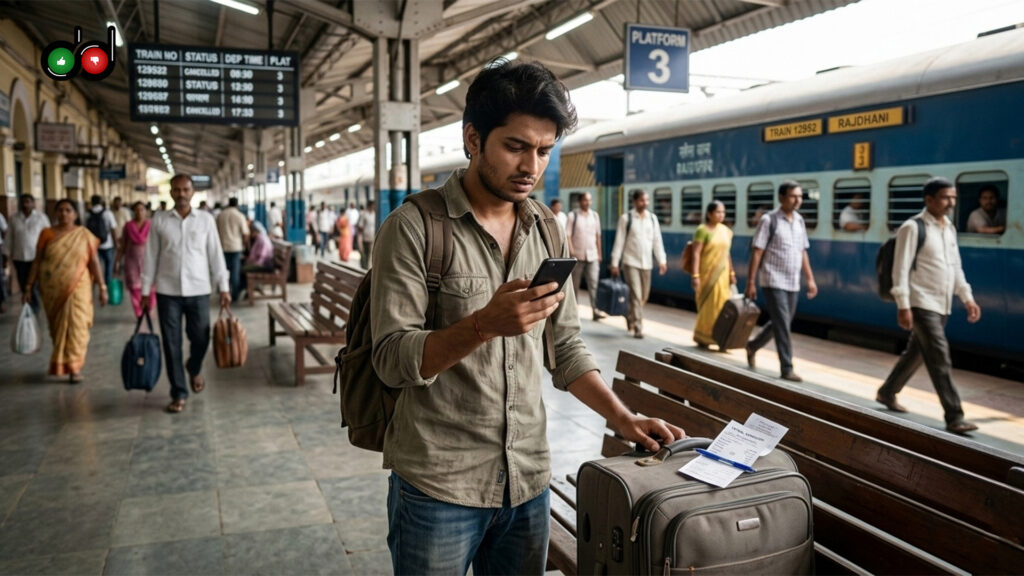
    For situations where cancellation happens after chart preparation, TDR is the only route left.

    The Only Refund Route After Chart Preparation Under IRCTC Refund Policy (TDR Filing)

    Once chart preparation closes your online cancellation window, TDR filing rules in India become the only way to claim a refund. A Ticket Deposit Receipt is the formal mechanism. IRCTC uses it for refund claims that fall outside standard cancellation, covering post-chart situations, train delays, coach issues, and service failures.

    1. Situations Where TDR Gets You a Full Refund

    Not every situation qualifies, but these do:

    • Train cancelled by Indian Railways: Full automatic refund for e-tickets. No TDR needed.
    • Train delayed 3+ hours: File TDR online before actual departure to claim a full refund.
    • Coach not attached: Valid TDR ground with supporting documentation.
    • Boarding station not on diverted route: Full refund applicable through TDR.
    • AC failure mid-journey: Refund covers the fare difference between AC class and second class for the distance AC was non-functional. The TTE certificate is mandatory.

    2. TDR Filing Deadlines That Cost Passengers Their Full Refund

    Missing the deadline means losing the entire fare. Here are the exact windows:

    • General TDR claims: File within 30 days of scheduled train departure.
    • Train running late claims: File before actual departure.
    • AC failure claims: File within 20 hours of arrival at destination.
    • Refund processing time: 30 to 90 days depending on zonal railway and claim type.

    3. The 2025 Chart Preparation Change That Shifted Every Deadline

    Indian rail ticket cancellation rules changed significantly with the 8-hour chart preparation time IRCTC shift for trains departing after 2 PM. For early morning trains between 5 AM and 9 AM, charts are prepared the previous night between 9 PM and 11 PM. 

    The RailOne app now displays real-time chart preparation time for any train directly on the booking screen. The cancellation rules also differ significantly depending on where you originally booked your ticket.

    Train Ticket Cancellation Charges for Counter Tickets vs. E-Tickets: Key Differences

    Train Ticket Cancellation Charges

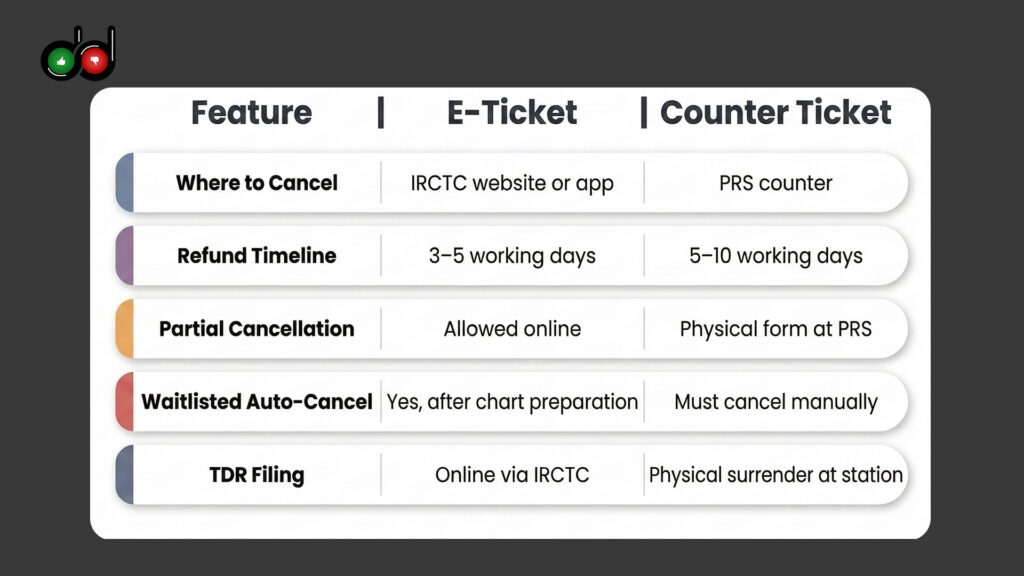
    One of the most overlooked Indian rail ticket cancellation rules is that your booking source controls your cancellation method. The IRCTC refund policy treats e-ticket vs counter ticket cancellation as two separate processes with different timelines and steps.

    1. Where You Booked Determines Where You Must Cancel

    E-tickets can only be cancelled through IRCTC, not at PRS counters. Counter tickets require an in-person PRS visit unless a valid mobile number was registered at booking, which allows online cancellation via IRCTC. 

    Third-party platforms like Paytm or MakeMyTrip apply their own service charges on top of standard train ticket cancellation charges, and those platform fees are non-refundable.

    2. Partial Cancellation: How It Works and When It’s Allowed

    Partial cancellation of Indian Railways rules allows individual passengers to be removed from family or group e-tickets while others retain their booking. A fresh e-reservation slip generates automatically for remaining passengers. Partial cancellation is not permitted after chart preparation.

    3. The 2025 Aadhaar Authentication Change for Tatkal Bookings

    All Tatkal bookings now require Aadhaar OTP verification across IRCTC and PRS counters from July 15, 2025. This directly affects Indian rail ticket cancellation rules because only Aadhaar-authenticated bookings carry a valid claim trail for exception-based refunds.

    E-Ticket vs Counter Ticket: Quick Cancellation Comparison

    E-Ticket vs Counter Ticket

    Here is how Dos and Don’ts help you apply these rules without confusion.

    How Dos and Don’ts Help You Follow Indian Rail Ticket Cancellation Rules Without Losing Money

    Most passengers lose refunds not because the rules are unfair, but because they couldn’t find the right information fast enough. Dos and Don’ts fixes that by providing objective, verified guidelines specifically for Indian rail ticket cancellation rules across 10,000+ public and private spaces.

    • Verified Rule Sets: Access factual, updated IRCTC refund policy details, including IRCTC cancellation time limits and TDR filing rules in India, without sifting through outdated sources.
    • Structured Information: Get clean, easy-to-read guidelines built for quick decisions on the go.
    • Universal Coverage: From Tatkal ticket refund rules to waitlisted ticket cancellation procedures, every ticket type is covered.
    • Time Savings: Know your exact train ticket cancellation charges before you act, not after.

    Explore how Dos and Don’ts simplifies Indian rail ticket cancellation rules and helps you book with confidence → Dos and Don’ts

    Conclusion

    Indian rail ticket cancellation rules are deadline-driven and unforgiving once windows close. Most passengers don’t check the IRCTC cancellation time limit for their specific ticket type until it’s too late. 

    A missed 4-hour window, an unfiled TDR claim under India’s rules, or a misunderstood Tatkal ticket refund rule means the entire fare is gone with no recovery option. That money doesn’t come back. 

    Dos and Don’ts gives you verified, ticket-specific IRCTC refund policy information before your next booking, so you act on time.

    Dos and Don’ts  

    Frequently Asked Questions 

    1. Can I cancel a confirmed train ticket on the day of the journey?

    Yes. Indian rail ticket cancellation rules allow confirmed e-ticket vs. counter ticket cancellation up to 4 hours before departure. After that, only the TDR filing rules of India apply. RAC ticket refunds and waitlisted ticket cancellations cut off 30 minutes before departure.

    2. What are the cancellation charges for a sleeper class ticket cancelled 24 hours before departure?

    The IRCTC refund policy deducts 25% of the fare for train ticket cancellation charges between 48 and 12 hours before departure. The minimum flat deduction for Sleeper class is ₹120 per passenger. No GST applies to Sleeper Class Indian Rail ticket cancellation.

    3. What happens to my e-ticket if Indian Railways cancels the train?

    Train cancelled: refund from IRCTC is automatic for e-tickets—full fare credited back with no action needed. Counter ticket holders must visit a PRS counter and cancel manually within 72 days of scheduled departure to claim their IRCTC refund policy settlement.

    4. How long does a TDR refund take?

    TDR filing rules in India: refunds take 30 to 90 days depending on the zonal railway’s processing timeline. IRCTC forwards your claim to the concerned railway office, and the IRCTC refund policy settlement credits back to your original payment account once approved.

    5. What changed in IRCTC cancellation rules in 2025?

    Two major updates affected Indian rail ticket cancellation rules: the IRCTC cancellation time limit for online cancellation shifted with the 8-hour chart preparation time. IRCTC changes for post-2 PM trains and mandatory Aadhaar OTP verification was introduced for all Tatkal ticket refund bookings from July 15, 2025.

    Leave a Reply

    Your email address will not be published. Required fields are marked *

  • IRCTC Luggage Rules: Carry-On Limits, Checked Baggage, and Penalty Charges

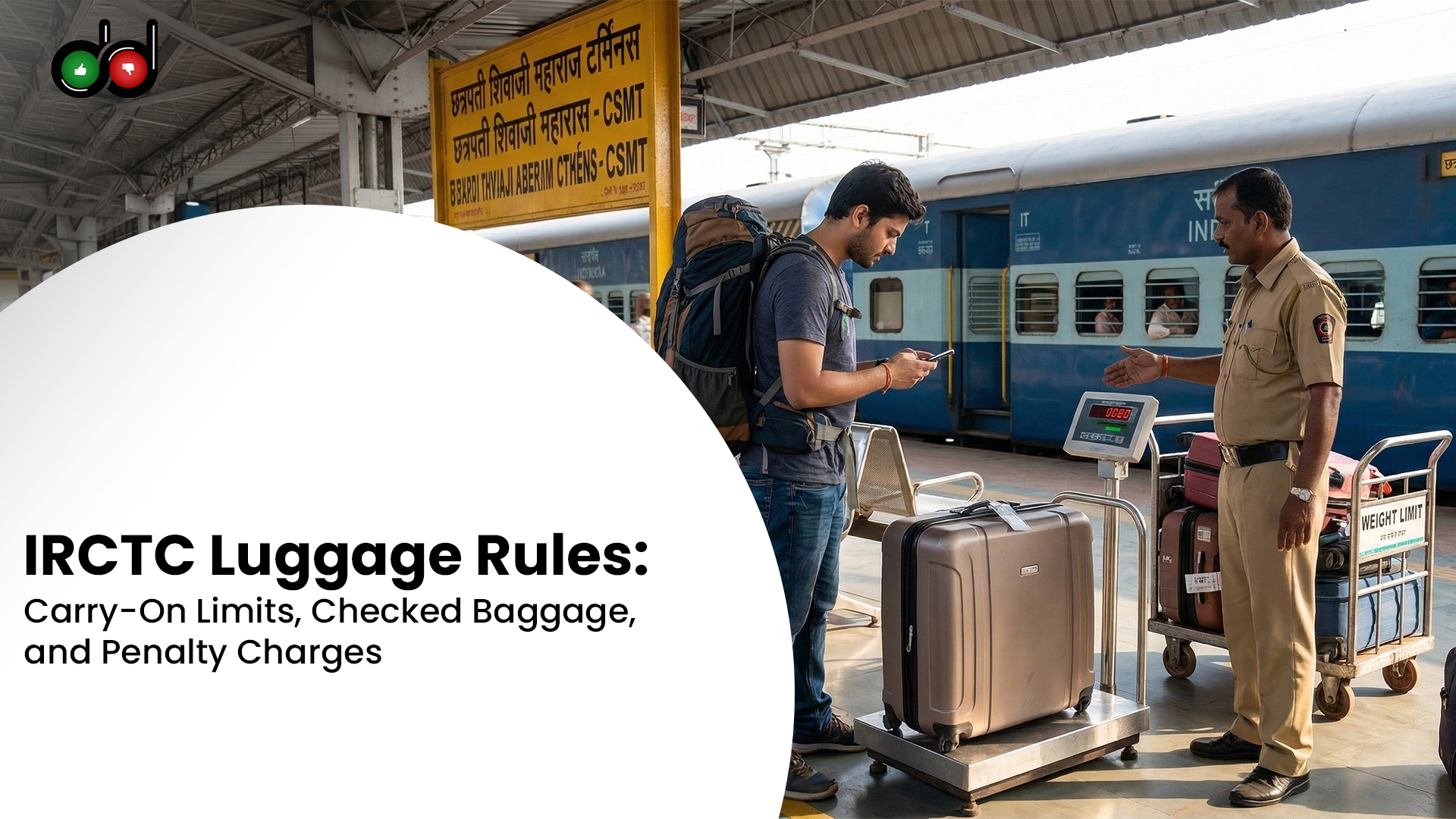
    IRCTC Luggage Rules: Carry-On Limits, Checked Baggage, and Penalty Charges

    You probably board your train without thinking about IRCTC luggage rules. Many passengers mix up carry-on bags with items meant for the parcel office. Indian Railways now uses electronic scales at major stations to catch an unbooked luggage fine. 

    If you ignore the IRCTC baggage allowance, you might face penalties at six times the normal price. This 2026 guide helps you pack right. Follow IRCTC luggage rules to avoid an IRCTC penalty for excess luggage on your next trip.

    The Two Systems Inside IRCTC Luggage Rules Most Passengers Mix Up

    Most travellers mix up two different ways to carry bags. Following IRCTC luggage rules helps you avoid a surprise unbooked luggage fine. You need to know which items stay in your coach and which items go to the train’s storage van.

    1. Carry-On Luggage (What Travels With You)

    These bags travel right next to your seat. You must keep them within the IRCTC luggage limit per class. Most coaches allow three pieces per person: a suitcase, a backpack, and a small handbag. 

    You don’t need an IRCTC baggage booking online if you stay under the free limit. TTEs check these items to ensure they don’t block the aisle.

    2. Checked Baggage (What Goes in the Van)

    Any heavy item exceeding your IRCTC baggage allowance belongs in the brake van. You must handle brake van luggage booking at the parcel office 30 minutes before departure. A parcel van booking with IRCTC ensures heavy trunks travel in the SLR coach. The minimum charge is Rs 30.

    3. Mandatory Packing Standards

    Railway staff now strictly enforce packing standards. You must wrap trunks in gunny bags or secure them with heavy-duty locks. Label every bag with your address in English or Hindi. This step prevents damage and helps staff track your gear.

    Following IRCTC luggage rules helps you avoid high excess luggage charges from IRCTC during your trip. This system keeps the coaches clear for everyone.

    IRCTC Baggage Allowance by Class: Free Limits, Marginal Bands, and Maximum Caps

    Knowing your weight limit before you reach the platform saves you money and stress. Every ticket class has a different IRCTC baggage allowance that defines how much you can bring for free. 

    Staying within the IRCTC luggage limit per class ensures you don’t face an unbooked luggage fine during your journey.

    1. IRCTC Baggage Allowance by Class (2025–2026)

    2. How Marginal Allowance Works

    The marginal allowance that Indian Railways provides acts as a small buffer above your free limit. If your bags fall into this weight band, you pay excess luggage charges to IRCTC at 1.5 times the standard rate. 

    However, if you cross the maximum cap, the IRCTC penalty for excess luggage jumps to 6 times the normal rate. For example, a Sleeper Class traveller with 80 kg unbooked pays roughly Rs 110 extra.

    3. Special Rules for Kids and Groups

    Your children’s baggage allowance train rules give kids aged 5 to 12 half the adult free limit. This is capped at 50 kg. If you travel in a group, remember that IRCTC luggage rules apply to each ticket individually. 

    You cannot combine limits to cover one massive trunk. Items like bicycles aren’t part of your personal bags and require a separate brake van luggage booking.

    Following these IRCTC luggage rules keeps your travel budget on track. Next, you need to watch out for the specific bag dimensions that could trigger a fine even if your weight is perfect.

    IRCTC Luggage Size Rules: The Dimension Trap That Catches Travellers

    IRCTC luggage rules

    Following IRCTC luggage rules means watching your bag’s size just as much as its weight. Many travellers focus on the scale and ignore the luggage size restrictions train staff now enforce at the gates. 

    If your suitcase is too bulky, you will face excess luggage charges from IRCTC even if the bag is relatively light.

    1. Coach-Specific Size Limits

    General and sleeper coaches allow trunks up to 100 cm x 60 cm x 25 cm. However, the rules for AC 3-Tier and Chair Car are much tighter. Your bags in these coaches must stay under 55 cm x 45 cm x 22.5 cm. Standard airport-style “check-in” bags often fail this test and require a parcel van booking with IRCTC instead.

    2. Handling Oversized Items

    Major stations like Prayagraj and Kanpur now use airport-style entry systems to measure bags before you board. If your item is too big, you have to take these steps:

    • Visit the parcel office at least 30 minutes before the train leaves.
    • Complete a brake van luggage booking for the oversized item.
    • Pay the flat booking fee of Rs 50 plus the weight-based rate.

    You cannot avoid these IRCTC luggage rules by simply tucking a large bag under your seat anymore. Checking your dimensions during your IRCTC baggage booking online process saves you from a last-minute scramble.

    These IRCTC luggage rules ensure every passenger has enough space in the compartment. Now, let’s look at exactly how much an unbooked luggage fine costs if a TTE catches you with extra gear.

    Excess Luggage Charges IRCTC: The Penalty Structure Explained

    The IRCTC luggage rules now include strict financial penalties to stop overcrowding. If you travel with more than your IRCTC baggage allowance, the cost depends on when you pay. Choosing an IRCTC baggage booking online early is always cheaper than paying an unbooked luggage fine on the train.

    1. How the 1.5x and 6x Penalty Rates Work

    The marginal allowance that Indian Railways offers covers a small amount of extra weight. You pay 1.5 times the standard rate if you book this extra weight at the station. 

    However, an IRCTC penalty for excess luggage hits much harder if a TTE catches you mid-journey. In that case, you pay 6 times the standard luggage scale rate.

    • Pre-booked Excess: Charged at 1.5x the standard luggage scale rate.
    • Unbooked Excess: Charged at 6x the standard rate when detected by a TTE.
    • Minimum Fine: The minimum charge for any violation of IRCTC luggage rules is Rs 30.

    For example, a 10 kg excess on a short trip might only cost Rs 5 to book, but the fine for being caught unbooked could exceed Rs 100 depending on the distance and class.

    2. Stolen or Lost Luggage Procedures

    If your bags go missing, act fast to protect your rights under IRCTC luggage rules. You should contact the coach attendant or dial 139 immediately to report the loss. The GRP (Government Railway Police) will provide an on-board FIR form so you don’t have to get off the train to file a complaint.

    Never leave valuables like jewellery in the overhead racks. Keep them in a small bag under your head while you sleep. Most excess luggage charges IRCTC don’t cover high-value items unless you declare them and pay a percentage charge at the parcel office first.

    Penalty Structure for Excess Luggage (2026):

    Luggage ScenarioBooking MethodCharge MultiplierResulting Action
    Inside Free LimitNo booking needed₹0 (Free)Enjoy your journey.
    Marginal AllowancePre-booked at office1.5x Standard RatePay the difference only.
    Marginal AllowanceUnbooked (TTE Check)1.5x Standard RateMinimum ₹30 fine applies.
    Above Maximum CapDetected in Coach6x Standard RateImmediate fine & offloading.
    Prohibited ItemsUnbooked / Hidden6x Standard RateSeizure and potential legal action.

    These IRCTC luggage rules protect your belongings and your wallet from unexpected costs. Next, let’s see how a simple platform can help you follow these rules without any stress.

    How Do’s & Don’ts Help You Follow IRCTC Luggage Rules Confidently

    Following IRCTC luggage rules ensures your trip stays on track. While most apps offer random reviews, Dos and Don’ts provide objective, location-specific guidelines for your IRCTC baggage allowance. 

    Our platform bridges the gap between official policy and your travel experience, helping you avoid an unbooked luggage fine at the station.

    Key Features for Confident Travel:

    • Verified Rule Sets: Access factual, up-to-date requirements for your IRCTC luggage limit per class and documentation needs.
    • Structured Information: Skip long reviews for easy-to-read, bulleted guidelines on excess luggage charges at IRCTC.
    • Universal Coverage: Get behavioural guidance for everything from parcel offices to the brake van luggage booking counter.
    • Time & Stress Savings: Know exactly what baggage sizes work before you arrive to avoid being turned away.

    By focusing on preparedness, Dos and Don’ts simplifies how you handle IRCTC luggage rules. Explore how Dos and Don’ts simplifies IRCTC luggage rules and helps you visit with confidence. → Dos and Don’ts

    Conclusion

    IRCTC luggage rules separate coach bags from those in the parcel office. Travelling with unbooked bags exceeding your IRCTC baggage allowance often leads to an unbooked luggage fine during sudden inspections. 

    If caught, you face an IRCTC penalty for excess luggage at six times the normal rate, which can drain your budget and delay your trip. Physical weighing machines now at major stations leave no room for error. 

    Avoid these high excess luggage charges with IRCTC by knowing your limits beforehand. Check Dos and Don’ts for verified, structured guidelines on IRCTC luggage rules to ensure a stress-free journey.

    FAQs

    1. How much luggage can I carry for free on an IRCTC train booking? 

    Your IRCTC baggage allowance depends on your class. First AC allows 70 kg, while AC 2-Tier permits 50 kg. The IRCTC luggage limit per class for AC 3-Tier and Sleeper is 40 kg. Stay within these to avoid an unbooked luggage fine.

    2. What is the difference between free allowance and marginal allowance in IRCTC luggage rules? 

    Free allowance is your zero-cost limit. The marginal allowance that Indian Railways offers is a buffer for extra weight. You pay excess luggage charges to IRCTC at 1.5x for this. Exceeding the maximum cap triggers a heavy IRCTC penalty for excess luggage.

    3. How do I book excess luggage on IRCTC? 

    Use IRCTC baggage booking online via the parcel portal or visit the station’s parcel office. A parcel van booking with IRCTC handles items exceeding coach limits. Always complete your brake van luggage booking 30 minutes before departure to avoid boarding delays.

    4. What is the fine for carrying unbooked excess luggage on an Indian train? 

    If the TTE detects unbooked gear, you face an unbooked luggage fine at 6 times the standard rate. This IRCTC penalty for excess luggage applies to all classes. Even a small excess luggage charge for an IRCTC violation carries a minimum Rs 30 fee.

    5. What size bags are allowed inside the train compartment? 

    Strict luggage size restrictions train passengers must follow are 100cm x 60cm x 25cm. AC 3-Tier limits are tighter at 55cm x 45cm x 22.5cm. Oversized items require a brake van luggage booking. Always follow IRCTC luggage safety tips to secure your gear.

    6. Can I carry jewellery or valuables as luggage on an IRCTC train? 

    Yes, but follow IRCTC luggage rules for security. Keep valuables in a small bag under your seat. For official booking, use IRCTC baggage booking online and provide ID. Proper IRCTC luggage safety tips suggest never leaving expensive items unattended in racks.

    Leave a Reply

    Your email address will not be published. Required fields are marked *

  • Train Luggage Rules in India: Weight Limits, Prohibited Items, and Baggage Guidelines

    Train Luggage Rules in India: Weight Limits, Prohibited Items, and Baggage Guidelines

    Indian Railways runs over 13,000 trains daily, carrying more than 20 million passengers, and yet most of them board without knowing the baggage limits that are now actively enforced. These train luggage rules recently changed. 

    In 2025, the free luggage allowance for the AC First Class train dropped to 70 kg. Carrying prohibited items in train cars leads to jail under Section 164 of the Railway Act. 

    This Indian Railways baggage allowance guide helps you avoid a railway baggage penalty. It explains every train luggage rules update for 2026 to keep your travel simple.

    Class-Wise Train Luggage Rules: What Free Actually Means

    Your ticket does not mean you can bring everything you own. The train luggage rules now use a strict class-based system. Every passenger gets a specific free luggage allowance limit on trains, based on their coach.

    If you pack more, you must pay excess baggage charges to Indian Railways or face a heavy railway baggage penalty. This Indian Railways baggage allowance system ensures that coaches remain clear and safe for everyone.

    1. Updated Free Allowance Per Class (2025–2026)

    • AC First Class: 70 kg free, up to 150 kg maximum.
    • First Class / AC 2-Tier: 50 kg free, up to 100 kg maximum.
    • AC 3-Tier / AC Chair Car: 40 kg free. Note that 40 kg is also the maximum limit allowed in these specific coaches.
    • Sleeper Class: 40 kg free, up to 80 kg maximum.
    • Second Class: 35 kg free, up to 70 kg maximum.
    • Children (5–12 years): Half the adult free allowance, up to 50 kg max.

    2. What is “Marginal Allowance”? Means

    Think of this as a small buffer. If your bag is just a few kilograms over the free limit, the train luggage rules allow a “marginal” window. Within this range, you pay 1.5 times the standard rate. 

    However, if you exceed the maximum limit or get caught with unbooked bags, you face a railway baggage penalty of 6 times the rate. Many travellers get fined because they don’t check their train luggage weight limit before leaving home.

    Size Restrictions in Indian Railways Baggage Allowance Most People Skip

    Indian Railways Baggage Allowance

    Knowing the train luggage weight limit is only half the battle. Indian Railways baggage allowance also depends on the physical dimensions of your bags. If your suitcase is too bulky, it won’t fit under the berth, which causes safety hazards in the aisles. 

    These luggage size restrictions of Indian Railways are now strictly enforced by ticket collectors and station staff.

    1. Dimension Limits by Compartment Type

    Different coaches have different space layouts, so the train luggage rules vary. If your bag exceeds these limits, you cannot keep it in your compartment.

    • Sleeper and General Coaches: Your bags must stay within 100 cm x 60 cm x 25 cm (length x breadth x height).
    • AC 3-Tier and AC Chair Car: These coaches have less floor space. The limit is tighter at 55 cm x 45 cm x 22.5 cm.
    • Oversized Bags: Any item larger than these dimensions must go to the parcel van booking counter.

    2. The Airport-Style Enforcement Coming in 2026

    Indian Railways is rolling out new technology to catch excess baggage charges on Indian Railways before you even board. Major hubs now use automated scanners that measure both weight and size. 

    By the end of 2026, you will need to clear these checkpoints to enter the platform. This system tags your bags to show they meet the IRCTC luggage policy standards. If you carry heavy goods over 100 kg, expect a double surcharge.

    Staying within these size limits ensures a smooth entry, but what you put inside those bags is even more important for your safety.

    Prohibited Items on the Train: The Full List Passengers Ignore

    prohibited items in train

    Safety on a moving train is a shared responsibility. The prohibited items in the train list exist to prevent disasters like fires or chemical leaks. If you ignore these train luggage rules, the legal consequences are severe. 

    Under Section 164 of the Railway Act, carrying dangerous goods can lead to a railway baggage penalty of 1,000 rupees and up to three years in prison.

    1. Items That Can Get You Jailed (Not Just Fined) d)

    Security teams use advanced scanners to detect banned items that Indian Railways prohibit for public safety.

    • Flammables: You cannot carry petrol, kerosene, or paint thinners.
    • Explosives: Gunpowder, firecrackers, and even small sparklers are illegal.
    • Gases: Both full and empty gas cylinders are prohibited items in train compartments.
    • Corrosives: Strong acids or chemicals that cause damage are strictly forbidden.

    2. Items Banned for Comfort and Safety: Less Obvious, Still Penalised

    Some items aren’t explosive but still violate the Indian Railways baggage allowance policy.

    • Smelly Items: Dead poultry, raw hides, or rotting food are banned to maintain hygiene.
    • Business Stock: You cannot use your train luggage rules allowance for commercial merchandise. These must go through parcel van booking.
    • Stoves: Any cooking device is a safety risk and belongs in the parcel van.

    3. What You Can Carry With Conditions

    You can take certain restricted items if you follow specific train luggage rules.

    • Ghee: Each passenger can carry up to 20 kg of ghee (clarified butter), but it must be in a sealed tin container to prevent leaks.
    • Bicycles: These require a separate train luggage rules booking and do not count as free bags.
    • Pets: You can only bring a dog into a First AC cabin if you book the entire coupe. Otherwise, your pet travels in the luggage van with a vet-issued health certificate.

    Respecting these train luggage rules keeps the journey safe for everyone. After sorting your bags, you need to know how to book any extra weight properly.

    How to Book Excess Luggage and Avoid Penalties Under Train Luggage Rules

    If your bags weigh more than the free luggage allowance on the train, you must register them. The IRCTC luggage policy is now strictly monitored by staff at the entrance. 

    Paying for your weight before you board is cheaper than paying a railway baggage penalty mid-journey. Always weigh your bags at home to avoid a surprise train luggage weight limit check at the station.

    A) Two Ways to Book Luggage in Advance

    You have two main paths to follow the Indian Railways baggage allowance guidelines properly.

    1. At the Time of Booking: You can add your luggage requirements while buying your ticket online or at the counter. This is the fastest way to handle excess baggage charges and Indian Railways fees.

    2. At the Station Luggage Office: If you forgot to book online, visit the luggage booking at the station counter. You must do this at least 30 minutes before the train departs. 

    The minimum charge is 30 rupees. Your bags must be packed correctly and show the sender’s address in Hindi or English.

    B) What Happens If You’re Caught With Unbooked Excess Luggage?

    If a ticket collector finds unbooked bags, the train luggage rules mandate a heavy fine. You will pay a railway baggage penalty of 6 times the standard rate. This applies even if you only go a few kilograms over the train luggage weight limit.

    Once you arrive, collect your bags within 30 minutes. If you are late, you pay extra storage fees. Following these train luggage rules keeps your travel budget intact.

    Use this table to decide the best path for your Indian Railways baggage allowance needs.

    Indian Railways baggage allowance

    How Do’s & Don’ts Help You Follow Train Luggage Rules Without Stress

    Instead of reading long reviews, use Dos and Don’ts for objective, location-specific train luggage rules guidance. Our platform bridges the gap regarding Indian Railways baggage allowance and station etiquette. 

    We ensure a respectful, confident experience across 10,000+ spaces.

    Key Features for a Stress-Free Trip:

    • Verified Rule Sets: Get factual requirements for the train’s free luggage allowance limit before you arrive.
    • Structured Information: Access easy-to-read, bulleted IRCTC luggage policy updates.
    • Universal Coverage: Find behavioural guidance for stations, offices, and landmarks.
    • Time Savings: Avoid a railway baggage penalty by knowing exactly what is expected.
    • Cultural Intelligence: Respect local traditions and administrative train luggage rules effortlessly.

    Explore how Dos and Don’ts simplifies train luggage rules so you can visit with confidence. Dos and Don’ts

    Conclusion

    Indian Railways has strictly updated train luggage rules for 2026. Most passengers struggle with class-specific Indian Railways baggage allowance limits and hidden luggage size restrictions Indian Railways imposes. 

    Ignoring these rules leads to serious trouble. You risk a railway baggage penalty of 6 times the rate or even jail time under Section 164 of the Railway Act for carrying prohibited items in train cars. 

    Don’t let your trip end at the police booth or with a massive fine. Use Dos and Don’ts to access verified IRCTC luggage policy facts and travel with confidence.

    Visit Dos and Don’ts →

    FAQs

    1. How much luggage can I carry for free on an Indian train in 2026?

    Your free luggage allowance on the train depends on your class. First AC permits 70 kg, while AC 2-Tier allows 50 kg. AC 3-Tier and Sleeper Class have a 40 kg train luggage weight limit. Check the IRCTC luggage policy to avoid a railway baggage penalty.

    2. What is the maximum size allowed for luggage inside the train coach?

    Under luggage size restrictions for Indian Railways, bags in general coaches must be within 100cm x 60cm x 25cm. AC 3-Tier is stricter at 55cm x 45cm x 22.5cm. For larger items, use parcel van booking to follow the Indian Railways baggage allowance rules properly.

    3. What items are completely banned from Indian train coaches?

    Prohibited items on trains include gas cylinders, flammables, and explosives. Carrying banned items that Indian Railways’ forbids is a crime under Section 164 of the Railway Act, punishable by jail or a 1,000 rupee fine. Always review train luggage rules to ensure your items are safe.

    4. What happens if my luggage is found overweight during the journey?

    If you exceed your train luggage weight limit, you face excess baggage charges from Indian Railways at 1.5 times the rate. If caught with unbooked bags, a railway baggage penalty of 6 times the standard rate applies. Avoid these costs by following train luggage rules.

    5. Can I carry my pet or bicycle on an Indian train?

    You can bring pets only in First AC if you book the whole cabin. Bicycles require a separate luggage booking at the station and don’t count toward your free luggage allowance on the train. Follow the IRCTC luggage policy for special items to avoid travel trouble.

    6. How do I book excess luggage for my Indian Railways journey?

    Book your extra bags during ticket purchase or at the luggage booking at station office 30 minutes before departure. This follows the IRCTC luggage policy and keeps you safe from a railway baggage penalty. For very heavy loads, choose parcel van booking.

    Leave a Reply

    Your email address will not be published. Required fields are marked *

  • Solo Travel in India: Safety Rules, Dos and Don’ts for First-Time Travelers

    Solo Travel in India: Safety Rules, Dos and Don’ts for First-Time Travelers

    The global solo travel market hit $482.5 billion in 2024. Many people worry about safety before they arrive. Solo travel in India works well when you know what to expect. 

    Most visitors stay safe by following simple India travel safety tips. This guide covers the India travel dos and don’ts that matter in 2026. Solo travel in India is easy when you have the right facts. You can have a smooth trip.

    Why Solo Travel in India Is Different From Every Other Destination

    India feels like a dozen countries in one. You move from snowy peaks to tropical beaches in a single flight. This variety makes solo travel in India unique. You must adapt your approach as you move between states. 

    These India travel safety tips help you manage the fast-paced changes.

    1. The Numbers Behind the Surge

    • Search interest for solo travel in India grew 60% since 2022.
    • New services like female-only cabs support solo female travel in India.
    • Verified guide networks now cover most safe cities in India.

    2. Regions With Different Rules

    North and South India have distinct vibes. South India often feels more relaxed for a first-time traveller to India. In places like Himachal Pradesh, the Indian cultural etiquette is often more informal than in big cities. Always check the current status of the India travel dos and don’ts for each specific state before you visit.

    Understanding these regional differences prepares you for the specific safety habits you need to use daily.

    Core Solo Travel in India Safety Rules First-Timers Ignore

    Independent travel is rewarding, but solo travel in India requires specific habits. You must focus on transport, digital tools, and booking habits to avoid common India tourist scams. 

    Most visitors stay safe by following these India travel safety tips.

    1. Transportation Rules That Change Everything

    Prioritise verified apps like Uber or Ola. These apps track your ride via GPS, which improves India’s transportation safety. Avoid unregistered taxis at airports, as they often overcharge. 

    For long distances, choose AC train coaches. Services like “Meri Saheli” provide extra security for solo female travel in India. Using these official channels reduces your risk during solo travel in India.

    2. Digital Safety Habits You Need From Day One

    A local SIM card is a mandatory tool for solo travel in India. It allows you to call India emergency contacts or use the 112 national emergency line. This is a must for a first-time traveller to India.

    • 112 India App: This connects you to emergency services instantly.
    • Offline Maps: These help you move through safe cities in India without data.

    3. Hotel and Accommodation Red Flags

    When picking a place to sleep, look for the “Incredible India” government approval badge. Unlicensed guesthouses often skip the required guest registration, which can leave you unprotected. 

    A reputable hostel or hotel makes it easier to follow India travel dos and don’ts because the staff can offer reliable local advice. Solo travel in India is safer when you choose vetted accommodations.

    • Check Form C Compliance: Ensure the hotel asks for your passport to register you legally.
    • Verify Location: Use satellite view to see if the hotel sits on a well-lit street.

    Following these rules keeps you ahead of potential issues. These habits protect you while you learn the local Indian cultural etiquette on the ground.

    India Travel Dos and Don’ts Nobody Puts in One Place

    Learning the local rhythm is the fastest way to feel comfortable during solo travel in India. You will find that small gestures go a long way in building trust and staying safe. Follow these India travel safety tips to blend in and avoid unnecessary attention.

    1. What You Must Do Before You Leave Your Accommodation

    Every morning, sync your day’s route while you still have Wi-Fi. It is a good habit for solo travel in India to confirm any transport through your hotel desk rather than a stranger on the street. 

    Carry a photocopy of your ID and keep your original passport in a secure locker. This is a basic rule for any first-time traveller in India.

    2. Cultural Dos That Get You Respect Instantly

    Using a simple “Namaste” shows you respect Indian cultural etiquette. Always use your right hand for transactions, eating, or handing over documents. Before you enter a home or a temple, follow the Indian temple dress code by removing your footwear. 

    If you want to take a photo of someone, always ask first. This simple act of politeness is one of the most important India travel dos and don’ts.

    3. Don’ts That Avoid Real Problems

    To stay out of trouble, never photograph military zones or government buildings. Avoid accepting “free tours” from people hanging around monuments, as these usually lead to India tourist scams.

    • Don’t touch heads: In India, the head is sacred.
    • Don’t discuss sensitive topics: avoid debating religion or local politics.
    • Don’t ignore the diet: Respect local food customs, like avoiding beef in Hindu-majority areas.

    By following these India travel dos and don’ts, you show respect for local traditions. This awareness makes solo travel in India a much richer and safer experience.

    solo travel strategy

    Safe vs. Risky: Cities and Zones for Solo Travel in India

    Picking the right start point affects your comfort level. Solo travel in India feels easier when you stick to “Green Zones” like Kerala, Himachal Pradesh, and Pondicherry. 

    These areas rank as safe cities in India because they have strong tourist infrastructure and many English speakers. They provide a soft landing for any first-time traveller to India.

    1. Green Zone Cities

    Kerala and Sikkim offer a relaxed pace that suits solo female travel in India. In places like Rishikesh, the community supports visitors, which reduces the chance of facing India tourist scams. 

    These regions are perfect for solo backpacking in India because transport is reliable and the vibes are friendly.

    • Kerala: This state offers backwaters and high literacy rates.
    • Himachal Pradesh: It is a top choice for mountain lovers and trekkers.

    2. Cities That Need Extra Awareness

    Big hubs like Delhi, Agra, and Varanasi offer amazing history, but you must keep your guard up during solo travel in India. You should follow India travel safety tips strictly here. 

    Always arrange a pre-booked pickup if you arrive at night. While these aren’t “no-go” areas, they are where most India travel dos and don’ts are tested.

    • Delhi: Watch for street touts near major monuments.
    • Agra: Use official guides to avoid overpaying at the Taj Mahal.

    3. Zones to Avoid Entirely

    Avoid border regions in Jammu & Kashmir and parts of the Northeast. While Operation Sindoor (May 2025) targeted specific issues, these areas remain unpredictable. 

    Before finalising your itinerary for solo travel in India, check the current status of India visa requirements. Sticking to vetted zones makes solo travel in India more enjoyable.

    Staying in vetted zones keeps your trip fun. You can focus on the beauty of the country instead of constant worry.

    How Dos and Don’ts Help You Navigate Solo Travel in India

    While typical platforms focus on subjective ratings, Dos and Don’ts provides objective, location-specific guidelines for solo travel in India. By bridging the information gap regarding Indian cultural etiquette, our platform ensures a respectful experience. 

    Use these features for solo travel in India to stay confident:

    • Verified Rule Sets: Access up-to-date India dress codes for temples and entry requirements.
    • Structured Information: Skip long reviews for quick-read India travel safety tips.
    • Universal Coverage: Get behavioural guidance for hospitals, clubs, and monuments.
    • Cultural Intelligence: Understand local norms to avoid India tourist scams.

    Dos and Don’ts simplifies solo travel in India so you can focus on the journey. Explore how Dos and Don’ts help you visit with confidence. → Dos and Don’ts

    Conclusion

    Solo travel in India is a top trend for 2026. However, ignoring India’s cultural etiquette or choosing the wrong transport leads to disaster. You risk facing aggressive touts, theft, or local backlash for breaking rules you didn’t know existed. 

    One simple mistake turns a dream trip into a legal nightmare. These India tourist scams can ruin your budget and your safety in seconds. 

    To stay safe, you need facts. The Dos and Don’ts platform provides the India travel safety tips and India travel dos and don’ts required for successful solo travel in India.

    Visit Dos and Don’ts to ensure your next adventure is guided by facts rather than chance.

    FAQs

    1. Is solo travel in India safe for first-time international travellers?

    Yes, solo travel in India is safe with planning. A first-time traveller to India should follow India travel safety tips by using verified apps. Sticking to safe cities in India and respecting Indian cultural etiquette ensures a smooth, secure, and rewarding journey.

    2. What are the most common scams targeting solo travellers in India?

    Avoid India tourist scams by booking via official apps. For solo travel in India, ignore “closed hotel” claims or fake guides. Following India travel dos and don’ts, like using fixed-rate transport, significantly improves your India transportation safety while exploring independently.

    3. What should solo female travellers specifically watch out for in India?

    For solo female travel in India, prioritise AC train coaches and women-only compartments. Following India travel safety tips like dressing modestly and keeping India emergency contacts ready helps. Solo travel in India is empowering when you choose well-lit, reputable, and vetted accommodations.

    4. Which Indian cities are best for a first solo trip?

    The safest cities in India for beginners are Kochi and Rishikesh. They offer a great introduction to solo travel in India. These spots have excellent infrastructure for solo backpacking in India, making it easy to learn the essential India travel dos and don’ts.

    5. What documents should solo travellers always carry in India?

    Before starting solo travel in India, verify your India visa requirements online. Always carry copies of your passport. Keep a digital list of India emergency contacts and hotel addresses. These India travel safety tips protect every first-time traveller to India during their trip.

    6. Are there any India travel dos and don’ts specific to religious sites?

    Respect India’s cultural etiquette by removing shoes at shrines. Following the India dress code for temples—covering shoulders and knees—is mandatory. These India travel dos and don’ts ensure you remain respectful while enjoying the spiritual side of solo travel in India and sightseeing.

    Leave a Reply

    Your email address will not be published. Required fields are marked *