Author: Dos and Don’ts

  • Goa Alcohol Rules: Beach Party Laws, Drinking Fines, and Safety Tips for Goa Nightlife

    Goa Alcohol Rules: Beach Party Laws, Drinking Fines, and Safety Tips for Goa Nightlife

    Goa remains India’s top party spot, but 2025 brings a major shift in how the state manages its nightlife. Officials noticed a 21% jump in tourism this year, leading to stricter enforcement of Goa alcohol rules. 

    After the tragic December 2025 Arpora fire, safety is the top priority. Police now treat public drinking as a nuisance. They increased the drinking fines by 150% to stop littering and keep people safe. 

    You can still enjoy the liberal Goa drinking age of 18, but you must follow the new laws to avoid a ₹100,000 (~$1,115) penalty. This guide breaks down Goa beach drinking laws so you stay out of legal trouble while enjoying your vacation.

    Age, Legality & Possession: The Basics

    Goa offers the most relaxed legal drinking age; Goa provides it at 18. Even with the liberal Goa drinking age of 18 limit, Goa alcohol rules now mandate carrying a physical government ID. 

    High-end clubs often reject phone photos of your Aadhaar or passport. These venues follow strict Goa alcohol rules to avoid the heavy drinking fines Goa police issue for serving minors.

    1. Understanding Possession and Permits

    You must respect Goa alcohol restrictions regarding personal stock. Without a specific permit under the Goa Excise Act, you can only legally have:

    • 3 bottles of IMFL (750 ml each).
    • 6 bottles of beer (650 ml each).

    For tobacco, follow the Goa Prohibition of Smoking and Spitting Act. You can carry up to 200 cigarettes or 50 cigars for personal use. However, public smoking is a serious offence.

    2. Transporting Alcohol and Tobacco

    If you want to take liquor out of the state, follow tourist alcohol rules by getting a Form E7A permit. These cost roughly ₹20 (~$0.24) at authorised shops. Border police strictly enforce Goa alcohol rules and will seize unpermitted bottles. 

    Following these Goa alcohol rules ensures you stay safe and follow all Goa beach drinking laws while travelling.

    Strict Goa Beach Drinking Laws
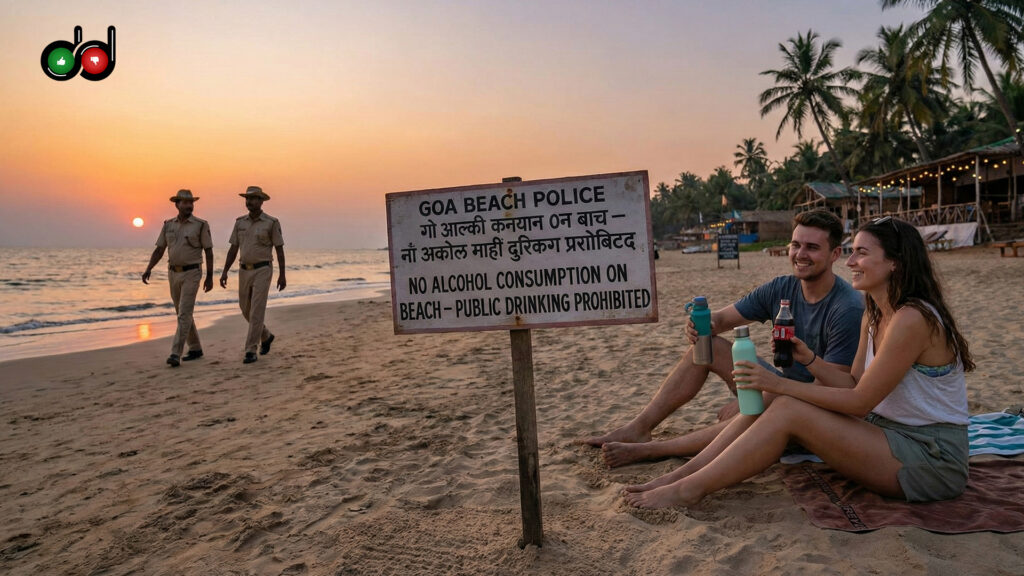
    Goa Beach Drinking Laws

    Open drinking on the sand is now a major legal risk under Goa alcohol rules. You must stay within the licensed seating area of a beach shack to consume alcohol. 

    Moving even a few feet toward the water violates Goa beach drinking laws and counts as a public nuisance. Officials strictly enforce alcohol regulations at beaches to prevent accidents and keep the coastline clean.

    Penalties for Public Drinking

    The government recently introduced the Goa bottle ban near the coastline. This policy encourages vendors to sell cans instead of glass. If police catch you with alcohol in unauthorised areas, you face heavy beach drinking penalties.

    • Individual Fines: Start at ₹5,000 (~$60) and can reach ₹100,000 (~$1,115) for a Goa public intoxication fine.
    • Imprisonment: Repeat offenders or those who refuse to pay drinking fines face up to three months in jail.
    • Littering: Breaking glass bottles on the beach triggers the highest Goa alcohol restrictions penalties.

    Stay inside the shacks to avoid these Goa alcohol rule traps.

    Nightlife & Club Regulations (2026 Update)

    Every licensed nightclub must now undergo an internal safety audit and publicly display their Fire Safety NOC. If you visit a club and don’t see this certification near the entrance, the venue could be operating illegally.

    New Service Cut-offs and Music Limits

    The state has introduced staggered closing times based on a venue’s location and fire safety rating. These Goa alcohol restrictions aim to manage crowds and ensure a safe exit for all guests.

    • Service Cut-offs: Depending on the specific licence, alcohol service now ends by 11:00 PM or 12:30 AM. Check with the staff early to avoid missing out.
    • Music Deadlines: Outdoor amplified music must stop strictly at 10:00 PM to follow noise pollution laws. Indoor clubs with certified soundproofing and safety clearances can sometimes play music until 1:00 AM.
    • Capacity Limits: Venues now have a strict “maximum occupancy” rule. Security will stop entries once the limit is reached to prevent overcrowding, a key factor in the recent safety reforms.

    Always check for the government-issued safety verification QR codes before you settle in. These tourist alcohol rules keep the nightlife vibrant while ensuring you stay safe during your night out.

    Nightlife & Club Regulations (2026 Quick View)
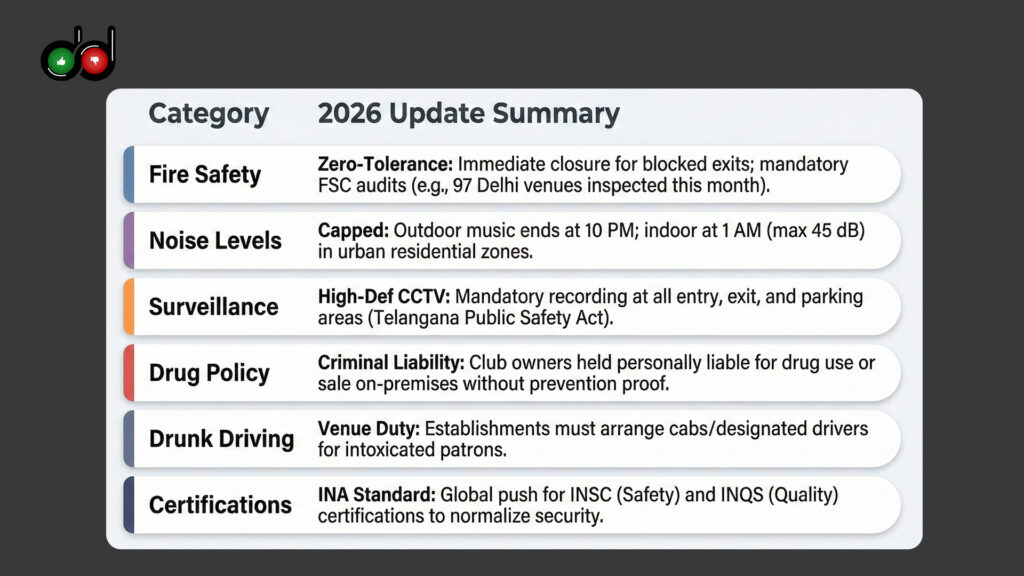
    Nightlife & Club Regulations

    Drunk Driving & Public Intoxication

    Goa Police have launched a mass crackdown on DUI cases across Drunk Driving & Public Intoxication

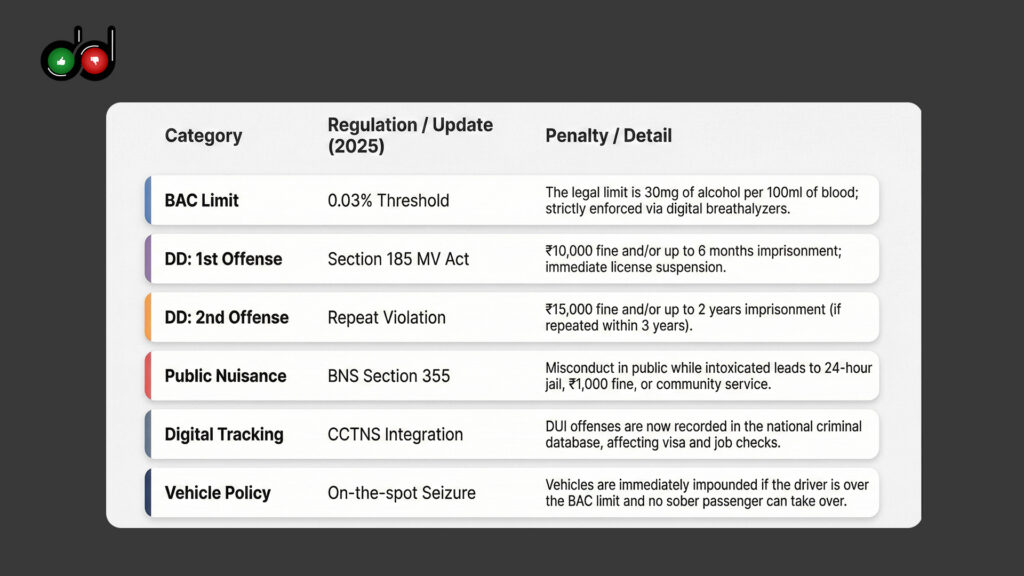
    Goa Police have launched a mass crackdown on DUI cases across the coastal belt. Coastal patrols in Baga, Anjuna, and Vagator now use advanced breathalysers nightly. Under Goa alcohol rules, the legal limit is 0.03% BAC. If you exceed this, you face immediate drinking fines that Goa officers issue on the spot.

    1. The Price of a DUI in 2025

    The government recently hiked penalties to deter reckless behaviour. New Goa alcohol restrictions mean a first offence results in a ₹10,000 (~$120) fine or six months in jail. 

    For repeat offences, the fine jumps to ₹15,000 (~$180). Police are also filing FIRs under BNS Section 125 for “public endangerment“.

    • Criminal Record: An FIR creates a permanent record, affecting future jobs and visas.
    • Licence Suspension: Expect an immediate 3-month suspension.
    • Vehicle Seizure: Rental scooters and cars are impounded instantly.

    2. Safe Transport Strategy

    Never ride a rental scooter after drinking. Instead, use these options to stay safe:

    • Goa Miles: Use the government-backed app for fixed, fair rates.
    • Pilot Bike Taxis: These licensed motorcycle taxis are affordable for solo travellers.
    • Pre-paid Cabs: Book these at stands near major beaches like Calangute.

    Following these Goa alcohol rules ensures you don’t end your night in a police station.

    Drunk Driving & Public Intoxication: 2026 Quick Glance
    Drunk Driving & Public Intoxication

    How Dos and Don’ts Simplify Goa Alcohol Rules

    While reviews focus on opinions, Dos and Don’ts provides objective, locWhile reviews focus on opinions, Dos and Don’ts provides objective, location-specific guidelines for Goa alcohol rules. Our platform bridges the gap regarding tourist alcohol rules, ensuring a smoother experience across 10,000+ spaces.

    Key Features for Planning with Confidence:

    • Verified Rule Sets: Access factual requirements for entry and the legal drinking age Goa mandates.
    • Structured Information: Easy-to-read bulleted guidelines for Goa beach drinking laws on the go.
    • Universal Coverage: Behavioural guidance for clubs, hospitals, and landmarks.
    • Time Savings: Know the Goa alcohol restrictions in advance to avoid being turned away.

    Dos and Don’ts provides the clarity you need to follow Goa alcohol rules without friction.

    Conclusion

    Goa alcohol rules now involve strict Goa beach drinking laws and rigorous safety checks. Following these regulations is essential, especially with the steep drinking fines Goa police now enforce. Overlooking a single rule might lead to a heavy Goa public intoxication fine or even a criminal record under the latest 2025 updates. 

    To avoid these serious legal setbacks, staying informed is the best strategy. Dos and Don’ts offer a reliable way to understand these regulations clearly. By using our platform, you get the facts on Goa alcohol restrictions and the Goa drinking age 18 limit. This allows you to focus on your trip while staying compliant with the law.

    FAQs

    1. Can tourists drink alcohol on Goa’s beaches? 

    No. Goa beach drinking laws prohibit alcohol consumption within 200 metres of the waterline. You must stay within a licensed shack’s seating area. Beach drinking penalties start at ₹5,000 and can reach ₹100,000 under the 2025 Amendment.

    The legal drinking age Goa enforces is 18, the lowest in India. Under current Goa alcohol rules, premium nightclubs now require a physical government-issued ID. Digital copies on your phone are increasingly rejected at high-end venues.

    3. What are the drunk driving penalties in Goa? 

    Under Goa’s drunk driving law, the BAC limit is 0.03%. A first offence costs ₹10,000 and can mean 6 months in jail. Goa Police booked 2,146 DUI cases in early 2025, mostly tourists on rental scooters.

    4. What nightclub hours does Goa currently follow? 

    Post the December 2025 Arpora fire: nightclub hours Goa authorities enforce are stricter. Alcohol service stops by 12:30 AM. Outdoor music cuts off at 10:00 PM. Venues without a Fire Safety NOC displayed at the entrance are operating illegally.

    5. What is the Goa bottle ban, and does it apply to tourists? 

    Yes. The Goa bottle ban restricts glass bottle sales near coastlines. Breaking or littering glass bottles in public is a direct violation of alcohol regulations on beaches in Goa. The Goa public intoxication fine for this offence starts at ₹5,000.
    Leave a Reply

    Your email address will not be published. Required fields are marked *

  • Nightlife in India: How to Stay Safe at Clubs and Pubs — Essential Nightlife Safety Tips

    Nightlife in India: How to Stay Safe at Clubs and Pubs — Essential Nightlife Safety Tips

    India’s party scene is growing fast. The alcohol market hit 35 billion dollars recently. Huge crowds visit Bangalore and Goa for nightlife in India’s party scene is growing fast. The alcohol market hit 35 billion dollars recently. Huge crowds visit Bangalore and Goa for nightlife in India. Events like the 2025 Birch fire tragedy in Goa show us the risks. 

    You must stay alert. Drink spiking is also a rising problem. This guide gives you nightclub safety tips to keep you secure. You can enjoy nightlife in India with confidence by following India’s nightclub safety rules. Strong nightlife security measures keep your night out fun. Here is how you stay safe.

    Personal Safety: Harassment & Drink Spiking

    Protecting yourself starts with staying alert to your surroundings. You need to know how to spot trouble before it ruins your night.

    A. Club Harassment Prevention

    Harassment often starts small. It might be someone following you or staring too long. Club harassment prevention works best when you act early.

    • Trust your gut. If a person makes you uncomfortable, move to a different area.
    • Tell venue staff if someone keeps bothering you. Ask for a female bouncer if you feel safer talking to one.
    • Use the “Ask for Angela” code at the bar. The staff will help you leave safely without drawing attention.
    • Call 112 if you feel in immediate danger outside the club.

    B. Drink Spiking Prevention

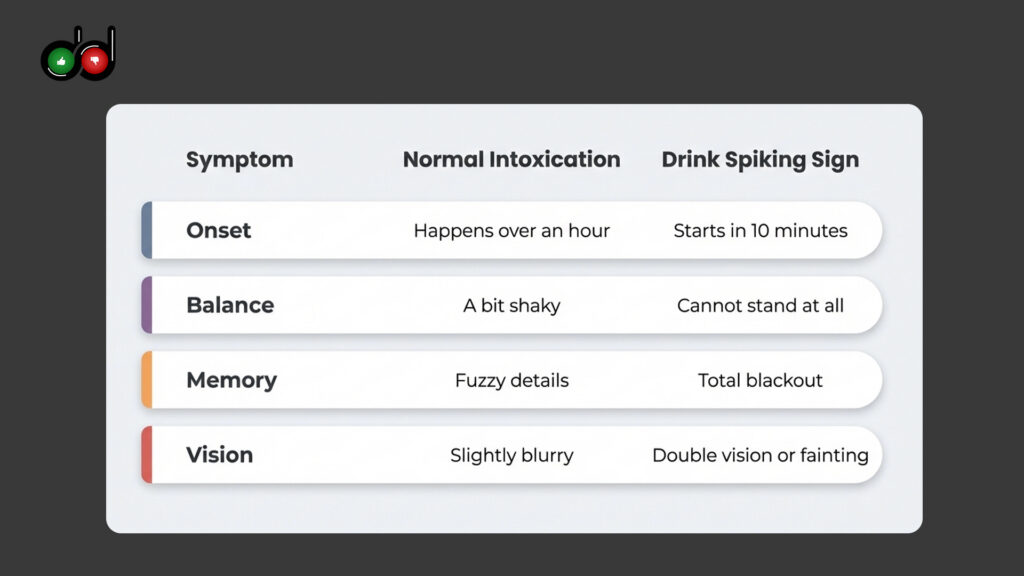
    Drink spiking prevention is about watching your glass. New 2025 reports show a rise in fast-acting sedatives. You must know the difference between being tipsy and being drugged.

    Drink Spiking Prevention

    Stay with your group if you start feeling “too drunk” for what you had. Never leave your glass alone. Use safe nightclub practices like ordering a new drink if you lost sight of yours for even a second. Vigilance tips from clubbing experts suggest always keeping your hand over your glass in a crowd.

    Once you know how to handle people, you need to check the building itself for hidden risks.

    The 30-Second Venue Safety Audit

    Before you order your first drink, check the building. Your safety depends on a quick look around.

    First, find the fire exits. Make sure they are not locked or blocked by boxes. Fire safety clubs must follow strict rules after the 2025 Birch fire. If you see only one exit, leave. This is a basic nightclub safety tips rule.

    Second, look at the crowd. If the room is too packed to move, it is a fire hazard. Emergency evacuation becomes impossible in a crush.

    Third, check for security. High-quality nightlife spots in India have bouncers near the doors and bathrooms. This helps with India nightclub safety. If the venue fails this audit, find a better place to enjoy nightlife in India. 

    By taking these precautions, everyone’s nightlife in India becomes safer. You can now concentrate on smarter ways to party with your friends.

    Prevention Strategies: Partying Smarter

    Prevention Strategies, Partying Smarter

    Smart planning keeps you safe without ruining the fun. You can enjoy nightlife in India more when you have a solid plan for the night. Use these safe nightlife strategies to stay ahead of potential risks.

    1. The Buddy System 2.0

    You should arrive together and stay together. Designate one friend to be the “Anchor”. This person drinks less to keep an eye on everyone’s safety. They monitor the group’s drinks and handle communication with staff if a situation arises. This is a top-tier club harassment prevention tactic.

    2. Use Drink Protection

    You can invest in SipLock lids or drink covers. These tools provide physical drink spiking prevention. You should never accept a drink from a stranger. Always watch the bartender pour your drink directly into your glass. If you leave your drink to hit the dance floor, you must get a fresh one when you return.

    3. Secure Your Transport

    You should avoid hailing a random cab on the street late at night. Use apps like Uber or Ola instead. These apps allow you to share your live location with friends. Most Indian pub safety experts suggest waiting inside the venue until your ride actually arrives at the door.

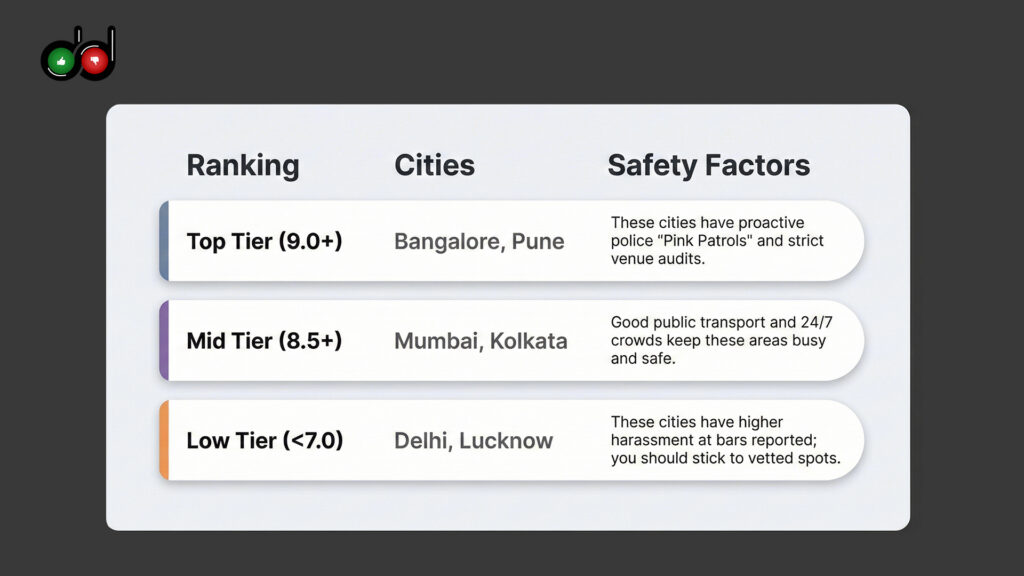
    4. City Safety Rankings (2025 Index)

    Choosing the right city matters for nightlife in India. Some cities have better nightlife security measures than others.

    City Safety Rankings

    High-end venues in Delhi or Noida can still be safe. You must stay more alert in these areas. Always check if a club has women-friendly venues certification. Following these safe nightclub practices ensures you get home without any trouble.

    Knowing how to plan your night is the first step, but you also need to know your legal rights if something goes wrong.

    How Dos and Don’ts Keep You Secure

    Traditional platforms focus on photos and opinions. Dos and Don’ts provides objective guidelines for nightlife in India. Our platform bridges the information gap regarding local rules and nightlife security measures. This ensures a smoother and more confident experience.

    Key Features for Partying with Confidence:

    • Verified Rule Sets: Get access to up-to-date entry requirements and anti-harassment policies for clubs. This eliminates guesswork before you arrive.
    • Structured Information: Skip the long reviews. We offer easy-to-read guidelines for safe nightclub practices designed for quick consumption.
    • Time & Stress Savings: Avoid being turned away by knowing the dress codes and documentation needs in advance.
    • Cultural Intelligence: Understand the specific etiquette for nightlife in India to remain respectful of local norms.

    Dos and Don’ts transform how you plan your night. We provide the clarity you need to enjoy nightlife in India without friction.

    Conclusion

    Many people feel anxious about nightlife in India because of unpredictable crowds and hidden safety risks. You might worry about harassment at bars or the sudden danger of drink-spiking prevention failures. Without clear facts, one wrong choice can lead to a dangerous emergency like the 2025 Birch fire. This fear often keeps people from enjoying their night out entirely.

    You can avoid these risks by being prepared. Dos and Don’ts provides objective, verified guidelines for India nightclub safety. Instead of guessing, you get direct access to nightlife security measures and anti-harassment policies for specific venues.

    FAQs

    1. What do I do if my friend is spiked? 

    Move them to a safe spot immediately and call 108. High-risk nightlife areas in India require fast action. Drink spiking prevention includes staying with them until help arrives. Never let them leave with strangers to ensure their India nightclub safety remains intact.

    2. Can a bouncer hit me? 

    No. Proper nightlife security measures forbid bouncers from using physical force unless in self-defence. If they use excessive force, it violates safe nightclub practices. You should report such incidents to the police to uphold public safety in India and your legal rights.

    3. Are “Ladies’ Nights” safe? 

    These events are safer at women-friendly venues with active anti-harassment policies. However, you must maintain vigilance, tips clubbing experts recommend. Keep your drink covered and stay with your group to ensure the best club harassment prevention while partying.

    4. How do I report harassment? 

    Immediately alert the venue’s nightlife security measures team or female bouncers. You can also use “Safe City” apps for harassment at bars. Filing a report ensures nightlife in India stays secure for everyone and supports broader club harassment prevention efforts.

    Leave a Reply

    Your email address will not be published. Required fields are marked *

  • Nightlife in Goa: Dress Code, Entry Rules, and What Works (and Doesn’t) at Indian Nightlife Spots

    Nightlife in Goa: Dress Code, Entry Rules, and What Works (and Doesn’t) at Indian Nightlife Spots

    Goa attracted 10.4 million visitors last year. This surge changed nightlife in Goa forever. You now face stricter bouncers and new safety laws. The December 2025 fire changed how clubs operate. 

    You need to know the latest Goa club entry rules before you head out. This guide shows you how to get past the velvet rope and avoid overpaying. We focus on real tips for Goa nightclub entry fees and safety. Stick to these rules to enjoy the best nightlife in Goa.

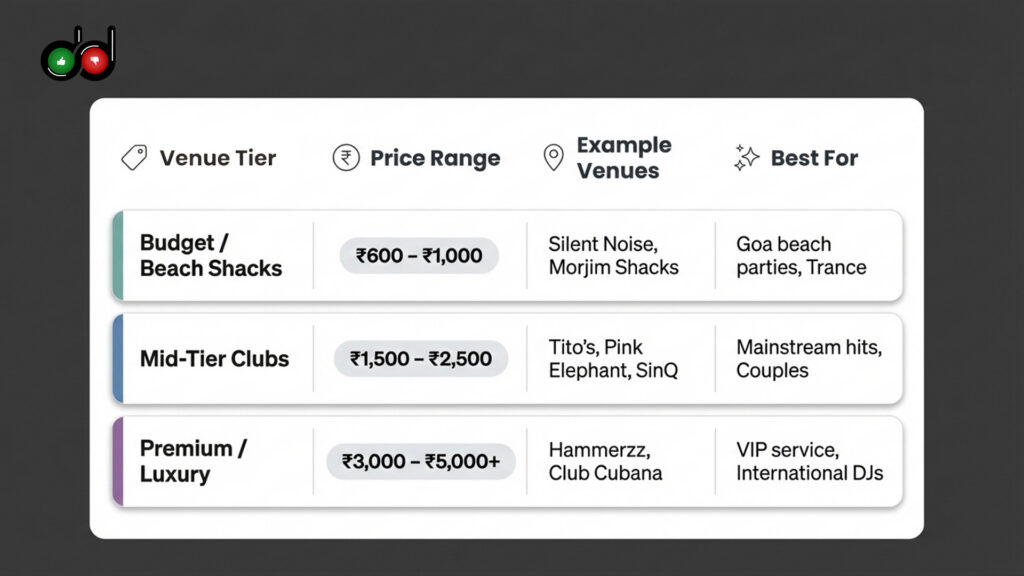
    Goa Nightclub Entry Rules & Pricing (The Cost to Party)

    Knowing the price before you go out saves you a lot of trouble. Nightlife in Goa changed after the 2025 safety mandates, so prices and rules are now much stricter. You must understand how venues set their rates to avoid overpaying for a night out.

    1. Understanding Your Costs

    Most venues use a cover charge system. This means you pay to get in, but you use that money as credit to buy drinks. These Goa nightclub entry fees vary based on the venue’s prestige and the day of the week.

    • Budget & Beach Shacks: Expect to pay ₹600–₹1,000 for Goa beach parties or Goa trance clubs.
    • Mid-Tier Clubs: Venues like Tito’s or Mambo’s charge between ₹1,500 and ₹2,500.
    • Luxury Venues: Premium spots like Hammerzz have Goa club pricing starting at ₹3,000 and going up to ₹5,000 for special events.

    2. Modern Entry Dynamics

    The Goa Club entry rules are very clear about who gets in. Couples usually pay less than single men. Stags often face the highest rates or get rejected if the club is too full. 

    Many places now enforce a strict Goa nightclub dress code at the gate to maintain a specific crowd. You should also check the specific Goa dress code policy for each venue before you leave your hotel. 

    Nightlife in Goa is now safer because venues must show their fire permits to stay open. Some spots have huge Goa cover charges during peak times or for international DJs.

    Goa Nightclub Entry Rules & Pricing

    The Dress Code Decoded: What Gets You In

    Most people think of flip-flops when they think of Goa. However, nightlife in Goa demands a much higher standard at the door. If you show up in beachwear, bouncers will likely turn you away. Understanding the Goa nightclub dress code is the only way to guarantee you get inside the best venues.

    1. Mastering the Smart Casual Dress Code

    A smart casual dress code strikes a balance between comfort and style. Since nightlife in Goa often involves humidity, you should pick breathable fabrics like linen or light cotton. Many clubs now have a strict Goa dress code policy that focuses heavily on footwear.

    • For Men: Stick to collared shirts or high-quality polos. Pair these with clean chinos or dark denim without holes. Closed-toe shoes are mandatory. Loafers, boat shoes, or crisp white sneakers work best.
    • For Women: You have more flexibility, but “beach chic” is the winning vibe for Goa party culture. Flowy dresses, stylish jumpsuits, or elegant tops with jeans are great. Choose wedges or block heels over stilettos to stay comfortable on varied dance floors.

    2. What Leads to Automatic Rejection

    The most common reason for failing Goa club entry rules is poor clothing choice. Goa nightclub etiquette suggests you dress for a night out, not a day at the shore. Avoid these items to keep your night on track:

    1. Rubber Flip-Flops: These are a strict “no” at almost every major club.
    2. Athletic Wear: Gym vests, tank tops, and sports jerseys will get you stopped at the gate.
    3. Board Shorts: Keep your swimming gear at the hotel. Short pants are usually only okay for daytime pool parties.

    Following the right Goa nightclub dress code ensures you look the part and feel confident. Once you look great, you can use local secrets to make your night even better.

    How to Party Like a Local (Insider Strategies)

    How to Party Like a Local

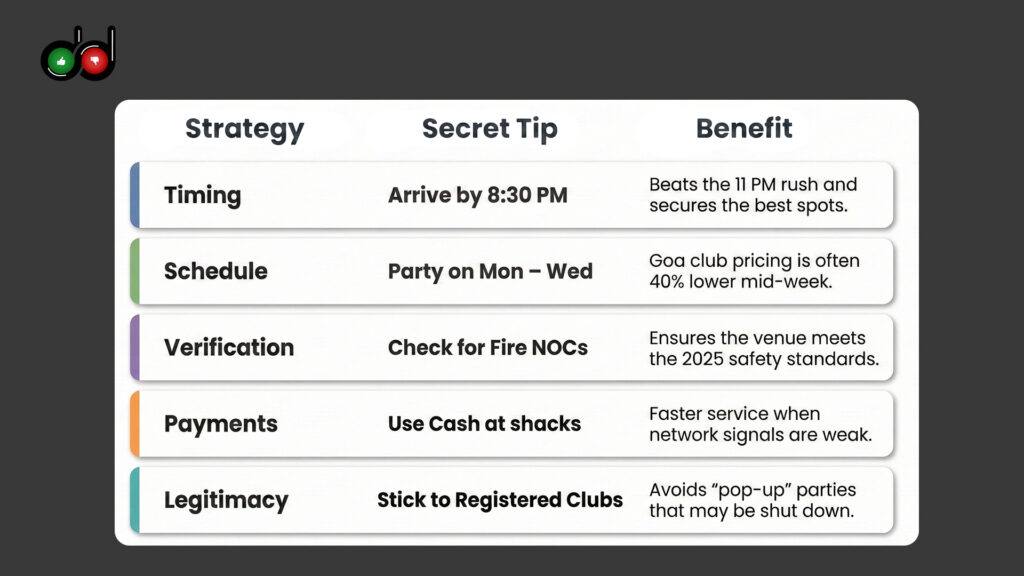
    Experience the best nightlife in Goa without hitting tourist traps by Experience the best nightlife in Goa without hitting tourist traps by following these local habits. Success at the door depends on your timing and choice of venue. Use these tips to master nightlife in Goa:

    1. The Early Bird Rule: Arrive by 8:30 PM. This helps you beat the 11:00 PM rush and ensures you pass Goa club entry rules before the club hits capacity.
    2. Mid-Week Magic: Visit on Mondays or Wednesdays. Nightlife in Goa is 40% cheaper then, and many clubs offer free entry for women.
    3. Verify Your Venue: Only visit clubs with a valid fire safety permit. After the December 2025 safety updates, avoid “pop-up” parties that lack official licences.
    4. Cash is King: Carry cash for beach shacks where card machines often fail. Use cards only for high-end nightlife in Goa spots.

    These simple moves help you avoid stress and enjoy the party. Now, you must focus on the new safety laws that protect everyone on the dance floor.

    goa club entry rules

    Safety First: The Post-Birch Fire Reality

    Safety is no longer a secondary concern for nightlife in Goa. After the tragic fire at Birch by Romeo Lane on December 6, 2025, the government changed the rules for every club and bar in the state. 

    You need to be aware of these changes to stay safe while enjoying nightlife in Goa. Authorities now conduct daily inspections to ensure every venue follows strict safety protocols.

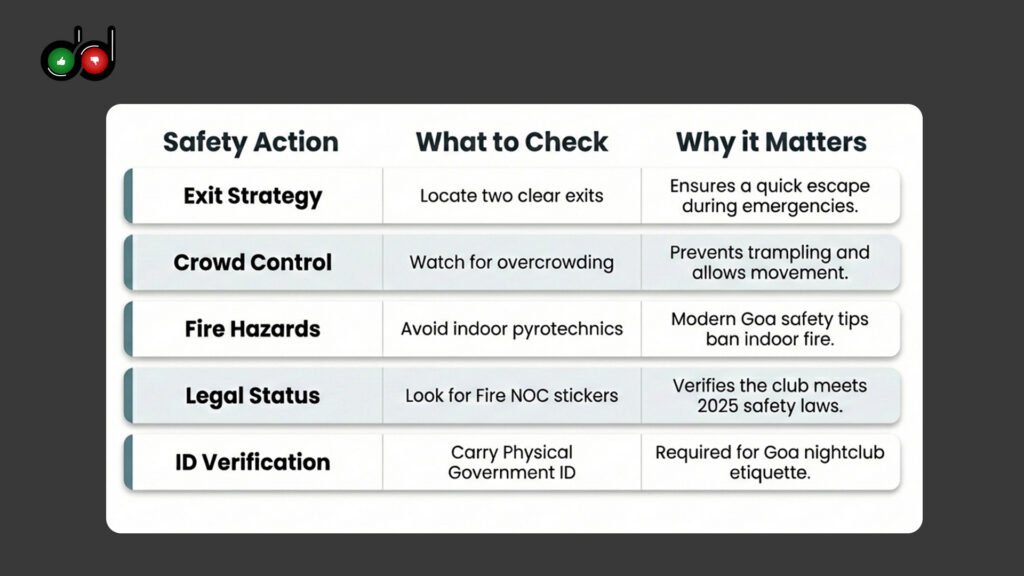
    Your Pre-Entry Safety Checklist

    You should take personal responsibility for your safety before the music starts. Nightlife in Goa is fun, but being prepared is smarter. 

    Use these tips every time you enter a new venue:

    • Locate Emergency Exits: Look for at least two clear, marked exits. After the 2025 incident, bouncers must keep these paths clear, but you should verify this yourself.
    • Monitor Crowd Density: If you cannot move your arms freely, the club is likely over capacity. Overcrowding was a major factor in recent accidents within Goa party culture.
    • Check Fire Equipment: Modern nightlife in Goa venues must display fire extinguishers and working sprinklers. If you don’t see them, reconsider staying.

    Verify Licences: Only patronise clubs that display their tourism and fire safety permits near the entrance. This is now part of standard Goa nightclub etiquette.

    The New Regulatory Standard

    The state now enforces a zero-tolerance policy for indoor pyrotechnics. You will no longer see cold sparklers or fire dances inside enclosed clubs. Nightlife in Goa has shifted toward better lighting and sound systems that don’t pose fire risks. If a venue feels unsafe or ignores these Goa safety tips, it is better to find a different spot.

    By staying alert, you ensure that your night ends on a high note. Now, let’s look at how to behave when the party moves to the sand for Goa beach parties.

    Beach Party Etiquette (Anjuna & Beyond)

    While nightlife in Goa feels more relaxed on the sand, specific rules still apply. Beach parties in areas like Anjuna Beach nightlife zones have a unique vibe that balances freedom with responsibility. You must respect the local environment to keep these parties going.

    1. Essential Beach Party Rules

    Following Goa party culture standards ensures everyone has a good time. Keep these pointers in mind:

    • Respect the Sand: Never leave glass bottles or cigarette butts on the beach. Goa safety tips prioritise keeping the shore clean for morning visitors.
    • Consent and Conduct: Goa has a zero-tolerance policy for harassment. Always ask before taking photos of strangers.
    • Stay Hydrated: The tropical humidity makes alcohol hit harder. Drink plenty of water to avoid heatstroke during Goa beach parties.

    2. The Shift in Dress Code

    Even at Goa trance clubs on the beach, the smart casual dress code often starts at midnight. While you can wear shorts during the day, many beach clubs ask you to switch to trousers for the late-night sessions.

    Proper etiquette keeps the nightlife in Goa vibrant and welcoming for everyone. Next, see how specific tools can make your night even easier.

    Why Dos and Don’ts Are Essential for Goa

    While traditional platforms focus on opinions, Dos and Don’ts provides objective guidelines for nightlife in Goa. We bridge the gap regarding Goa club entry rules and local etiquette to ensure a respectful experience.

    • Verified Rule Sets: Get factual requirements for Goa nightclub entry fees and dress codes.
    • Structured Information: Access quick, bulleted guidelines on the go.
    • Universal Coverage: We cover everything from Goa trance clubs to luxury lounges.
    • Cultural Intelligence: Understand specific Goa nightclub etiquette to avoid friction.

    Plan your night with clarity and skip the guesswork. Explore how Dos and Don’ts simplify nightlife in Goa → Dos and Don’ts.

    Conclusion 

    Trying to enjoy nightlife in Goa often leads to frustration due to hidden Goa nightclub entry fees and inconsistent Goa club entry rules. Many tourists face the embarrassment of being rejected at the door for simple dress code errors. 

    These hurdles create a fear of being scammed or wasting an entire evening. Following the 2025 safety crackdowns, choosing the wrong venue can even put your physical safety at risk. 

    Dos and Don’ts solves this by providing verified, objective entry requirements and safety data. It gives you the clarity needed to navigate the scene with total confidence.

    Frequently Asked Questions

    1. What is the legal drinking age in Goa? 

    The legal drinking age is 18, and bouncers strictly enforce it. Always carry a physical ID to comply with Goa Club entry rules. Modern nightlife in Goa venues will reject digital copies, so keep your original documents ready for seamless entry.

    2. Are Goa nightclub cover charges worth it? 

    Yes, because most Goa cover charges are fully redeemable for food and drinks. This system makes Goa club pricing more manageable if you plan to dine or drink, effectively turning your entry fee into a prepaid credit for the night.

    3. Can I wear shorts to a Goa beach club? 

    You can wear shorts during the day, but the Goa nightclub dress code usually changes after 9 PM. To avoid rejection, follow the Goa dress code policy by switching to chinos or trousers for a seamless nightlife experience in Goa.

    4. How do I find safe Goa beach parties? 

    Only attend Goa beach parties at licensed venues. Check for a valid fire safety permit at the entrance to ensure the spot meets 2025 standards. Using Goa safety tips and verified platforms helps you enjoy Goa party culture without risks.

  • Nightclubs in India: Club Entry Rules, Dress Codes, ID Requirements, and Cover Charges

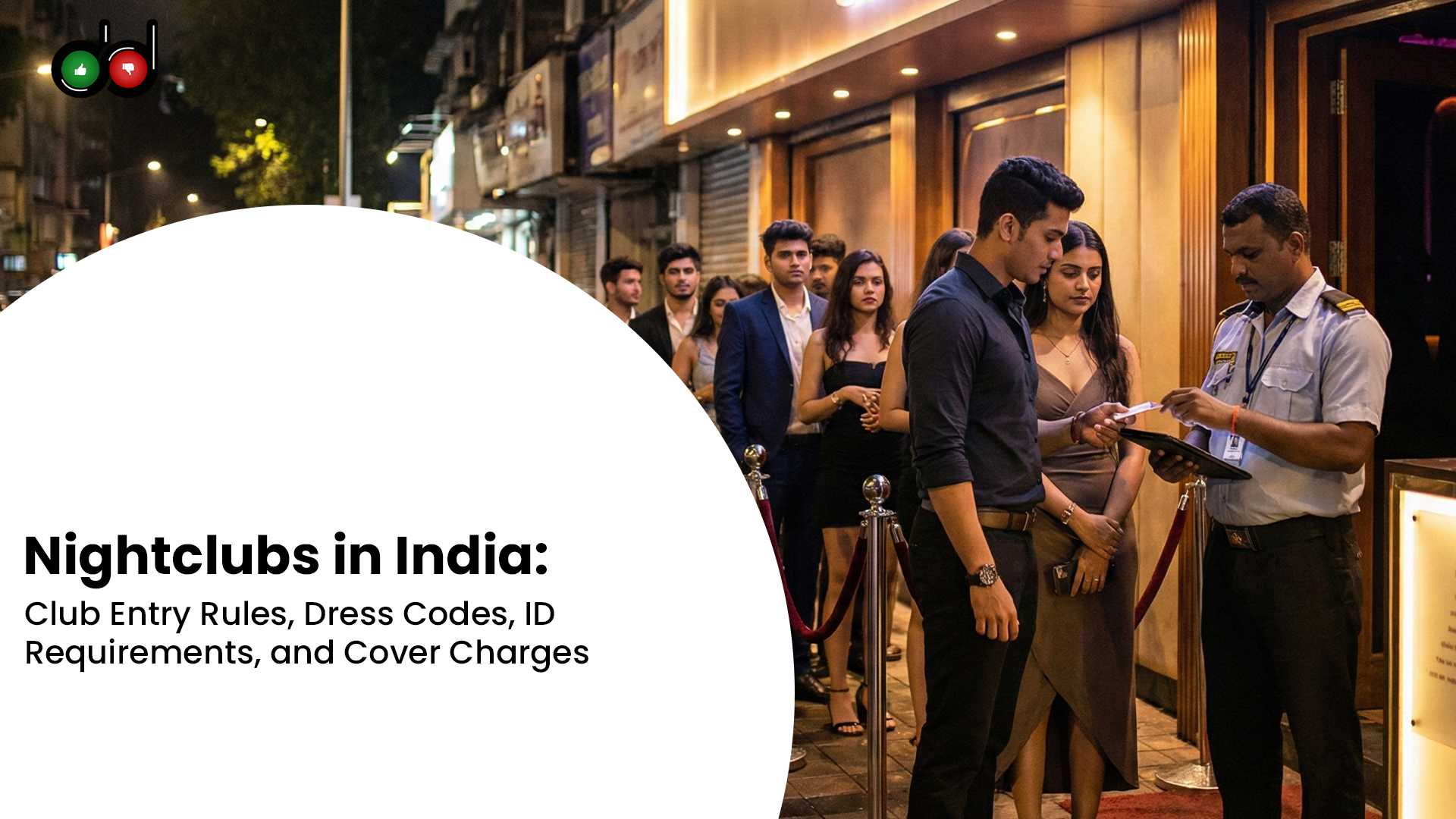
    Nightclubs in India: Club Entry Rules, Dress Codes, ID Requirements, and Cover Charges

    India’s nightlife is growing fast. Experts say the market will reach $5.8 billion by 2033. Getting past the bouncer at nightclubs in India is a challenge despite this growth. 

    Many people face rejection because they ignore India nightclub entry rules. You need a clear plan for nightclub dress code requirements and cover charges and entry fees to avoid trouble. 

    This guide explains the hidden rules for nightclubs in India. You’ll learn how to handle ID checks and age limits without stress. Stay on the dance floor tonight. Here is how you get inside.

    The Entry Checklist: Age, IDs, and “Stag” Rules

    Clubs in India follow strict laws regarding age and identity. Getting into nightclubs in India requires knowing the local laws for each city. Many nightclubs in India require you to be 25 years old to buy spirits in cities like Delhi and Mumbai. Even if you are 21, some elite venues bar entry for anyone under the legal drinking age.

    1. Meet the Nightclub ID Requirements

    Bouncers at nightclubs in India have become very strict about paperwork. To avoid rejection, follow these India nightclub entry rules:

    • Carry a physical Aadhaar card, passport, or driver’s licence.
    • Avoid using digital photos or screenshots, as nightclub ID requirements usually demand original documents.
    • Use the DigiLocker app if you do not have your physical card.

    2. Handle the Stag Entry Rules

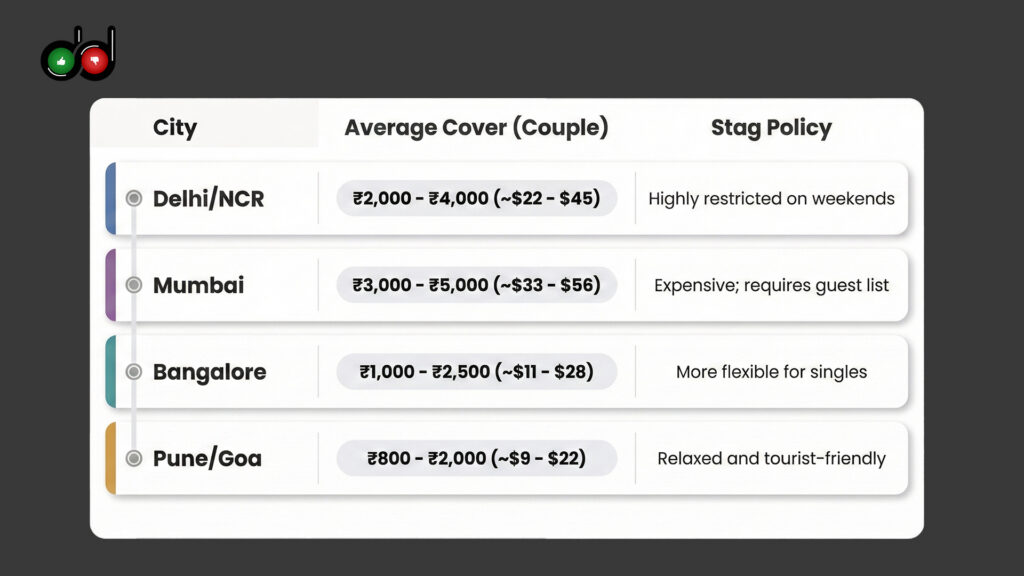
    Single men often face a tough time at the door. Management uses stag entry rules to maintain a gender balance on the dance floor. This means you might pay much higher cover charges and entry fees than couples. On weekends, many spots refuse single men entirely unless they have a table reservation.

    3. Use the Gender Policy to Your Advantage

    The nightclub gender policy often favours women and couples. Many nightclubs in India host ladies’ nights on Wednesdays. You get free entry and often free drinks until midnight. It is a smart way to enjoy the vibe while keeping nightclub costs low.

    Nightclub Dress Code Requirements: Smart vs. Traditional

    nightclub dress code requirements

    Clothing is the first thing a bouncer checks at nightclubs in India. To Clothing is the first thing a bouncer checks at nightclubs in India. To avoid rejection, you must follow the specific nightclub dress code requirements for each venue. Most high-end spots in Delhi or Mumbai enforce a premium club dress code to keep the vibe sophisticated.

    1. Follow These Dress Code Standards

    Most nightclubs in India expect a smart casual nightclub look. Stick to these rules for a smooth entry:

    • Men’s Tops: Wear collared shirts or polo shirts. Avoid sleeveless vests and gym tees.
    • Bottoms: Choose chinos or dark, clean denim. Steer clear of tracksuits or ripped jeans.
    • Footwear: Always wear closed shoes. While nightclubs in India often accept designer sneakers, they always ban flip-flops and sandals.

    2. The Rise of Ethnic Wear

    The nightclub door policy regarding traditional clothes has changed. Many nightclubs in India now accept high-end ethnic outfits as part of their nightclub etiquette updates.

    • For Women: Designer sarees and Indo-western sets are popular and stylish.
    • For Men: A sharp kurta with a Nehru jacket is usually allowed.

    Always check the India nightclub entry rules for the specific club before you go. Remember that dressing well doesn’t exempt you from cover charges and entry fees.

    Cover Charges and Entry Fees: City-Wise Breakdown

    Spending a night at nightclubs in India requires a clear budget. You will encounter different cover charges and entry fees depending on the city and the day of the week. Most high-end nightclubs in India use a redeemable system where your entry fee becomes credit for food and drinks.

    1. City-Wise Fee Estimates

    Prices fluctuate, but these are the current averages for couples at popular nightclubs in India:

    cover charges and entry fees

    2. Essential Money Tips

    Keep these points in mind before you reach the door of nightclubs in India:

    • Redeemable vs. Flat Fees: Always ask if your payment is a cover charge or a straight entry fee. A cover charge usually pays for your first few drinks.
    • Weekend Hikes: Expect fees to double on Friday and Saturday nights.
    • Table Reservations: Booking a table often waives the individual entry fee but requires a high minimum spend.

    Remember that following nightclub dress code requirements is just as vital as having the cash ready.

    How Dos and Don’ts Simplify Your Night Out

    Traditional platforms focus on reviews, but Dos and Don’ts provides objective guidelines for nightclubs in India. We bridge the information gap regarding local rules and nightclub etiquette across 10,000+ spaces. This ensures a smooth experience at every venue.

    Key Features for Your Night Out

    • Verified Rule Sets: Access up-to-date nightclub ID requirements and nightclub dress code requirements to eliminate guesswork.
    • Structured Information: Get quick, bulleted India nightclub entry rules designed for consumption on the go.
    • Time & Stress Savings: Avoid being turned away by knowing the cover charges and entry fees in advance.

    By focusing on preparedness, we transform how you plan your visits. Explore how dos and don’ts simplify your night out.

    Conclusion: From Doorway Rejection to Insider Access

    Nightclubs in India offer high energy, but the pain points are real. You often face confusing nightclub dress code requirements or sudden changes in cover charges and entry fees. 

    This lack of clarity creates a fear of rejection or being stranded at the door after a long drive. Such social friction ruins your night before it begins. 

    Dos and Don’ts solves this by providing factual, location-specific India nightclub entry rules. Instead of guessing, you get the clarity needed for a seamless experience. Focus on the music while we handle the logistics.

    FAQs

    1. Can I enter a club in India with a digital copy of my Aadhaar? 

    Carry physical ID for nightclubs in India. While India nightclub entry rules accept DigiLocker, bouncers prefer physical cards. Meeting nightclub ID requirements with an original Aadhaar prevents rejection. Always verify the nightclub door policy before arriving. This follows standard nightclub etiquette to ensure a smooth, fun night out.

    2. What is the average cover charge for a couple in Mumbai? 

    In nightclubs in India, Mumbai nightclubs cost an average of ₹3,000 to ₹5,000 (~$35-$60). High-end venues enforce a strict cover charge policy on weekends. These cover charges and entry fees are usually redeemable for drinks. Always check the age requirements for clubs before paying to avoid any entry issues.

    3. Is stag entry allowed on Saturday nights? 

    Stag entry rules are very strict on Saturdays at nightclubs in India. Most spots use a nightclub gender policy to limit single men. You often need a guest list spot or a higher cover charge policy fee. Budget for increased weekend cover charges, as they often double on peak nights.

    4. Are sneakers allowed in Indian clubs? 

    Nightclubs in India allow clean lifestyle sneakers under modern dress code standards. However, nightclub dress code requirements always ban gym or athletic shoes. Stick to a smart casual nightclub look with leather footwear or designer kicks. This helps you meet the premium club dress code and ensures easy entry.

    5. Does a cover charge include a guaranteed table? 

    Delhi nightclub fees often include a table, but Mumbai venues rarely do. At nightclubs in India, table access usually requires a separate minimum spend. Always confirm the India nightclub entry rules for seating when you pay your cover charges and entry fees to avoid standing all night long.

    Leave a Reply

    Your email address will not be published. Required fields are marked *

  • Delhi Tourist Guide: Metro Rules, Safety Tips, and Common Tourist Mistakes to Avoid

    Delhi Tourist Guide: Metro Rules, Safety Tips, and Common Tourist Mistakes to Avoid

    Delhi hits your senses the moment you arrive. Millions of people visit this city every year. It feels vibrant and loud. You need a reliable Delhi tourist guide to help you move around without stress. 

    This guide shows you how to follow Delhi Metro rules and safety while using the best transport system in the city. We also focus on avoiding tourist scams in Delhi so you don’t lose money to tricks. 

    Street smarts and knowing the Delhi Metro fares make your trip better. Use this Delhi tourist guide to stay safe and enjoy the local food and history.

    Mastering the Delhi Metro: Rules, Fares & Safety

    Using the train system is the smartest way to see the city. This Delhi tourist guide explains how to use the network like a local.

    1. Operational Basics

    Trains generally run from 5:30 AM to 11:30 PM. You should avoid Delhi Metro peak hours from 8:30 AM to 10:30 AM and 5:30 PM to 8:00 PM. During these times, stations like Rajiv Chowk become extremely crowded. If you travel outside these hours, your journey remains comfortable and quick.

    2. Fare Intelligence (2025 Update)

    The DMRC updated Delhi Metro fares in August 2025. Prices now range from ₹11 for short trips to ₹64 for longer distances. This Delhi tourist guide recommends buying a Smart Card for ₹150. It gives you a 10% discount on every ride. 

    You get an extra 10% off if you travel during off-peak hours before 8 AM or between 12 PM and 5 PM. Sundays and national holidays also feature lower rates, making them the best days for long-distance sightseeing.

    3. Essential Metro Rules & Safety

    Following Delhi Metro rules and safety ensures a smooth trip.

    • Women-Only Coaches: The first car in the direction of travel is for women only. Look for pink floor markers on the platform. Men who enter this coach face a ₹250 fine.
    • Luggage Limits: You can carry one bag weighing up to 25 kg. The size should not exceed 80 cm x 50 cm x 30 cm.
    • Security Checks: Every station has CISF officers and X-ray scanners. Cooperate with them to maintain Delhi Metro safety tips.
    • Emergency Button: Only use the yellow alert button inside the train if there is a real crisis.

    This Delhi tourist guide helps you stay within the law while moving fast. Using these Delhi Metro safety tips keeps you and your belongings secure. Always keep your smart card ready for a quick exit. 

    Knowing Delhi Metro rules and safety helps you avoid fines and stay safe in the crowds. Once you know the train rules, you need to watch out for people trying to trick you on the street.

    The Delhi Scam Watchlist: 3 Red Flags to Spot

    delhi metro rules and safety

    Spotting Delhi tourist traps keeps your money in your wallet. This Delhi tourist guide highlights the most frequent tricks used to target visitors.

    Scam #1: The Fake Official Tourist Office

    Watch for fake “Government Tourist Offices” near Connaught Place. Touts tell you the official center moved or that roads are closed. This is a classic example of avoiding tourist scams in Delhi. 

    They lead you to a private shop to sell overpriced packages. Only trust the India Tourism office at 88 Janpath. Always use Google Maps yourself to verify locations with this Delhi tourist guide.

    Scam #2: The Train Cancelled Ruse

    The “Train Cancelled” ruse happens often at New Delhi Railway Station. Scammers pose as guards and claim your train is gone. They want you to buy expensive private car rides. 

    Check the official IRCTC app or the tourist bureau on the first floor of the station. This is one of the most famous common Delhi scams. Use your Delhi tourist guide to stay informed.

    Scam #3. The 10x Markup (Taxi/Rickshaw)

    Avoid the 10x markup from taxis and rickshaws. Drivers often claim the meter is broken to charge high flat rates. While BluSmart faced service changes in early 2025, you should stick to Uber or Ola for transparent pricing. 

    If you take a rickshaw on the street, tell the driver, “Meter se chalo,” which means “Use the meter.” These simple tips turn you into a pro and help you use this Delhi tourist guide effectively.

    These Delhi scams to avoid usually target people who look lost. Staying alert prevents these issues while following Delhi Metro rules and safety on your travels. This Delhi tourist guide keeps your budget safe.

    4 Costly Mistakes Every First-Timer Makes

    avoiding tourist scams in delhi

    First-timers often make errors that cost time and money. Use this Delhi tourist guide to fix your plan and stay safe.

    Mistake #1. Ignoring “Delhi Belly” Rules

    Eating raw salads or using ice cubes in street drinks too early ruins trips. Stick to hot, fresh food. This Delhi tourist guide suggests drinking only bottled water with a sealed cap to avoid getting sick.

    Mistake #2. Pickpocket Vulnerability

    Keeping phones in back pockets during the Yellow Line rush is a big Delhi tourist mistake. Wear your backpack on your front in crowds. Following Delhi Metro rules and safety means staying alert at all times. Use Delhi pickpocket safety tricks to keep your gear.

    Mistake #3. Cultural Insensitivity

    Religious sites require modest dress. Carry a scarf to cover your head at Gurudwaras. Wearing shorts to a mosque is one of those common Delhi travel mistakes. Always show respect at holy sites.

    Mistake #4. Underestimating Distances

    Delhi is huge. Planning Old Delhi and Qutub Minar for one afternoon causes burnout. This Delhi tourist guide recommends grouping sites by area while avoiding tourist scams in Delhi.

    Knowing these Delhi tourist traps and errors makes your visit better. This Delhi tourist guide prepares you for the local pace.

    Next, see how specific guidelines simplify your entire visit.

    How Dos and Don’ts Simplify Your Delhi Visit

    Knowing the specific rules of a city makes your trip much easier. Most travel sites focus on photos, but Dos and Don’ts gives you facts. Our tool works as a digital Delhi tourist guide by providing clear rules for 10,000+ locations

    It helps you with avoiding tourist scams in Delhi by showing you exactly what to expect.

    • Verified Rules: Access entry and dress code requirements for your Delhi tourist guide spots.
    • Universal Coverage: Find behavioural tips for everything from hospitals to landmarks.
    • Cultural Intelligence: Learn local etiquette to stay respectful.

    Dos and Don’ts simplifies your plan. Use it to follow Delhi Metro rules and safety and improve your Delhi tourist guide skills.

    Conclusion: Turning Chaos into Adventure

    Missing your train because of a “cancelled” lie or getting fined in the wrong Metro coach ruins your day. These mistakes lead to lost money, wasted hours, and a feeling of being unsafe in a new city. Falling for common Delhi scams can turn a dream vacation into a stressful memory. 

    However, the right Delhi tourist guide information changes everything. By using Dos and Don’ts, you get the facts on Delhi Metro rules and safety before you arrive. This preparation helps you avoid Delhi tourist mistakes and lets you focus on the city’s amazing history instead.

    FAQs

    1. What is the safest transport at night? 

    Always use app-based cabs like Uber or BluSmart for late-night travel. These services provide GPS tracking and verified driver details, which helps with avoiding tourist scams in Delhi. Avoid taking random rickshaws or walking in dark areas to maintain your safety.

    2. Can I use one Metro Smart Card for two people? 

    No. One card is for one passenger only. Each person needs their own card to follow Delhi Metro rules and safety. For groups, use the DMRC WhatsApp bot to buy multiple QR tickets, making navigating the Delhi metro easier for everyone.

    3. How do I identify a real tourist office? 

    A real government office is at 88 Janpath. Look for the “Incredible India” logo and official signage. This Delhi tourist guide tip is vital: real officials won’t approach you on the street, helping you with avoiding tourist scams in Delhi.

    4. Are there luggage restrictions on the Metro? 

    Yes. You can carry one bag weighing up to 25 kg. The size must stay within 80 cm x 50 cm x 30 cm. Following these Delhi Metro rules and safety protocols ensures you pass security quickly without being turned away at the station entrance.

    5. Is street food safe? 

    It is safe if you follow this Delhi tourist guide tip: only eat at busy stalls with high turnover. Ensure food is piping hot and cooked in front of you. Avoid raw items to stay healthy while avoiding tourist scams in Delhi.

    Leave a Reply

    Your email address will not be published. Required fields are marked *

  • Mumbai Tours and Travels: Local Etiquette, Scams to Avoid, and Getting Around

    Mumbai Tours and Travels: Local Etiquette, Scams to Avoid, and Getting Around

    Mumbai feels like organised chaos. Twenty million people live here. You see the rush. You feel the heat. Most visitors get lost in the noise. Others pay a “tourist tax” to scammers. You want to see the city without stress. 

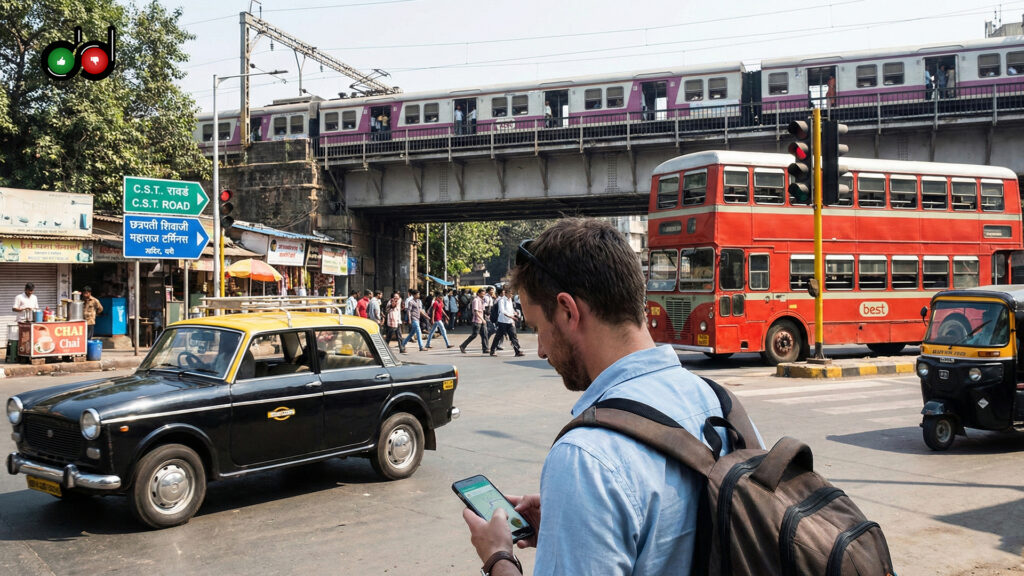
    This guide simplifies your Mumbai tours and travels. We focus on local etiquette in Mumbai to help you blend in. You’ll learn the best way of navigating Mumbai transportation without getting stuck. Stop worrying about the crowds. 

    We give you the Mumbai unspoken rules right here. Use these Mumbai travel tips for a better trip. Your Mumbai tours and travels start with prep. You now have the tools for travelling in Mumbai safely.

    The Unspoken Rules of the Street

    Mumbai operates on a secret social code. You need to know these habits to avoid standing out. Mastering local etiquette in Mumbai keeps your interactions smooth. Your Mumbai Tours and Travels success depends on how you handle the street.

    1. The “Boss” Culture

    Stop saying “Bhaiya”. In this city, “Boss” is the magic word. Use it for your driver or a street vendor. This shift makes your Mumbai tours and travels much more efficient. It is a vital part of Mumbai culture and customs.

    2. Live and Let Live

    Mumbai is packed. Locals stay sane by ignoring what others do. This non-interference is a key cultural etiquette habit in Mumbai. These Mumbai unspoken rules keep the peace in a crowd.

    3. Dress Codes and Shoes

    Dress modestly in traditional markets. This is one of the top Mumbai travel tips. Always take your shoes off at the door of a house. Understanding these habits helps you when navigating Mumbai transportation. 

    Now, protect your Mumbai tours and travels from people who want your money. Smart Mumbai tours and travels require vigilance against street tricks.

    Common Mumbai Scams & How to Dodge Them

    Common Mumbai Scams

    Mumbai moves fast. Scammers move fast too. You must stay alert to keep your Mumbai tours and travels fun. Spotting a trick early stops you from paying the “tourist tax.” 

    Knowing these Mumbai tourist scams to avoid helps you maintain local etiquette in Mumbai by staying calm. Use these tips for better Mumbai tours and travel results.

    • The Broken Meter. If an auto driver refuses the meter, find another ride. They use this trick to overcharge you. This is one of the common auto rickshaw scams.
    • Airport Arrival Tricks. Use the prepaid counter or apps. People in the hall often lie about app wait times to get you into private cars.
    • Fake Closures. Strangers might claim the Gateway of India is “closed for a VIP event.” They do this to push you toward their shops. Walk to the entrance yourself. This is essential for Mumbai tourist safety.
    • The Hotel Lie. Some drivers claim your hotel is “closed for repairs.” They want to take you to a commission-heavy spot. Call your hotel directly to verify.

    These tips help your Mumbai tours and travels stay on track. This knowledge makes navigating Mumbai transportation much easier.

    Navigating Mumbai Transportation Like a Pro

    Navigating Mumbai Transportation

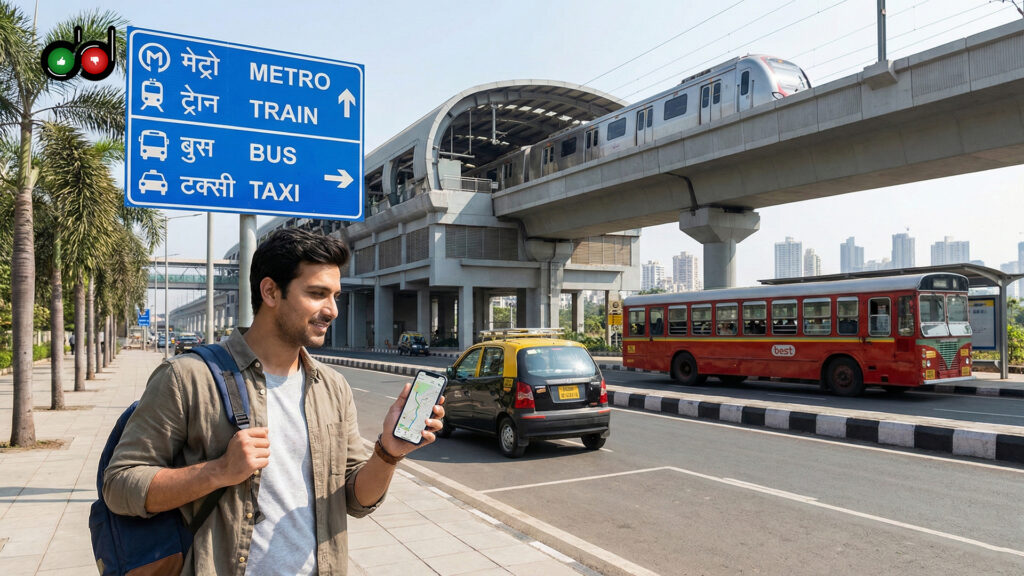
    The city moves on its feet and wheels. Your Mumbai tours and travels depend on how well you handle the crowds. Use the Mumbai local transport system to save time and money. Here is how you master the roads and rails.

    1. The Lifeline: Local Trains

    The trains are the heart of the city. Use the Mumbai metro guide and rail maps to pick your route.

    • Peak Hour Survival. Avoid trains from 8 AM to 11 AM and 6 PM to 9 PM. This is the only way to skip the “Super Dense Crush Load”.
    • Smart Booking. Use the RailOne app for digital tickets — it replaces the older UTS app and works for both unreserved and reserved bookings. Check the m-Indicator app for live train times. This is vital for navigating Mumbai transportation.
    • Special Coaches. If you are a woman, look for the ladies’ compartments. They offer more space and safety.

    2. The Modern Metro

    The Mumbai metro guide is growing fast. The new Aqua Line connects South Mumbai to the suburbs through underground tunnels.

    • Skip the Line. Buy a “National Common Mobility Card” (NCMC). It works for the Metro and helps you avoid ticket queues.
    • AC Comfort. The Metro stays cool. Use it to cross the city when the heat gets too high.

    3. Cabs and Rickshaws

    You will see yellow and black cars everywhere. These are the “Kaali-Peelis”.

    • The Auto Limit. You won’t find an auto-rickshaw in South Mumbai. They stop at Sion and Mahim. Use taxis or the Mumbai public transportation buses there.
    • Fare Checks. Ensure the driver resets the meter. Mumbai travel tips say you should always check the latest fare chart on your phone.

    Understanding these transit rules changes your Mumbai tours and travels experience. Now you can see how specific dos and don’ts keep things simple.

    How Dos and Don’ts Simplify Your Mumbai Journey

    Dos and Don’ts Simplify Your Mumbai Journey

    Dos and Don’ts provides objective, location-specific guidelines for your Mumbai tours and travels. We bridge the gap in local etiquette in Mumbai with these features:

    • Verified Rule Sets. Get factual entry and dress code requirements.
    • Structured Info. Use quick bulleted facts while navigating Mumbai transportation.
    • Universal Coverage. Understand Mumbai culture and customs at 10,000+ locations.

    Skip long reviews for instant Mumbai travel tips. This tool ensures you follow Mumbai’s unspoken rules perfectly. Stay prepared for better Mumbai tours and travel results, and visit with confidence.

    Conclusion 

    Planning Mumbai tours and travels often feels like a mess. You face aggressive touts, massive crowds, and tricky transit habits. If you mess up, you pay the price in lost time or extra cash. These bad experiences make people fear the city instead of loving it. This anxiety ruins your trip before it starts. 

    Dos and Don’ts offer a better way. It gives you clear facts on local etiquette in Mumbai. You get the help you need for navigating Mumbai transportation without the stress. Preparation stops the worry and lets you explore with peace.

    FAQs

    1. What is the safest way to travel in Mumbai at night? 

    Use app-based cabs for travelling in Mumbai safely after dark. These services offer GPS tracking and transparent fares, helping you avoid Mumbai tourist scams. Whether you are navigating Mumbai transportation via Uber or the Mumbai metro guide, sticking to well-lit hubs ensures better Mumbai tourist safety late at night.

    2. Why can’t I find an auto-rickshaw in South Mumbai? 

    The Mumbai local transport system restricts autos from the city centre to manage traffic. For your Mumbai tours and travels in Colaba or Fort, use black-and-yellow taxis or Mumbai public transportation buses. Understanding these Mumbai unspoken rules prevents confusion while you are getting around Mumbai like a local.

    3. How much should a minimum auto fare cost? 

    The starting fare for auto rickshaw scam prevention is ₹23. Always check the official Mumbai local transport system tariff card on the m-Indicator app. Ensuring the driver resets the meter is a top Mumbai travel tip priority. This keeps your Mumbai tours and travels budget-friendly and ensures you pay the right price.

    4. Is the Mumbai Local train safe for solo female travellers? 

    Yes, use the designated ladies’ compartments for a secure experience. These coaches are a vital part of navigating Mumbai transportation for women. Following local etiquette in Mumbai and avoiding peak hours makes your Mumbai tours and travels much smoother. This is a key step for travelling in Mumbai safely alone.

    5. How do I know if a “local guide” is a scammer? 

    If a stranger claims landmarks are “closed”, stay alert. They often try to push Mumbai tourist scams to avoid by redirecting you to shops. Check the gates yourself to maintain Mumbai tourist safety. Learning cultural etiquette Mumbai Standards helps you handle these unsolicited interactions during your Mumbai tours and travels.

    Leave a Reply

    Your email address will not be published. Required fields are marked *

  • Domestic Flight Rules India: Check-In, Baggage Guidelines, and Boarding Tips

    Domestic Flight Rules India: Check-In, Baggage Guidelines, and Boarding Tips

    Flying within India changed recently. You must follow the latest domestic flight rules in India to avoid stress at the terminal. From May 2024, carriers strictly enforce the cabin baggage allowance and airline cabin luggage rules. If you miss the boarding gate timing, you lose your seat. 

    Knowing the current check-in procedures at the airport keeps your travel smooth. This guide explains the domestic flight baggage limits and airport security procedures in India for 2026. Stick to these domestic flight rules in India to save money and time.

    The “7 kg Rule”: New Baggage Policies

    Indian aviation authorities now enforce a strict “one bag” policy to reduce cabin congestion and speed up boarding. Understanding these domestic flight rules in India helps you avoid unexpected fees at the gate.

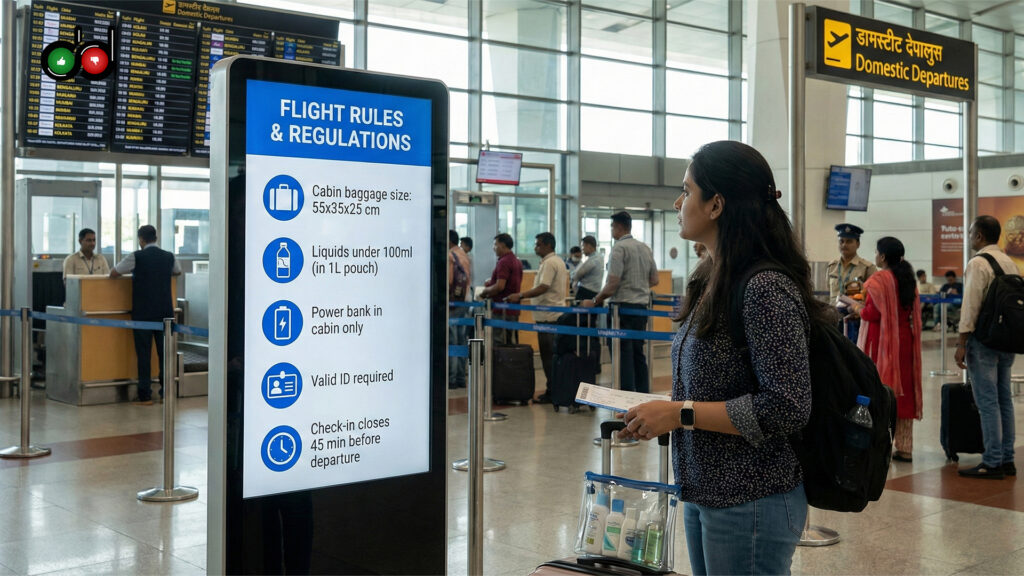
    1. Cabin Baggage (Hand Luggage)

    • Weight Limit: You get exactly 7 kg in economy class. Business class passengers often enjoy a higher limit of 10 kg.
    • The “One Bag” Rule: You can carry one main bag plus a small personal item like a laptop bag or a purse. The personal item must weigh under 3 kg and fit under the seat.
    • Dimensions: Your main bag must stay within 55 cm x 35 cm x 25 cm.

    2. Checked Baggage (Main Luggage)

    • Standard Limit: Most airlines, like IndiGo and Akasa Air, offer a 15 kg limit.
    • Air India Benefits: Depending on your fare type, Air India allows between 15 kg and 25 kg.
    • Baggage Excess Charges: If you go over, airlines charge between ₹550 and ₹700 per extra kg. Pre-booking extra weight online is up to 30% cheaper than paying at the counter.

    Strictly following these domestic flight baggage limits ensures you won’t face delays during the security screening process.

    Once you pack your bags within the airline cabin luggage rules, you need to plan your arrival to handle the airport check-in procedures smoothly.

    Airport Procedures: 2026 Timeline

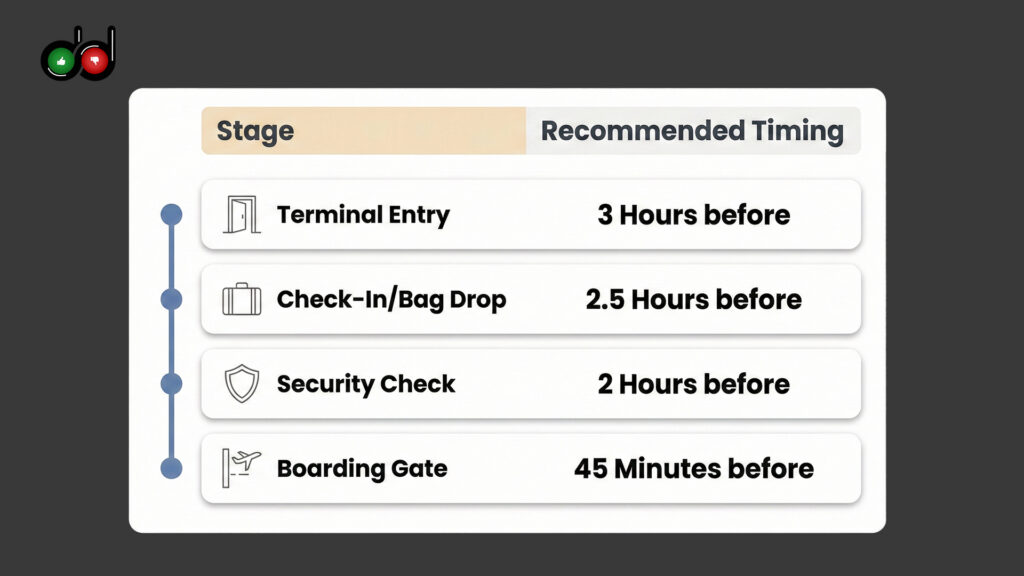
    Passenger traffic in India has surged. You must adapt your schedule to meet domestic flight rules in India and avoid missing your flight.

    1. Arrival (3 Hours Before): Major hubs now see heavy congestion. Following updated airport arrival time guidelines saves you from last-minute panic.

    2. Check-In/Bag Drop (2.5 Hours Before): The check-in procedures at airport counters close 60 minutes before departure. Complete the online check-in process beforehand to use “Express Bag Drop” kiosks.

    3. Security Check (2 Hours Before): All passengers undergo the security screening process. Be ready to remove laptops and power banks for airport security procedures and India checks.

    4. Boarding Gate (45 Minutes Before): Airlines strictly enforce boarding gate timing. Gates close 25 minutes prior to takeoff to ensure on-time departures.

    Airport Procedures in India

    Use DigiYatra to bypass long entry lines. This service helps you maintain your boarding gate timing by using facial recognition. Adhering to domestic flight rules in India ensures you don’t get stuck at the desk. Keep your original ID ready at the entrance. These domestic flight rules in India are non-negotiable for a smooth trip.

    Once you master the timing for domestic flight rules in India, you need to know exactly what fits in your bags.

    Security: What You Can & Cannot Carry

    Following the domestic flight rules in India requires careful packing to pass through the security screening process without losing your belongings. The CISF maintains a strict list of items that can or cannot enter the cabin.

    1. Prohibited in Cabin Baggage (Hand Luggage)

    • Liquids and Gels: You must limit all liquids, including shampoos and perfumes, to 100 ml containers. Common Indian items like ghee, achar (pickle), and syrups are also treated as liquids under airport security procedures in India and will be confiscated if they exceed this limit.
    • Sharp Objects: You cannot carry metal scissors, nail cutters with blades, or Swiss knives.
    • Lighters: Standard lighters and matchboxes are generally forbidden in your cabin baggage allowance.

    2. Prohibited in Checked Baggage

    • Power Banks: These must stay in your hand luggage. If security finds a power bank in your checked baggage, they will open your bag to remove it, causing significant delays.
    • E-Cigarettes: These are completely banned in India. Carrying them in any bag can lead to legal issues and fines.

    Strictly adhering to these domestic flight rules in India regarding prohibited items and carry-on lists keeps the line moving. Understanding what you carry is the first step; using technology is the second.

    By mastering your packing list, you can now use digital tools to speed through the check-in procedures at airport gates.

    The DigiYatra Advantage

    Modern domestic flight rules in India now prioritize digital efficiency to handle growing passenger volumes. The DigiYatra platform serves as a digital identity for travelers, allowing you to pass through checkpoints using facial recognition instead of physical documents.

    A) Key Benefits for 2026:

    • Speed: By using dedicated lanes, you can complete the initial entry and the security screening process in less than 15 minutes.
    • Paperless Entry: You no longer need to show a printed boarding pass or physical ID at every gate. Your biometric data acts as your ticket.
    • Expansion: As of 2026, the service is operational at over 24 major airports, including Delhi, Mumbai, and Bengaluru.
    • Privacy: Your data stays on your smartphone in an encrypted format. It is shared with the airport only during the 24 hours surrounding your flight.

    B) How to Set It Up:

    1. Download the DigiYatra app and register using your Aadhaar-linked mobile number.
    2. Upload a clear selfie and verify your identity through a quick OTP process.
    3. Link your flight ticket by scanning the QR code or entering the PNR before you arrive at the terminal.

    Following these domestic flight rules in India regarding digital registration saves you from the long lines typically found at the airport check-in procedures. Once you have your digital ID ready, keep a few final “dos and don’ts” in mind to ensure your trip remains on track.

    How Do Dos and Don’ts Help You Master Domestic Flight Rules in India?

    Do Dos and Don’ts Help You Master Domestic Flight Rules in India

    While reviews offer opinions, Dos and Don’ts provides objective, factual guidelines to help you follow domestic flight rules in India. This platform ensures you stay prepared for every stage of your journey.

    • Verified Rules: Access up-to-date domestic flight baggage limits and entry requirements.
    • Time Savings: Avoid being turned away by knowing your boarding gate timing in advance.
    • Clarity: Use structured, bulleted info for the airport check-in procedures on the go.

    Preparedness transforms your travel experience. Explore how Dos and Don’ts simplifies domestic flight rules in India and helps you visit with confidence.

    Conclusion

    Ambiguous rules and packing errors often cause unnecessary stress at the terminal. Failing to follow domestic flight rules in India results in extra costs, confiscated items, or missed departures. These situations delay your travel and impact your schedule. 

    To stay prepared, you need clear and updated information. Dos and Don’ts provides the objective guidelines and etiquette required to handle Indian airports with ease. Using this resource helps you avoid friction and ensures a predictable journey every time you fly.

    FAQs

    1. Can I carry my laptop separately from my 7 kg bag? 

    Yes, you can. Under domestic flight rules in India, airlines allow a personal item like a laptop bag. This doesn’t count toward your cabin baggage allowance if it fits under the seat. Keep hand baggage dimensions within airline cabin luggage rules to avoid hassle.

    2. What happens if I miss the 60-minute check-in window? 

    Missing the flight check-in time means you lose your seat. You must follow the check-in procedures and airport rules to avoid no-show status. Complete the online check-in process early. This ensures you meet the boarding gate timing required by the domestic flight rules in India.

    3. Are medications allowed in hand luggage? 

    Yes, you can carry medicines. During the security screening process, show any liquid over 100 ml with a prescription. Airport security procedures in India require checking prohibited items on carry-on lists. Following these domestic flight rules in India and domestic flight baggage limits ensures a smooth trip.

    4. Can I carry items like ghee or pickles in my cabin bag? 

    No. Airport security procedures India treats these as liquids. To avoid confiscation during the security screening process, pack them in your checked baggage. Stick to domestic flight rules in India and airline cabin luggage rules regarding prohibited carry-on items to stay safe.

    Leave a Reply

    Your email address will not be published. Required fields are marked *

  • Historical Places in India: Entry Rules, Timings, and Visitor Tips for Monuments and Forts

    Historical Places in India: Entry Rules, Timings, and Visitor Tips for Monuments and Forts

    India draws millions of visitors to its historical places in India every year. These sites carry centuries of history, strict rules, and limited access windows. A casual plan often leads to long queues, denied entry, or missed areas. 

    This guide helps you plan smarter visits to historical places in India with clear details on monument entry fees, timings, ticket rules, and visitor conduct. You will learn how pricing differs for Indians and foreign tourists, how digital tickets work, and why early morning slots matter. 

    You will get practical tips on dress, security checks, photography limits, and on-site behaviour. Read this before you book, pack, or arrive. It saves time, money, and frustration.

    Entry Fees: Indian vs. Foreigner Pricing 2025

    India follows a tiered pricing system at historical places in India to balance public access and site upkeep. Pricing varies by visitor category and monument type.

    Key pricing points:

    • Indian citizens pay subsidised entry rates at most historical places in India.
    • SAARC and BIMSTEC visitors fall under a mid-level pricing slab.
    • Foreign tourists pay higher fees that support conservation and site management.

    Popular monument examples:

    • Taj Mahal: ₹50 for Indians plus ₹200 for mausoleum access, ₹1,100 (~$12.27) for foreign visitors
    • Red Fort and Qutub Minar: ₹35 for Indians, ₹550 (~$6.14) for foreign visitors
    • Agra Fort: ₹40 for Indians, ₹650 (~$7.25) for foreign visitors

    Children under 15 enter all ASI monuments free. Always check the Dos and Don’ts and updated monument entry fee timings online, since access areas and pricing rules differ across monuments and ticket categories.

    How to Book Tickets for Historical Monuments

    Booking tickets early cuts delays at historical places in India. Most historical places in India now follow digital entry with timed slots and QR checks.

    A) Official Online Booking Options

    • Open the ASI Payumoney portal or the Monument India app.
    • Select the monument from the official ASI list.
    • Review updated monument entry fees and timings shown on the page.

    B) Step-by-Step Booking Process

    • Step #1: Choose your visit date and available time slot
    • Step #2: Select the visitor category: Indian, SAARC, BIMSTEC, or foreign.
    • Step #3: Complete payment using a UPI card or net banking.
    • Step #4: Receive a QR ticket by email and SMS

    C) Entry Checks You Must Follow

    • Check #1: Carry the same ID used during booking for verification.
    • Check #2: Save the QR ticket offline to avoid network issues.
    • Check #3: Arrive at the gate early for security and bag checks.

    Most travellers now rely on booking historical monuments online to avoid queues and ticket errors. Always check the Dos and Don’ts and ASI monument rules listed on the booking page before visiting historical places in India.

    Timings and Golden Hour Strategy

    Timing shapes the entire experience at historical places in India. Entry hours vary by monument, season, and crowd controls. Missing the right slot often means long waits or restricted access at historical places in India.

    1. Standard Visiting Hours

    Most ASI monuments stay open from sunrise to sunset. The last entry usually closes 30 to 60 minutes before sunset. The Taj Mahal remains closed every Friday for general visitors. Always confirm daily schedules and updated monument entry fees and timings online before planning travel.

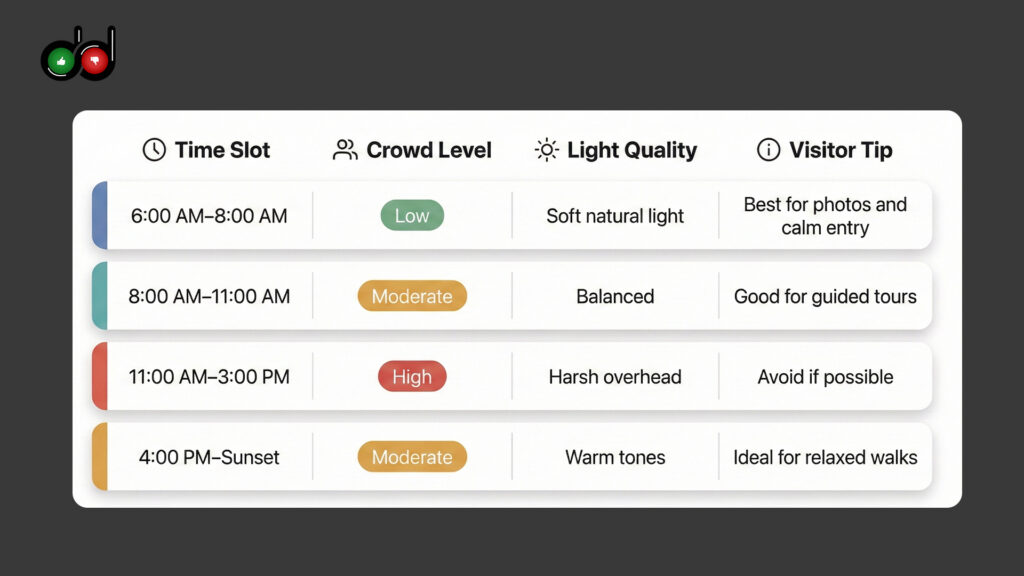
    2. Best Time to Visit

    Early morning visits work best. Sunrise hours offer cooler weather, fewer visitors, and better light within monument photography restrictions. Midday visits bring heavy crowds and heat, especially at open forts. Late afternoon visits offer calmer movement and softer light than noon.

    3. Special Viewing Rules

    The Taj Mahal allows limited night viewing on select full moon dates. These visits require separate tickets, strict ID checks, and fixed entry batches. Check availability in advance to avoid last-minute issues at historical places in India.

    Quick Glance: Best Time to Visit

    Best Time to Visit Taj Mahal

    Visitor Guidelines and Etiquette

    Rules exist to protect fragile structures at historical places in India. Ignoring them leads to denied entry or fines, even with a valid ticket. Follow posted signs and staff instructions at all historical places in India.

    A) Items You Cannot Carry

    Drones, tripods, selfie sticks, and external lights need prior permission. Food, tobacco, and lighters stay restricted inside core areas. Large backpacks face checks or storage limits. Carry only essentials and keep your ticket QR ready.

    B) Dress and On-Site Conduct

    Many forts include active temples or mosques. Cover shoulders and knees. Carry a scarf for head covering if needed. Avoid touching carvings or leaning on stonework. Skin oils damage marble and sandstone over time.Before visiting historical places in India, review dos and don’ts, ASI monument rules, and updated monument entry fees and timings online to prevent entry issues.

    How Dos and Don’ts Bring Clarity to Rules and Etiquette

    Dos and Don’ts Bring Clarity to Rules and Etiquette

    Visitors often reach historical places in India without clear rule awareness. Dos and Don’ts fixes that gap using verified, location-based data instead of opinions. India records over 140 million annual visits across protected monuments, and small mistakes still cause entry denial.

    What dos and don’ts help:

    • Verified rules on ID checks, dress codes, and monument photography restrictions.
    • Clear guidance on bags, prohibited items, and security checks.
    • Up-to-date access notes for historical places in India across 10,000-plus public locations.
    • Faster planning by skipping unreliable reviews.

    Use Dos and Don’ts before visiting to avoid confusion and wasted time. 

    Conclusion

    Confusion around entry rules, visiting hours, and on-site conduct creates real problems at monuments and forts. Visitors miss early slots, buy wrong tickets, carry restricted items, or dress in ways that trigger objections. 

    These mistakes lead to denied entry, wasted travel days, fines, and tense interactions with staff. In crowded sites, one error can cancel an entire visit. 

    Dos and Don’ts addresses this gap by giving clear, location-specific rules before you arrive. It helps you prepare properly, respect site requirements, and avoid preventable issues without relying on guesswork or reviews.

    Frequently Asked Questions

    1. What are the entry rules for historical places in India?

    Most historical places in India require online tickets, valid ID, and security screening. Bags, food, drones, and tripods face restrictions. Review ASI monument rules and dos and don’ts before arrival to avoid denied entry.

    2. How do monument entry fees and timings differ by visitor type?

    Monument entry fee timings vary for Indians, SAARC and BIMSTEC visitors, and foreign tourists. Some areas need add-on tickets, such as Taj Mahal tomb access. Always confirm inclusions during online booking.

    3. What is the best time to visit Indian forts and monuments?

    Early morning works best for historical places in India. Sunrise slots offer fewer crowds and better conditions. Midday brings heat and queues. Timings change by season, so confirm official hours.

    4. Are photography rules strict at historical monuments?

    Yes. Monument photography restrictions apply at many sites. Drones, tripods, flash, and interior photos may be banned. Follow signs and staff directions to avoid penalties.

    5. Can I book tickets online for all historical monuments?

    Most major sites support historical monument booking online through ASI platforms. Smaller monuments may allow offline tickets, but online booking reduces delays during peak periods.

    6. What etiquette should visitors follow at forts and heritage sites?

    Follow fort visitor guidelines by dressing modestly, avoiding contact with carvings, staying on marked paths, and respecting security rules at historical places in India.

    Leave a Reply

    Your email address will not be published. Required fields are marked *

  • Photography in India: Where Cameras Are Allowed at Monuments and Temples

    Photography in India: Where Cameras Are Allowed at Monuments and Temples

    India draws millions of photographers every year. Photography in IIndia draws millions of photographers every year. Photography in India feels effortless until security stops you. Cameras get blocked, phones get sealed, and gear gets taken away. Photography in India changed fast during 2024 and 2025, with tighter checks at temples and heritage sites. You need clear rules before you press the shutter.

    This guide explains photography in India without fluff. You will learn monument photography rules, temple camera restrictions, and equipment limits that matter right now. 

    The focus stays on real locations like the Taj Mahal, major temples, and public landmarks. You will know where photos are allowed, where they trigger trouble, and how to shoot without fines or confrontation. Read this before you pack your camera.

    The Taj Mahal 2026 Photography Zones

    The Taj Mahal sits at the centre of photography in India, yet many visitors still violate rules without knowing it. Clear zoning decides where cameras stay active and where they stop under current monument photography rules.

    1. The Yes Zone

    Photography is allowed in outdoor areas only.

    • Charbagh gardens
    • Reflecting pools
    • Main entrance gate
    • Open courtyards

    These are officially approved photography areas under photography rules in India. Handheld cameras work best here.

    2. The No Zone

    Photography stops inside the mausoleum.

    • Tomb chamber
    • Cenotaph platform
    • Inner marble halls

    These Taj Mahal photography restrictions are enforced strictly. Security checks screens and memory cards.

    3. Pro Tip: Golden Hour

    Shoot between 6:00 AM and 7:30 AM.

    • Soft marble tones
    • Controlled crowds
    • Better exposure

    Tripods are flagged as photography equipment restrictions, so keep gear simple during photography in India visits.

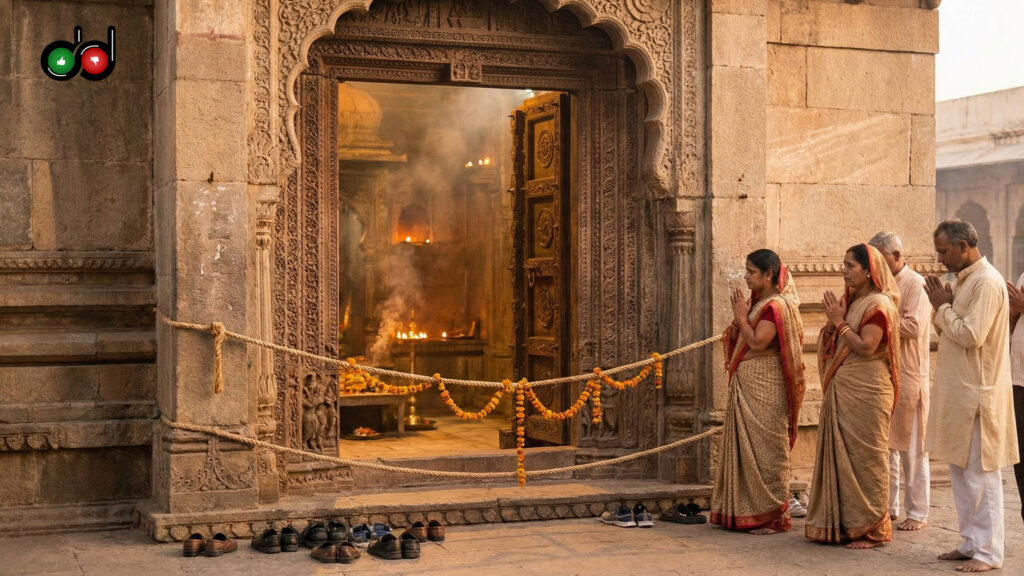
    Temple Restrictions Protecting the Sacred

    Temple Restrictions

    Temple rules play a central role in photography in India. Religious Temple rules play a central role in photography in India. Religious spaces treat cameras as interruptions, not accessories. Security teams enforce temple camera restrictions firmly.

    1. The General Rule

    Photography always stops at the inner sanctum.

    • The Garbhagriha (inner sanctum where the deity is placed) never allows cameras.
    • Deity-facing areas stay restricted
    • Flash photography rules apply even in outer halls.
    • Phones often get sealed or deposited at entry.

    These norms apply across photography-allowed Indian temples. When signs are missing, ask temple staff before taking photos.

    2. The 2025 Influencer Ban

    Several temples tightened rules in 2025.

    • The Golden Temple photography ban now blocks video across the complex.
    • Still photos remain limited to outer courtyards.
    • Kashi Vishwanath bans phones inside temple halls
    • Lalitha Ghat corridor allows legal exterior shots

    These changes address misuse tied to social media under temple photography etiquette.

    3. Temple Etiquette

    Follow conduct before photography.

    • Cover shoulders and knees
    • Remove footwear before entry
    • Keep phones silent
    • Avoid blocking devotees.

    Respect protects access and supports responsible photography in India.

    Photography Equipment Restrictions You Must Know

    Photography Equipment Restrictions

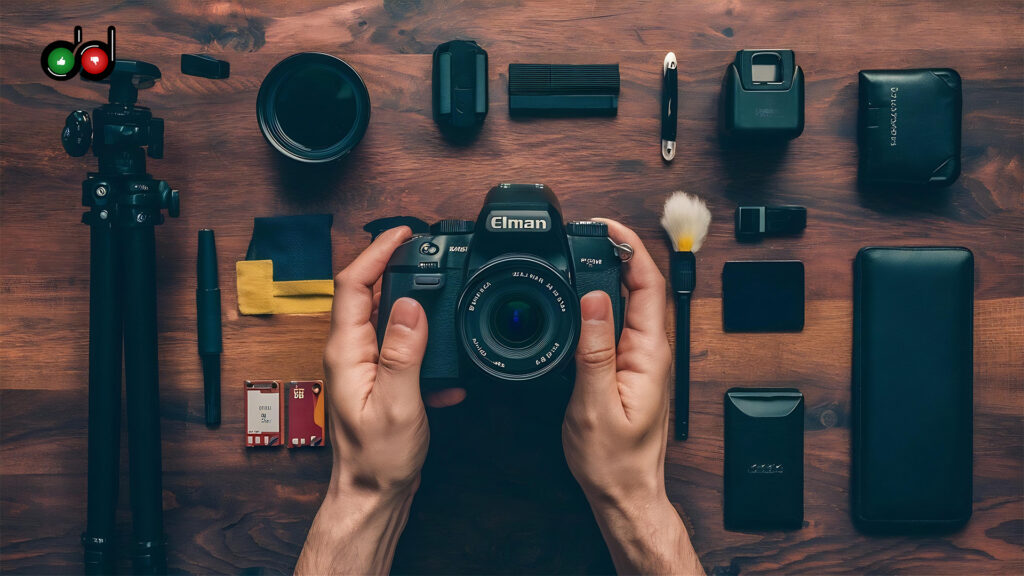
    Gear choice decides how smoothly photography in India goes. Gear choice decides how smoothly photography in India goes. Security teams judge intent by equipment, not behaviour. Carrying the wrong tools triggers checks under monument photography rules.

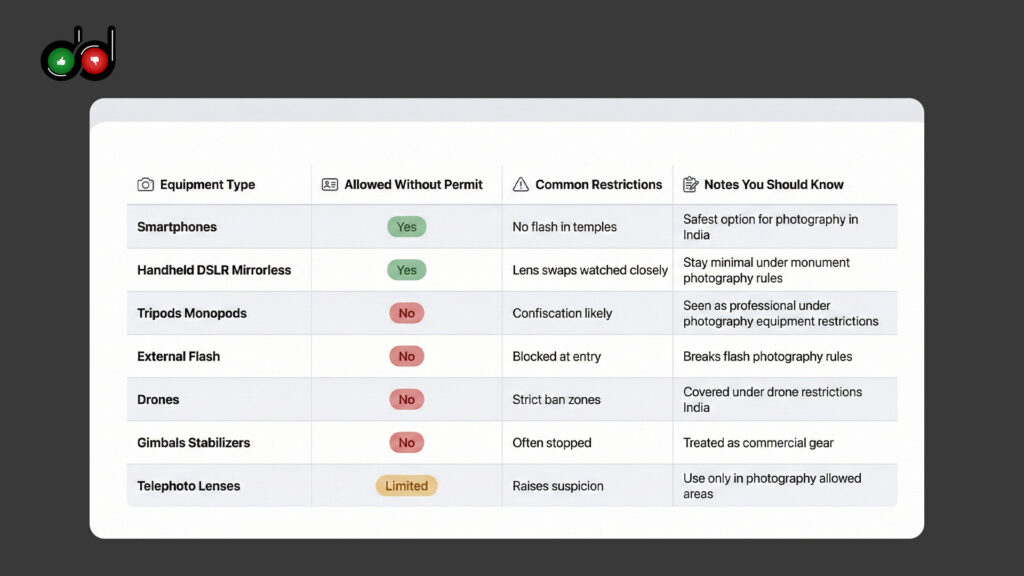
    1. Allowed Personal Use

    Personal gear passes security in most locations.

    • Smartphones and iPhones
    • Handheld DSLRs or mirrorless cameras
    • Small prime or kit lenses
    • One camera body per person

    These items fit personal use standards under photography in India and work across most photography-allowed areas. Keep cameras visible during checks to avoid delays.

    2. Banned Without Permit

    Certain gear signals professional intent.

    • Drones fall under strict drone restrictions in Indian laws.
    • Tripods and monopods get flagged as professional
    • Gimbals and stabilisers attract scrutiny
    • External flashes break flash photography rules.

    Security enforces photography equipment restrictions aggressively. Violations lead to deposits or removal from the site. Pack light. Minimal gear keeps photography in India simple and stress-free.

    Quick Photography Equipment Rules Snapshot:

    Quick Photography Equipment Rules

    The India Gate 2025 Security Shift

    India Gate remains a popular stop for photography in India, yet rules tightened during mid-2025 following recent Delhi blast incidents and related security alerts. 

    Police teams now judge intent based on gear size and shooting behaviour under updated India Gate photography rules.

    1. New Security Protocols

    Security checks focus on setup visibility.

    • Large camera bags attract screening
    • Lens changes raise questions.
    • Multiple accessories signal professional intent.
    • Officers may ask photographers to move.

    These actions follow broader monument photography rules used across Delhi landmarks.

    2. The Workaround

    You can still shoot without trouble.

    • Smartphones remain fully allowed.
    • Handheld cameras pass when kept simple
    • One lens avoids attention
    • Stay within open public walkways

    Following these steps keeps photography in India smooth and prevents delays or forced exits at India Gate.

    Professional Permits and Fees

    Paid shoots follow separate rules under photography in India. Authorities treat any image linked to revenue as commercial, even when one person shoots with a single camera. These checks apply across protected sites under monument photography rules.

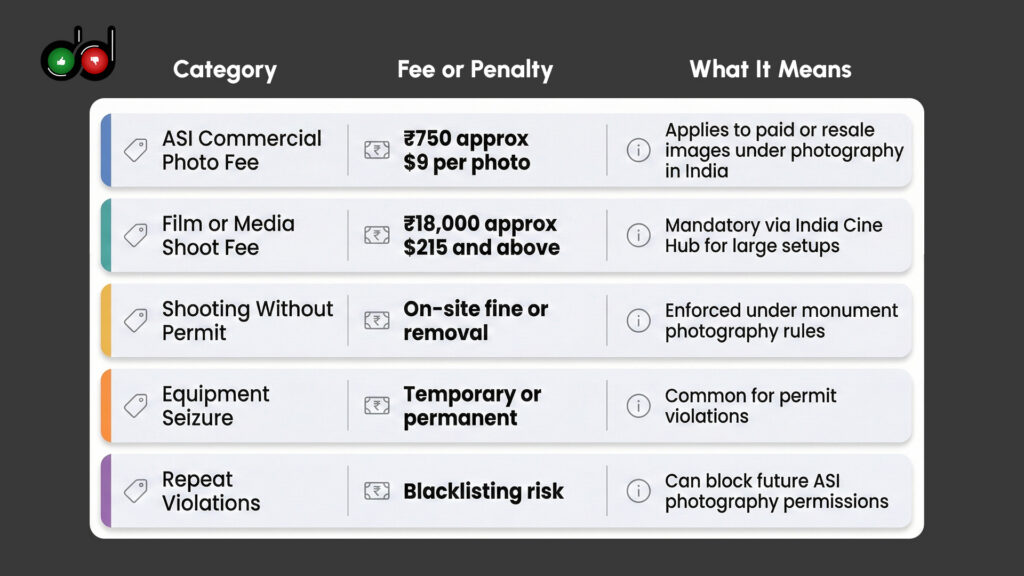
    1. ASI Permit Rules

    The Archaeological Survey of India controls most monuments used for photography in India. Commercial images require approval under ASI photography permissions. Fees start at ₹750 (about $9) per photograph and apply per monument and date. Security teams verify permits during entry and during active shooting. Selling images online still counts as commercial use.

    2. Filming and Media Projects

    Film crews and media teams must apply through the India Cine Hub portal. Processing fees start around ₹18,000 (about $215). Authorities require full disclosure of cameras and accessories under professional photography permits.

    3. Timeline and Penalties

    Apply at least 30 to 45 days early. Shooting without clearance leads to fines, removal, or gear seizure during photography in India visits.

    Quick Fees and Penalties Overview:

    Quick Fees and Penalties Overview in India

    How Dos and Don’ts Help You Avoid Penalties While Photographing in India

    Dos and Don’ts helps you stay compliant during photography in India by sharing clear, location-specific guidance instead of opinions. It focuses on real monument photography rules and temple camera restrictions that security teams enforce daily.

    How it helps:

    • Verified rules for entry, dress codes, and equipment used in photography in India
    • Simple bullet-based guidance for quick reference on-site
    • Coverage across temples, monuments, public spaces, and restricted areas
    • Reduced risk of fines, photo deletion, or gear seizure
    • Better awareness of temple photography etiquette and conduct

    This approach keeps photography in India respectful, predictable, and penalty-free. Explore dos and don’ts to follow the right rules before you take the shot.

    Conclusion 

    Photography trips often fail during photography in India because rules change by location, signage stays unclear, and enforcement varies by officer. Many people break monument photography rules or temple camera restrictions without intent. 

    Phones get sealed. Photos get deleted. Gear gets confiscated. In serious cases, security escorts visitors out or issues fines. One mistake can ruin an entire visit and block future access during photography in India.

    Dos and Don’ts help reduce that risk. It offers clear, location-based guidance so you know where photography is allowed, where it stops, and how to act before trouble starts.

    FAQs

    1. Is photography in India allowed everywhere?

    No. Photography in India depends on location. Many monuments follow strict monument photography rules, and most temples enforce temple camera restrictions. Inner sanctum areas stay restricted, flash photography rules apply, and security decides access. Always confirm photography-allowed areas before shooting to avoid deletion or fines.

    2. What are the Taj Mahal photography restrictions in 2025?

    Taj Mahal photography restrictions allow photos only in outdoor zones like gardens and courtyards. Photography inside the mausoleum remains banned. Tripods are not allowed, flash photography rules apply, and security checks devices. These rules fall under official monument camera rules 2025, enforced daily.

    3. Is photography allowed inside Indian temples?

    Most temples ban photography near the deity area under sanctum photography prohibited rules. Some outer courtyards permit photos. Temple photography etiquette expects silence, covered clothing, and no flash. Photography allowed in Indian temples varies by site, so ask staff before lifting your camera.

    Drone use falls under strict drone restrictions in Indian laws. Most monuments and public landmarks remain no-fly zones. Flying without permission leads to confiscation and legal action. Only approved operators with Digital Sky clearance may fly drones outside restricted zones under professional photography permits.

    5. Do I need a permit for professional photography in India?

    Yes. Selling images or shooting for brands requires professional photography permits. ASI sites demand approval under ASI photography permissions. Fees apply per monument and date. Shooting without permits leads to fines or gear seizure under photography equipment restrictions during photography in India.

    6. What happens if I break photography rules accidentally?

    Security usually asks you to delete images immediately. Repeated violations lead to removal, fines, or confiscation. Breaking monument photography rules or temple camera restrictions can block future entry. Staying informed about photography rules in India lowers risk and protects your equipment.

    Leave a Reply

    Your email address will not be published. Required fields are marked *

  • Family Trip in India: Safety Checklist for Crowded Places and Long Queues

    Family Trip in India: Safety Checklist for Crowded Places and Long Queues

    Recent data shows 98% of parents plan domestic travel this year. This surge pushes popular sites to max capacity. A family trip in India now requires more than just tickets; you need a tactical plan. 

    Managing India’s crowded places safely demands smart timing and modern tech. This guide moves you from stressed tourist to prepared explorer. We cover a family travel India safety checklist to keep everyone secure. 

    From queue hacks to preventing separation, here are the essential family travel tips children need. Your family trip in India just got much safer.

    Beating the Crowds: Modern Queue Systems

    Effective planning makes a huge difference when you visit busy sites. Handling large groups is much easier with a clear strategy.

    1. September 2025 Infrastructure Updates

    The India queue management system at major sites has seen big changes this year.

    • Taj Mahal family visit: You must book online at least 7 days early to secure a slot.
    • Puri Jagannath Temple: A new 6-lane ‘Dhadi Darshan’ system at the Natamandap provides dedicated, air-conditioned paths for women, children, and seniors.

    2. Timing Your Arrival

    Recent India family tourism statistics show that 71% of visitors travel in groups, making crowded tourist attractions busier than ever.

    • Golden Hours: Arrive between sunrise and 9:00 AM to skip 60% of the rush.
    • The Danger Zone: Avoid 10:00 AM to 3:00 PM when heat and congestion peak.

    Always identify CISF booths for help. Following these family travel tips children need will keep your family trip in India on track. 

    Child Safety: The Separation Prevention Blueprint

    Child safety during your family trip in India depends on a solid separation plan. In dense areas, you need a family travel India safety checklist that everyone knows and follows.

    1. The ID Bracelet Strategy

    The 2025 standard for family travel tips for children involves using “no-name” NFC wristbands or tiny GPS trackers like Trakbond.

    • Wristband Info: Write “Call Mom/Dad” and your phone number with the +91 code.
    • The Rule: Avoid putting the child’s name on the band. This prevents strangers from using a name to gain false trust.

    2. Meeting Points and Safe People

    Teach your kids to identify “safe strangers“, such as CISF officers in uniform or other mums with children. This step improves the safety of India’s crowded places significantly.

    • Taj Mahal: Use the West Gate ticket booth as a base.
    • Red Fort: Meet at the main CISF assistance booth near the entrance.

    If anyone gets lost, stay in one spot immediately. This makes your family trip to India much less stressful. A secure family trip in India allows everyone to enjoy the sights.

    Next, you need to protect your gear from professional pickpockets.

    Outsmarting Pickpockets in 2026

    Outsmarting Pickpockets

    Professional thieves at crowded tourist attractions have changed their tactics this year. To keep your family trip in India safe, you must recognise these patterns and use the right gear.

    1. The Distraction Playbook

    Security experts for India Travel Safety 2026 highlight three common scams used in markets and transit hubs:

    1. The Accidental Bump: Someone knocks into you while an accomplice grabs your phone from your pocket.
    2. The Helpful Stranger: Someone points out a “stain” on your clothes. While you look down, your bag is opened.
    3. The Metro Snatch: Thieves wait for the “doors closing” chime on the Delhi Metro to grab a phone and jump off.

    2. Proactive Security Measures

    • Chest-Loading Gear: Always wear your backpack or crossbody bag on your chest. This is a vital pickpocket prevention step for a family trip in India.
    • The “Dummy” Wallet: Keep a fake wallet with a few small bills in your back pocket. Store your actual credit cards and large cash in a hidden money belt under your clothes.
    • Phone Lanyards: Use a wrist strap for your phone. It prevents “snatch-and-run” theft in busy streets like Chandni Chowk.

    These steps are a key part of any family travel in India safety checklist. By following these family travel tips, children and adults can stay safe, and you ensure safety in crowded places in India for the whole group. Your family trip in India will be much more relaxing when your valuables are secure.

    Now that your belongings are safe, let’s focus on keeping your family healthy and moving safely between cities.

    Health & Transport: The Multi-Generational Guardrail

    Keeping everyone healthy and moving safely is the backbone of a successful trip. You must stay vigilant about hygiene and logistics to enjoy your family trip in India.

    1. The 2025 Water and Food Protocol

    Waterborne illness remains a top risk for travellers. Maintain 100% reliance on sealed bottled water for your family trip in India. This applies to brushing teeth and avoiding ice as well.

    Health and Transport The Multi Generational Guardrail

    2. Road Safety and Travel Logistics

    Children’s road safety in India is a major concern this year. 2025 stats show 45 daily child fatalities, making safety gear vital for your family trip in India.

    • Car Seats: Taxis rarely provide them. Bring a portable vest or book premium ‘Uber Intercity‘ cars and request one.
    • Hotels: Verify hotel kid-friendly facilities like clean high chairs and gated play zones before you book.
    • Insurance: Secure travel insurance families can rely on for medical emergencies and 2025 flu variants.

    These steps are a must for your family travel to India safety checklist. Staying healthy ensures you don’t miss out on the fun. Following these family travel tips for children will help you maintain safety in India’s crowded places for all ages.

    How Dos and Don’ts Provide a Safety Checklist

    Using a structured guide helps you respect traditions while maintaining India’s crowded places safely. Dos and Don’ts provides objective, location-specific guidelines for your family trip in India across 10,000+ spaces.

    Navigate with Confidence:

    • Verified Rules: Access up-to-date dress codes and entry requirements for a family trip in India.
    • Cultural Intelligence: Learn specific etiquette to avoid social friction.
    • Quick Tips: Use your right hand for money and stick to the “Namaste” greeting.

    Avoid uncomfortable situations by knowing what is expected in advance. Following these family travel tips children need ensures a respectful journey. Explore how dos and don’ts simplify your family trip in India.

    Conclusion

    A family trip in India involves managing large crowds and specific local rules. Lack of clear info often leads to entry delays or missed attractions. 

    These setbacks affect your travel schedule and group energy. Having direct guidelines helps prevent these common issues. 

    Dos and Don’ts provide the specific rules for safety in India’s crowded places. This platform offers the family travel tips children need to stay secure. It gives you the facts for a smooth family trip in India.

    FAQs

    1. What should my family do if we get separated in a crowded market? 

    Stay put immediately. Tell kids to find a “safe stranger,” like a police officer or a mother with kids. This proactive step for India’s crowded places’ safety ensures your family trip in India stays secure. It is a vital family travel India safety checklist rule.

    2. Is street food safe for kids during our family trip in India? 

    Generally, no. A child’s gut is not used to local bacteria. Stick to reputable, busy restaurants for your family trip in India. These family travel tips children need ensure you avoid illness and maintain your family travel India safety checklist standards.

    3. How do I find a clean restroom for my kids while sightseeing? 

    Look for modern malls or premium hotels near crowded tourist attractions. These spots offer hygienic facilities for your family trip in India. This practical tip for your family travel India safety checklist keeps kids comfortable and improves safety for families in crowded places in India.

    4. Are car seats available for taxis and intercity travel? 

    Rarely. For a safe family trip in India, bring a portable vest or book ‘Uber Intercity.’ This addresses children’s road safety concerns in India. Always confirm child-friendly features when planning your family trip in India to meet your family travel India safety checklist.

    5. Do I need special travel insurance for a family trip in India in 2025? 

    Yes. Secure travel insurance families can use for medical emergencies and 2025 flu variants. This is a non-negotiable part of your family travel India safety checklist. It protects your family trip in India and ensures 2026 India travel safety standards are met.

    Leave a Reply

    Your email address will not be published. Required fields are marked *